Home
- since published as "Fractal Home"
- > I think people really really really really really WANT a sense of Home that is pragmatically not available
but can be co-created, with a ton of shared attention and adequate toolkit
and to the extent that one feels like a given group of people is consciously co-creating that, while taking into consideration every emergent concern from any member, that in itself is a kind of meta-Home- (this relates to handledness / in good time)
- When I use the word "need" or "want" or "careabout" or "desire" in this piece of writing, I'm pointing at, fundamentally, a cybernetic control system set point. See PCT or PCT Error for more about this.
- What makes one a need, vs a want, might be essentially, as my friend Catherio put it:
- "if this goes unmet, I will make substantial changes to my life"
- Said needs & wants include things on every level from psychological safety & meaning to food & water & shelter, and probably stuff Maslow forget to mention.
- I am Home to the extent that:
- (and in the ways that)
- I can relax knowing that the systems around me aren't going to subvert my needs & wants (whether malevolently or carelessly) and will in general support them.
- I feel, and am, empowered to make the changes I need to the situation in order to care for my needs.
- This applies to any context, not just to a house. In particular, it can also apply to a group of people or a relationship.
- This applies to all sorts of meta dimensions but it's also very concrete:
- When I'm at my home, if I realize I don't like upholstery, I can redecorate.
- When I am at a restaurant, I can't. The restaurant is not my home! It's also not supposed to be my home. That's okay.
- But I'll feel more at home at restaurants whose furniture & vibe I like, because I'll have less sense of error so the fact that I can't change it won't be relevant or meaningful.
- There is an interesting implication here which is that there are limitations to how at-home one can be in an apartment where one can't paint the walls or redo the floor.
- As with anything, the object-level situation as well as the having-the-right-to-make-such-changes-regardless-of-whether-one-needs-it is a dimension that will matter much more to some people than others, meaning that pragmatically, one person might feel more at home in an apartment than another. This is obviously true about nearly everything—some people like hot climates, some cold, some don't care. Etc.
- An apartment-style living situation can create external constraints on realizing Home, although ironically so can an overzealous HomeOwner's Association. Home self-own-ers Association, amirite? And things like zoning laws create constraints even if you technically "own" a property.
- There are also internal constraints:
- skill (I might not know how to fix the sink)
- money (I might not be able to afford the furniture I want)
- motivation (I might have unconscious schemas that say that while I would like a sodastream, I don't deserve one)
- Some people have a kind of learned helplessness around actually making their lives better.
- (see opening of Ben Hoffman's There is a war.)
- tweets on this:
- Sharing Home
- However, sometimes people need or want to share Home, on various scales.
- Again, speaking very boringly-literally, sometimes people live in the same house!
- Larger scales:
- But also, inasmuch as a given city is my home, I'm sharing that larger home with thousands or millions of other people.
- And this planet, at present, needs to be home for everybody.
- And so say you and I are living in the same house. How can it be my Home and your Home at the same time? We potentially have separate bedrooms or offices, that are even more our respective homes, but what about the common space?
- To the extent that we have shared needs/desires/preferences, whether that's about paint color or cleanliness or sound levels at certain times of day, then such Home will be there naturally—to the extent that both of us are individually able to actually care for those needs (see internal constraints above)
- To the extent that one of has a careabout and the other is indifferent, this is pretty similar to the previous bullet, but even simpler, provided we can talk about the situation enough to realize this is the case.
- Otherwise you might think I actively want things to be in a state other than what you want, which would mean conflict (described below). It's often worth checking when this comes up.
- But say that we have different set points for some aspect, with no overlapping range.
- For example:
- I feel too hot if the air temperature is above 21°; you feel too cold if it's below 22°
- Home for me wants listening to loud music at 8am; Home for you wants being able to meditate in silence in the morning.
- Home for me means keeping the kitchen consistently clean; Home for you means not having to worry about it, and just cleaning whenever feels good.
- Any of these might be an utter dealbreaker—it might not be possible for us to have complete Home together, without compromise. But there's a post-compromise way to orient to all of this, on a mindset level at least.
- The thing to start with is everybody doing their best to find a stance that says "I want ALL of us to be COMPLETELY satisfied. We may not be able to achieve that, but that, not compromise, is the actual goal." This is important for getting everybody on the same side. As long as compromise is on the table, it means we are opponents in a tug-of-war.
- There may be a set of inevitable tradeoffs, but ideally we can at least come to a place where we're on the same page about which tradeoffs to make for The Time Being.
- This is not always easy! But it's usually not a thing people even try, and it becomes easier with practice.
- I've written out a little exercise that may help with this:
- For example, a solution to the air temperature problem might involve different temperatures in different rooms or at different times of day, using perhaps more precise heating technology like in-floor heating. Maybe it turns out that a huge chunk of what makes one person cold is their feet being cold, and having in-floor heating allows them to be even more comfortable with the air at 20° than they usually would be with the air at 23° but no in-floor heating. Maybe the person whose face overheats in warm air also loves the in-floor heating! This is a good example because it highlights a real zero-compromise solution to what could seem like a totally intractable conflict. And it might not be possible with the resources available! Retrofitting in-floor heating into an existing building isn't free (although I just looked it up and it's not nearly as expensive as I imagined!)
- A huge part of what gets in the way of even discovering such a solution, in the meantime, is the compromise-based mindset, which necessitates constantly defending one's own needs from a perception that others will try to undermine those needs getting met. However, this protective energy is to others the very threat that one is oneself defending from! And it invites it in return.
- see defensiveness = protectiveness for more on this dynamic
- NVC has stuff on this re "needs" vs "strategies"
- that can probably be usefully incorporated into this stuff
- but needs a larger meta-frame like the NNTD to hold it
- otherwise in some low-trust situations it devolves into frame battles that can't easily be talked about within the frame of NVC
- Compromise and Home are thus in some vital sense incompatible.
- Thus:
- We are Home together to the extent that:
- We can relax knowing that our individual needs aren't going to be subverted by each other or by agents outside our collective systems.
- We feel, and are, empowered to make the changes we need to the situation in order to care for our individual needs, without compromising each others' needs.
24 linked references
April 24th, 2024
- this thread is fractal Home, talks about how we get adequate distance from each other
Podcast summaries
With Joe Lightfoot — Podcast with Joe Lightfoot Transcript › Outline of ideas discussed (I'm 'M', Joe is 'J')
- 0:00:34 - 12:55 - Home, what might a healthy community look like?
- 0:00:34 - J invites M to share “any kind of song that is inside of your heart if there's one that is desired to be shared right now”. This leads to M sharing this song:
- 9:20 - 12:54 - What it would look like if I built my own community, using Euvie Ivanova and Mike Gilliland's Smart Village as reference.
- Keywords: NNTD, Home, everyone will constantly point out ways in which things are incomplete, Learning how to trust yourself when all men doubt you, but make allowance for their doubting too, community, what might a healthy community look like?, complaints are sacred: how we affirm our values, protectiveness is damage control, defensiveness = protectiveness, Everyone is basically living in a dream mashup of their current external situation & old emotional meanings, sometimes things need to be said even though they feel like they really really should go without saying, What is Blame?, everything makes sense, there's no way to communicate correctly or incorrectly - there's just what works in context and what doesn't work, apologize in the other person's frame; forgive in your own frame, power dynamics
With Jonny Miller — Podcast with Jonny Miller Transcript › Outline of ideas discussed. (I'm M, Jonny is J)
October 3rd, 2021
@ 19:47 - thinking about doing some writing/publishing › gotta make a new showtime by tonight › 2 major candidates are
- @ 23:52 - I re-read Home and it's pretty good and I kinda want to make it into a post
- gonna re-read Home
September 6th, 2021
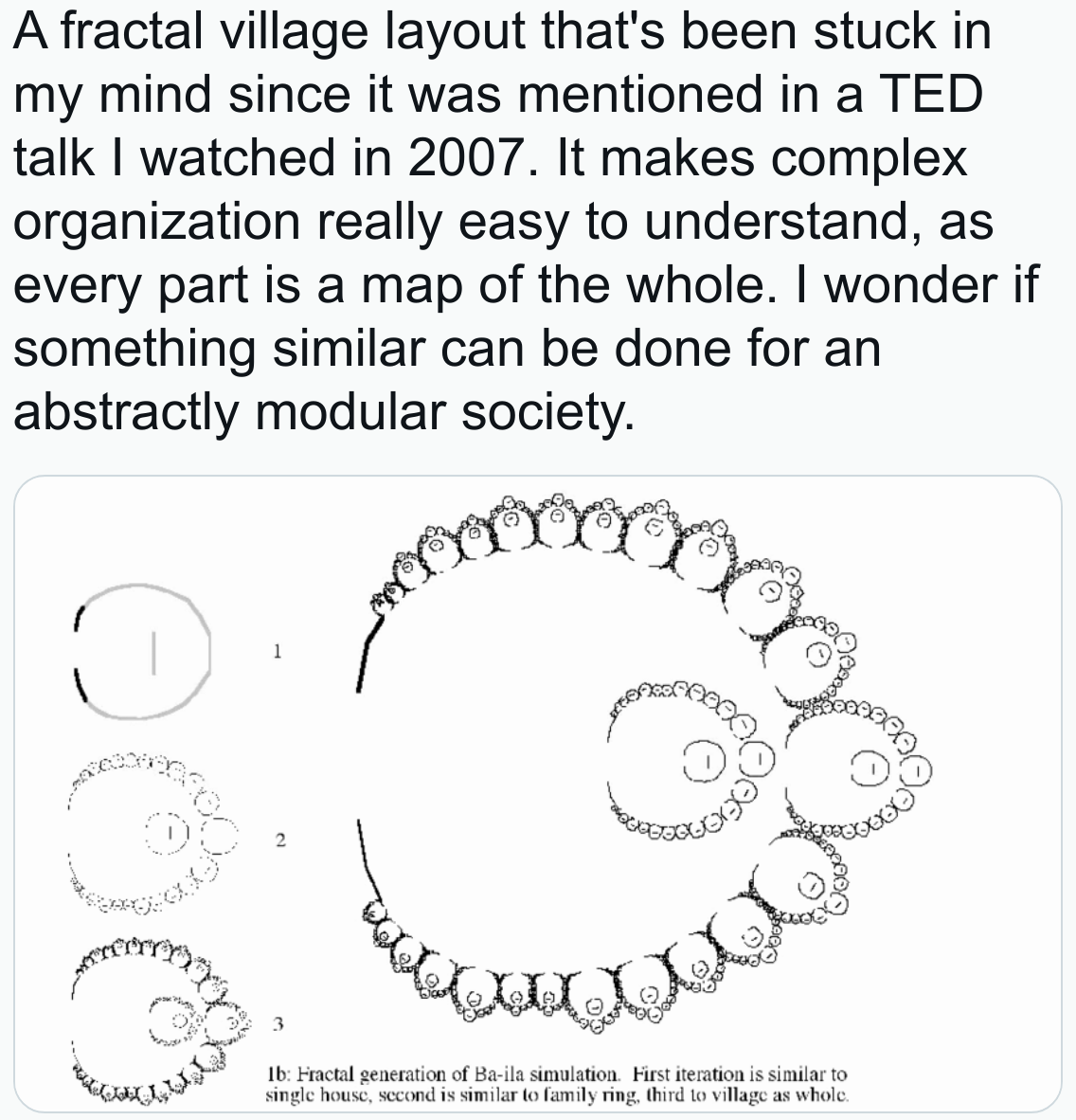
- impressively relevant to both fractal Home (quite literally) and also to what might a healthy community look like? in the physical sense (lots of cool related links in the thread)
August 26th, 2021
- Valued this article which touches on Home and what are you organizing your life around?
August 1st, 2021
- Widening the Bridges: Beyond Consent and Autonomy - relevant to full-fractal buy-in and fractal Home
- recommended by Richard Bartlett
- it seems full of good stuff, though heavily using some frame I don't quite trust or vibe with
- (one dimension of which is that the whole site is in an anarchist context - site is literally called Center for a Stateless Society)
- and while I'm broadly into a lot of what anarchist folks talk about, some of the frames are missing key pieces from my perspective
- the first part operationalizes "fluid selfing" and so on
- cool bit on networked selves
- > Consent and autonomy both depend on some general recognition of a self through which we can determine both unjustified aggression and the locus of choice. For most situations this kind of works fine. Despite what any guru or academic may have said, there is definitely something that roughly aligns with the self or individual. Obviously this does not map perfectly in all ways though. The self is multi-determined, internally contradictory, and deeply interdependent on social interconnectedness. Empathy, for example, is imprecise. The difference between what an injured person feels and what a strongly empathic observer does is proof of self alone but in any case, blood loss only kills one of them. The brain is hundreds of billions of neurons organized into neural pathways and subroutines through repeated channels of action and thought. These paths can and often do contradict each other because the self is a networked phenomenon.
- then a bit on consent
- > The extent to which we can be seen or see another has structural limits and without a more full recognition, our consent processes are concurrently throttled.
- Quite a statement, talking about limitations of perception & language. Seems broadly true
- then autonomy
- > Autonomy is more so in the realm of the first, and least complex, view of the self. It recognizes a kind of individuality that honors things like personal boundaries and personal choice. Although autonomy is far closer to this static view of individuality, it can also be complexified to include a recognition of the complex self-building dynamic connections as long as those connections are not seen as undermining the primacy of individual choice.
- hmm
- 3 examples of intertwingled things
- decriminalization
- > even if drug addiction can create problematic cycles impacting both individuals and their networks, trying to eliminate their usage would create a net-loss in freedom that would quickly become authoritarian. This doesn’t mean that the freedom of many can be justified by the suffering of one, just that maximizing freedom must take into account the many layers of interconnected agency that make up factors such as suffering and joy.
- suicide
- > A third and final example is our right to make bad decisions and learn from our mistakes. Everyone does things they regret and everyone has watched people they care about make undeniably bad decisions. However, we all learn in our own ways and frankly, it’s our lives and we can even choose not to learn from our mistakes. But watching a child, friend, or lover make choices that we know will hurt them, hurts us. Not only does it hurt them, often we know that when it all blows up, we’ll likely be called in to help. Of course, we could choose not to help, but if no one else will it raises the above issues of obligation.
- > All three of these examples show how someone’s autonomous choices can impact us.
- > A racist may claim autonomy of their beliefs but we have an obligation to stop the spread.
- this is a great example of like "wow, this person has a totally different frame than me"... some sort of frame that has a right to autonomy of beliefs (not a right that had exactly occurred to me - wrong level of abstraction) but still sees ending racism as something that will happen on the basis of obligation as opposed to appetite & purpose? ¯\_(ツ)_/¯
- like I'm super baffled that an anarchist frame would invoke obligation at all - it seems completely incompatible from my perspective
- the piece even had a section a few paragraphs above about obligation, which seemed to agree with me that it's problematogenic
- > So when I finally asked for some basic help I left the caveat of, “I can also ask someone else if you can’t rn no worries” but everyone I asked was super down to help in an authentic way because friendship is built on solidarity and they had the space. So whatever minor cringe of discomfort and obligation I may have caused by asking, was outweighed in all cases by my suffering. An important piece of consent and autonomy is asking for what you need and trusting people to set boundaries as best they can.
- interesting. author seems to conceptually get this but not integratedly (not just in terms of emotional integration but also something like spiritual integration)
- > With intensity can come the honor and genuine joy of mutual-aid but also, real life is about making all kinds of sacrifices and doing tons of shit we don’t want to because we have to.
- yeah, this statement speaks to a lack of integration overall, I think
- but it's also true in the meantime even if a sufficiently integrated being would in some sense always be feeling enthusiastic towards the best possible move they're aware of
- (though I'm thinking also of chess masters sometimes feeling like "yes, this is a v good move" vs "hmm maybe this will do something okay?")
- I followed a link to this other anarchist bit
- > Anarchism does not represent a final state of affairs, but a direction, a vector pointing beyond all possible compromises.
- I like this! post-compromise
- although I'm not particularly inclined to use Anarchism to point at the thing I'm aiming for
- still, seems that there would be lots of allies among anarchists

July 7th, 2021
- this tweet touches some really really important stuff about healing from trauma is about learning that it's okay to feel what you feel and know what you know and Home and safety
- corollaries: 1. you can only heal to the level of safety you’re *actually at*
2. healing is the process of making sure you never return to the less-safe environment, after you’ve left.
in contrast to trauma, which answers “what’s safest while I’m still inside the unsafe envt”
June 30th, 2021
- maybe related to Dimensions of Trust-Dancing or Home, this shortlist of things people need - also metta
- May you experience enough safety in life
That your body can viscerally relax - May you be surrounded by people
Who support you to express yourself - May you experience being held
In a compassionate and non-judgemental space - May you fall in love with someone
Who sees the real you - May you feel enough security
To be able to share yourself and your resources freely and openly - May you find enough meaning and purpose in life
To make it feel like it's worth it - May you have the courage
To stand up for these things
For yourself and others
Sequence on NNTD
- stuff about arriving Home together
fractal Home
- This concept is discussed on the page for Home. Also since published as fractal Home
March 15th, 2021
- re fractal Home
- something called Dragon Dreaming
- oriented towards eliciting everyone's dreams and orienting to how you could have them all come true
- finding underlying things that can be cared about that aren't in conflict
- PCT-style! / Method of Levels
- everyone writes activities that we could do that could make all these dreams come true
February 18th, 2021
- Home writing
"healing from trauma is about learning that it's okay to … › I would add "okay to want what you want"
- and this is really important - related to Home, intentionality & many other topics
February 9th, 2021
- I just realized I have my config files and slack custom emoji inside folders called things like "Misc" and so on but they are actually profoundly not miscellaneous. Custom emoji and config files are central to what Home is in digital contexts!
January 26th, 2021
- Notes on Home