metaphor
- status: thinking out loud, but I've now sent it to many people
- Metaphor Design & Design Metaphors
- Metaphors We Design By
- Before UI design, or even UX design, is something like "semantic interaction" design, which is the design of the experienced meaning of using a system. This is done not visually or by talking about interaction patterns or features or goals-to-be-done, but by talking about the metaphor.
- What sort of situation does this system allow or encourage me to understand myself to be in?
- Metaphors are partially embodied in the words used for the elements of a system but ultimately a new metaphor does also require a new mode of interaction or it's just an old metaphor in disguise.
- eg Intend has a list of items with a checkbox next to them, that it calls "intentions" instead of "tasks" or "todos".
- Part of what legitimizes the use of a new word here is that those intentions have to be set afresh each day, so they are actively something the user is intending to do, not just a contextless "task". This structural change reinforces the different metaphor.
- (of course, people are so used to todos from years or decades from school, work, homework, deadlines... that it's easy for that lens to get projected onto the intentions. I don't yet know of an app-related solution for that, although techniques like Bio-Emotive have been helpful for me & others escaping being trapped in a Everyone is basically living in a dream mashup of their current external situation & old emotional meanings dream mashup)
- eg Gmail introduced labels instead of folders for emails
- and these were legitimately different from folders—impressively, you could use them the same way, by archiving & applying just one label, but you could also apply labels to emails still in your inbox (including automatically with filters) and you could apply multiple labels to the same email. All of this powerfully emphasized the role of search
- By contrast, Evernote doesn't have "files" & "folders", it has "notes" and "notebooks", and you can "stack" the notebooks.
- This might look like it's an excellent use of metaphor, but the words they're using don't actually match how notebooks work at all. With (most) real notebooks, they're organized by date and you don't move the notes around within the notebook later. Also you can easily flip through them, and have multiple notebooks open at once.
- So secretly this is just a reskinned version of the "files & folders" metaphor! Nice try—can't fool me.
- If you want a notes app with a genuinely new metaphor, look no further than the app you're in right now: Roam, which is made by Conor who wrote the tweet below. It's using new metaphors on the deepest level.
- On reflection, I'm actually not so sure that Roam is using particular new metaphors so much as just that it has ditched the old metaphors.
- Roam is inspired by the zettelkasten, which is a very obscure and unfamiliar system, but is still a physical structure
- related:
- Metaphor debt
- People talk about technical debt in the context of software, but there's also huge metaphor debt. If Evernote has trouble competing with Roam, this will be part of why. They've invested a ton of resources not just in the specific implementation of their software but in the entire meaning of what notes are and what it means to take notes or organize them.
- In addition to designing new empowering metaphors & meanings for something you're creating, you can also also use metaphor design to illustrate shortcomings with existing / competing systems.
- I did this without being consciously aware of it in designing Complice, with the metaphor of "staleness" as a problem most other task systems have, which we use throughout the site copy and onboarding emails, as well as in blog posts that elaborate on the metaphor, like Designing a fridge to reduce spoiled food
- People resonate with the staleness metaphor a lot, and even though solutions are way harder than problems, my ability to point at the problem in a new way gives people some hope I might have a solution for them
- > I was actually about to delete this onboarding email after a quick scan when the boldfaced "they go stale" caught my attention.
- Another example.
- Using the metaphor of addiction, it manages to imply various things:
- Just because you want something doesn't mean it's good for you.
- Just because there's a market for a product doesn't mean that those selling it are benefitting the world.
- There's a deeper problem here to be solved, and slack is just treating the symptom of that problem, and in the process, reinforcing the generator.
- I have made a few design docs:
- More examples
- Related to metaphor design
- Series by a designer I like on visual metaphors (only Part 1 up as of June 14th, 2020)
- she links to this PhD thesis on computational metaphors, which I haven't read but it seems neat:
- she also referenced
- > "The metaphor designer isn’t trying to make something beautiful. She wants to change your view on things. Here’s how"
- which explicitly references metaphor design! :D
- Frank Chimero - What Screens Want

- > For instance, if I say “This is a Trash Bin,” you may not know a computer’s file management system or directory structures, but you’ve got a pretty good idea of how trash bins work, so you can deduce that the unwanted files go in the trash bin, and you’ll be able to retrieve them until the bin is emptied.
> Metaphors are assistive devices for understanding. - He makes a powerful analogy with a presentation on how plastic transformed manufacturing
- He talks extensively about skeumorphism, which is a kind of extreme metaphorical conceit()
- > Flux is changing the colors of your website at night, to customize for a different reading experience based on time.
- yes! this is a natural thing for a screen to do
- "Any organization that designs a system (defined broadly) will produce a design whose structure is a copy of the organization's communication structure." — Conway's Law
- This is related to something that Lawrence Wang said on a Relational Exegesis call June 11th, 2020, which was about Roam using ClojureScript and also being itself structured as a list-of-lists, which is kind of like Lisp
- Metaphoria by Rubin Battino
- > I’ll add something to the list. This is more-so geared towards psychotherapy, but it’s a fascinating book on the power of metaphor.
- book by Hofstadter
- subtitle something like "analogy as the core of cognition"
- maybe relevant workshop:
- this guy runs a site called useronboard.com where he breaks down apps' onboarding processes in extreme detail, and he's very conscious of the meaning-level of what's happening
- Notes from a chat
- Metaphor design sounds fascinating!
I've been reading through the metaphor sections in 'Figurative Language' by Barbara Dancygier, but it's mainly a breakdown of how metaphors are constructed and how people's cognition is affected by them.
I would love to hear about what you're reading! - Robin Goins (@coponder)
- Would love to chat about metaphor design sometime - it reminds me of my interest in Naming Things Well (though it seems hard to find a good resource on this. Someone once pointed at Conceptual Engineering as a lead, curious if you've looked into that.)
- Metaphors Matter thread:
43 linked references
March 10th, 2024
- web design / metaphor — a-website-is-a-room.net/
★ Redesigning Twitter
- Think more seriously about design metaphors
March 15th, 2023
- thread on metaphor design
February 22nd, 2023
- this is sort of an example of metaphor design
- I sometimes like letting go of what I think something is and asking myself how it functions
- including like, features in the app I've designed
- it's like "okay, it's called this, but what is it REALLY?"'
- and it's like, if we forget our associations with ownership and just ask "what does it mean that Bob owns 123 Main St?"
- then we find this connection with animal territory, beautifully evoked in this passage from Eric S Raymond
- "Anybody who has ever owned a dog who barked when strangers came near its owner's property has experienced the essential continuity between animal territoriality and human property."
- it's not just that the government will defend it on behalf of the owner, tbh, it's that there's common knowledge of that fact
- and yeah, "what does it mean that Bob owns 123 Main St?" currently means that the government defends Bob's ownership of the land, and the price Bob pays for that service is way below its natural value...
- not that we want markets on land defense—that's gang territory stuff, or close to it
- but we do want the price to be apt, because otherwise weird shit happens
January 19th, 2022
- metaphor notes listening to Mike Haber
- "good way to ask without imposing your ideas"
- "try on metaphors"
- prompt of simply eg "Complice is like ___"
- > "labels" isn't a metaphor for me
- 🤨
- it's a little underspecified but labels are a kind of physical object and the mapping of them onto digital contexts is just as much of a metaphor as a folder is
- he also said "intention" wasn't a metaphor (for him)
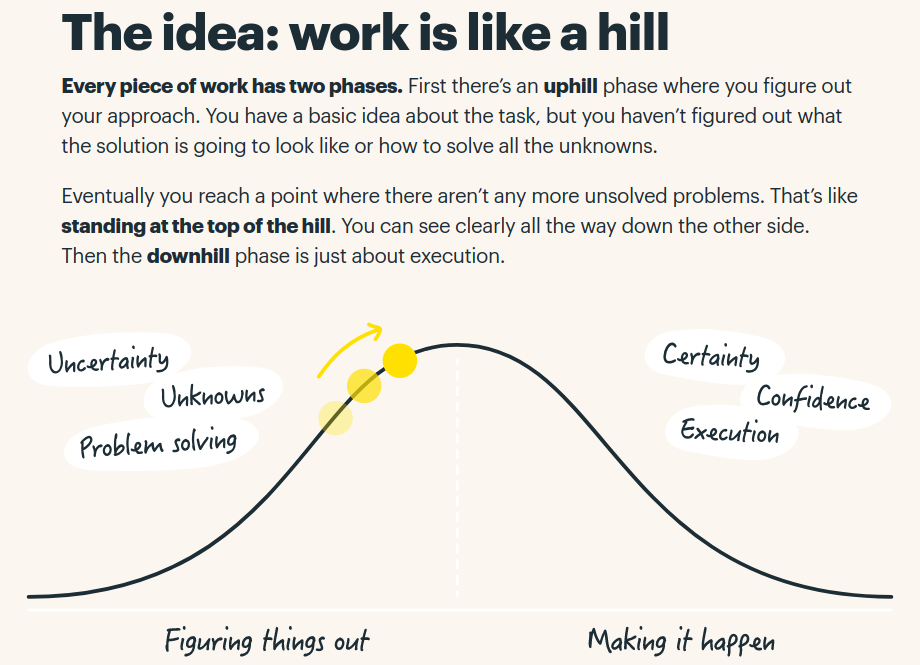
- interesting point about basecamp's Basecamp hill charts - uphill/downhill
- basically that the metaphor and/or the use of it can highlight a difficulty or a problem
- such as that in the downhill phase, the implementer may have trouble getting issues heard
- (I think this is not as much of an issue with how basecamp works, but that's not obvious just from the chart)
Podcast summaries
- Keywords - barn-raising collecting barn-raising resources metaphor meta-team meta-vision Goal-Crafting Intensive Intend Philosophy & Paradigm Intend Philosophy & Paradigm Intend Philosophy & Paradigm me as project advisor / biz consultant / design jammer / co-visioner steward ownership What are the components or dimensions required for collaborative culture? Self-Organized Criticality Everything is a Remix how do we arrange the world so that I get to eat bananas in Canada and everyone is satisfied with the arrangement? UBI
- 5:56 - 12:30 - Why is "barn-raising" the perfect metaphor for helping people launch their self-owned ventures? metaphor barn-raising collecting barn-raising resources self-energizing
November 23rd, 2021
- oooh, found a cutting metaphor that I actually like: the Gordian Knot
July 30th, 2021
- this isn't exactly about metaphor but it's related, and it uses related case studies about skeumorphisms in early iPhones, and how long it took to bust old assumptions
June 27th, 2021
- always in search of a better metaphor
March 6th, 2021
- metaphors & metaphor design
February 18th, 2021
call with Qiaochu, co-reading PJ Eby's Self-Help Myth › Q > "mind-hacking" is just such a bad aesthetic. I really… › M > Reality is alive: don't carve it
- hacking metaphor
- as a computer metaphor, either
- hostile (as in hacking a server)
- kludgy & fragile (as in hacking together a solution)
- as a physical metaphor
- violent/destructive (hacking with a knife, axe, or machete)
omnitext
Notes from this call)) › QC > so if I imagine it being a really good assistant › QC > in slack, channel identity & participation is static…
- MO > what the fuck is a channel, anyway? where's that shit metaphor from - Conversation App Design ("slack but good")
- [...wikipedia investigation into IRC...]
- > It offered several channels, each of which could accommodate up to five people, with messages appearing on all users' screens character-by-character as they were typed.
- > (Internet) A particular area for conversations on an IRC network, analogous to a chat room and often dedicated to a specific topic.
(Internet) An obsolete means of delivering up-to-date Internet content.
- MO > I think the metaphor comes from how with radio channels, you need a groove between them so they don't intermingle
- literally the lack of intertwingledness is implied by the metaphor
- which is not how Conversation As Medium works
tuning
- 2 metaphors
- tuning a radio
- nice little analog metaphor
- and lets
- emotional attunement
- Malcolm > this is you living in the future
- not with respect to ML / whether or not it's possible, per se
- but like, you know what it feels like to interact with a system that's attuned to you
- and you think it's reasonable to expect that of a computer
- (I think Nick Winter had an old piece of software that did webcam mood analysis)
- design metaphor of being able to specify something like a mood or
- serves them to you at the right time
- context-dependent
- there should be a much richer way to describe you context to your browser
- and then it goes to the giant repository of links that you have and serves you the right ones
- M > relates to my concept of tags in optimal streaming-music player & organizer
- QC > like how spotify serves you a song and you like/dislike
- what if it, or twitter, could let you say "this is not the thing I'm in the mood for"
- QC > tiktok I think is good at this?
- Malcolm > old blog post of mine
- QC > "After some reflection, I concluded that how I really felt was misunderstood."
- YES! I feel misunderstood
me as project advisor / biz consultant / design jammer / co-visioner
- check out my metaphor design page for my philosophy around a lot of this
- see also my spontaneous Design Docs
- and also my spreadsheets
January 28th, 2021
- I hate the word positive-sum... we need a better metaphor - not all positive-sum outcomes are win-wins \ omniwin
- positively-correlated points at part of the better thing
- I think I have tweeted about this
- simple analogy with arbitrary units of value:
- if you put in 5 units, and I put in 5 units, and 5 extra units get generated (total = 15), and then I take 12 units and you take 3, this was positive sum because Δsum=+5, but you LOST (-2) and I WON (+7)
- but this is not positively correlated because the signs are different on +2
- this is sort of a standard exploitative capitalist scene
- all win-win positively-correlated situations are positive sum, because with zero or negative sum games
- lose-lose is also positively correlated!
- in a negative sum game both people *can* lose
- (I put in 5, you put in 5, 8 are destroyed, we're each left with 1)
- omniwin relates very closely to post-compromise
January 5th, 2021
call with Andy Ayrey re Designing a better browser\workfl… › A > tinder for tabs was one of our first experiments
- existing tabs are like, having a bunch of dishes but you can only put them on the dining table or the kitchen counter... no drawers or shelves or cupboards or whatever
Designing a better browser\workflow for Twitter & more
- "tab" is actually itself an outdated metaphor that is inspired by the tabs on file folders!
- (and then "closing" them is actually kind of weird in that you lose all of the order originally implied by having them arranged together. "closing" a folder leaves it as it is, but this completely breaks the metaphor because it destroys a lot of information)
- a browser could in principle keep not just history but like, the whole flow of which tabs were ever next to each other. each url would get saved as an entity within eg roam, and tagged with timestamps and adjacent tabs whenever you open it or something
- what would be a better new metaphor to replace tabs?
- the randomness of it (although I guess technically it could be deterministically ordered and sorted by various things) has had me using the word "pile"... "document" is sort of it
- page, site, frame?
- page & site are clearly something else
- I kinda like frame...
- it's like a frame almost in the movie sense... in that it has its own lil history/state, but at a given moment only displays one thing
- but like, what actually is a "tab"? it's......... not just a url or a hyperlink.... it's something like, a representation of browser state...
- it's actually a pretty weird concept, in how bendable it is
- like consider these tab management extensions
- Tab Snooze: it doesn't just present you with a link or reminder later but it actually reopens the tab
- The Great Suspender: it doesn't destroy the fact that the tab was actually opened, it just stops the process
- OneTab: it doesn't just archive your tabs "somewhere", it converts them all into a single tab
- SessionBuddy: tracks not just a list of links, but dates and windows, and can restore those in a fair bit of detail
- and the number it shows on the tab is the number of actually opened sites at a given time
- Motion: (link) has a thing that compresses tabs into one active tab with an in-frame manager over top
- they all have in common that they rely on the basic unit of a browser "tab" as being fundamental
- I'm thinking about people (maybe Ben Kuhn?) talking about forcing all of their browsing to use new windows instead of just new tabs
- and this is kind of neat but it's missing the thing that should exist instead of tabs
- there's something more like "threads" or "trains of thought" that wants to exist here
- hmm... trains is making me think like, what if instead of tabs we had "cars" or "carriages" or "wagons" or something. I don't quite like that, although it is neat to note the appropriateness of how one car can go to different sites (in a physical sites)
- knovigator is onto something with its "quest" objects, in that you have a kind of question or something you're trying to figure out, and you would do searches or open tabs or think out loud, in service of that quest
- but what are the units of a quest? the sites form the waypoints along the journey
- breadcrumbs? breadcrumbs are kind of the thing
- bag? viewport? I mean viewport is very literally what this thing is called on the backend, and it's not a bad metaphor
- open portal? hm
- simply node?
- I'm thinking about treeverse, and how in general browsing tends towards treeshapedness because you open new tabs but there's rarely a convergence
- (although, mostly an aside to much of this page, it would be neat if you could see when clicking on a link that it was a link to a tab you already had open, and then it could just take you there!)
- "a tab you already had open"? or a site you already had open in a tab? hmm
October 14th, 2020
- re uhh metaphor stuff and how do brains work?
intertwingled.blog
- I tend to use a fair bit of metaphor design, to break out of existing conceptions of how to approach the situation that needs redesigning.
July 9th, 2020
- And it seems there's sort of a few basic metaphors here:
- cyclical process, eg in-breath out-breath
- relates to the idea of "balance" - be careful with that
- oscillating contradiction (similar to above)
- buzzer in circuit
- i/j in paradox logic
- self-destructive contradiction
- ?
- higher-dimensional thinking
- goals that are incompatible might be resolveable with higher-dimensional thinking or they might amount to a double bind or oscillating contradiction (similar to above)

Conversation App Design ("slack but good")
I feel a pretty clear sense that ultimately a layer on-to… › What makes it a conversation is › more clear dated-ness of each message within conversation… › and the idea that utterances are by default frozen - you … › this actually relates to the thing where if you have a qu…
- Say that I was quoting "metaphors we live by" (Lakoff) and then I decided to change my metaphors page to be called Metaphor Design & Design Metaphors
- Slack and the other apps are all using old dead metaphors.
- Well, for starters, using a metaphor of "conversations" rather than "channels" or "groups" seems like a great start. The latter metaphors assume a kind of staticness to the "who" of a conversation.
- There might also be something appropriate to having something like a "context" or "room" but these would not be topic-oriented
- conversations might be topic oriented
Self-Organized Criticality
- this is a new metaphor for talking about what's broken with our civilization, and like any new metaphor it has new affordances
- talking about sustainability/unsustainability in the sense of resource depletion is one lens on it
- but this new sandcastle metaphor allows us to talk about not just the consumption of the society, but the instability of the structure itself:
- it's not simply that it will run out, but that it will fall down
- moreover, like any falling down, civilizational collapse would involve a release of potential energy
- which points at how while there's a sense in which since the industrial revolution we've used more energy than is sustainable, there's also a sense in which a lot of that energy, not in exactly a physical sense in terms of joules, but in terms of meaning-energy or something, is still embedded in #unfinished
- and—while the sandcastle metaphor lacks the level of detail to describe this—it's clear that society has more dimensions & complexity than just a pile which is effectively a 2D shape (up↔down and horizontal spread)
- and this means that the state-space has multiple options, so we can ask:
- "what shape would it collapse into?"
- "what shape would we like it to collapse into?"
- "to what extent are new structures emerging that can catch #unfinished
Werewolf variant ideas
- Exploring a whole new metaphor space for talking about variants:
- At a high-level, the new metaphor is that you have a team that could basically trust each other if only they could figure out who else is on their team. And their mission is to eliminate murphys before the murphys eliminate them.
- (playful idea: the team could be called Here Co, which is a flip of "cohere", & the game is about coherence)
- "Anything that can go wrong, will." — Murphy's Law
- new terms
- "jitsu"
- (sometimes "lynch" in Werewolf)
- I think that once I fully clarify the metaphor for this game, there will be a more appropriate name for this move.
- 3 roles
- murphy
- wins if everything that can go wrong, does (ie all persons are eliminated)
- I love this metaphor because it makes the whole thing seem more game-like and learning-oriented, and I think reduces the extent to which simply a scary metaphor makes the murphy team scary. it's like, they're trying to deceive me to stress-test me, but this isn't a matter of their character
- Oh—it has to be murphy instead of the environment, because the environment doesn't deliberately take out your most important players. Like it's a fake environment that fights back.
- Part of why I shifted away from the werewolf metaphor is that it doesn't make sense
- ecologically: the wearwolves starve if out of food (though I guess they could migrate to a neighboring village?)
- but this wouldn't actually work well as the new deaths would be immediately obvious when they arrived...
- psychologically: in lore, werewolves are still people and actually want, themselves, to continue having relationships with their loved ones (who live in the same village)
- Yeah, the murphy metaphor seems to be the perfect name for the at-night stage, where it's like, the thing that could most "go wrong" for a team (in some ways) is that they lose the member that is most contributing towards their shared purpose
- However, does the murphy one itself have issues?
- In particular, does murphy appear to you in human form and convince you to make bad decisions...?
- I was initially thinking no, but then on some metaphorical level yes.
- and—ha! in this game-metaphor, instead of the goal being "safety" from the murphies, the goals are:
- care for the capacity of your team to think clearly
- detect shared purpose / teamship
- hm. I'm undecided about this!
- Other potential names
- "black hats" is simple & evocative
- liars, deceivers
- meddlers, disruptors
- pretenders, hiders
- I think "murphy" is playful, and would create an affordance among players of this game to recognize when they're being murphy in a real-life context
- like "oh, I seem to be casting myself in a role of trying to disrupt this group's shared purpose while pretending I share the purpose and am helping with it"
- this is actually pretty common in group coherence work, and usually stems from the person having a feeling of scarcity around some other purpose they have
- person
- (is a general category for the "uninformed majority" team)
- interconnected person
- wins if all murphy eliminated
- (could give variable score for "how many team members remaining")
- (I considered "how long this took", which is usually ~equivalent, but the frames are different. the current metaphor doesn't obviously lend itself to one or the other, at the moment.)
- N points where N is the number of surviving persons
- scarcity-minded person
- wins if all murphy eliminated
- loses if eliminated
- (could give variable score, where nonzero-but-fewer points if eliminated but also all murphy team eliminated)
- (has a very different feel than the all-or-nothing vibe of "if the villagers win but I die, it was all for nought / idgaf")
- (also very different options)
- say the default person score is N points where N is the number of surviving persons... these are all very different things that an eliminated scarcity-minded person might get:
- N-1 or N-2 points
- N/2 points
- 1 or 2 points
- (some are much closer to zero, or to non-scarcity)
- They also might have totally nonlinear effects! Like it could be that it's actually easier to cooperate as a scarcity-minded person when you get no points if you're eliminated, because there's less calculus to do you just focus on helping
- (could also vary this by whether )
- exploring name ideas...
- scarcity-minded person is sort of the most direct metaphor
- but self-{absorbed,obsessed} person could also make sense
- After writing a few thoughts over on a new psychopaths page, I found myself thinking that this role couldn't possibly metaphorically fit with "sociopath"
- because they still care about the human team winning
- whereas a true sociopath character would only care about making it to "the end of the game"
- but then I realized that win condition doesn't actually say that, it just says wins if all murphy eliminated, which a sociopathic person does want because... OH. Oh interesting. I'm actually implicitly importing some old meanings from the werewolf metaphor version
- with werewolves, all a sociopath wants is to stay alive, and they're only safe once there are no more werewolves
- but if, in shifting to the ((murphy))-metaphor, we take the sting out of being eliminated... then... yeah. hm...
- damn, this breaks a bit. because there aren't clearly two different ways to metaphorize the whole thing
- there could in principle be a character that only cares about making it til game-end, which I guess would basically mean that if only they and murphy were left, they would also win, which is not true of a person
- oh yeah, that's a coherent win condition with coherent strategies to pursue, mostly to be vaguely helpful to everybody but not very helpful to anybody
- this idea feels bizarre as long as I continue importing the werewolf metaphor, but once I set the werewolf aside, it's clear that this is a coherent role that's basically the opposite of observer
- but "sociopath" is only one way to language this, and not necessarily the best way at all
- especially since a real sociopath might be on a team where they are indeed actively wanting to execute the shared purpose (in this case eliminating the murphys)
- ones that are about not getting targeted might be
- dodger
- nothing to see here
- survivor
- ones that are about the meaning of this in the context of the game, similar to observer
- "no spoilers"
- (as long as you stay "in" the game, you don't find out any secret information; there's a role of trying to do this)
- "talker" etc
- (this player wants to continue being part of the discussions, even though they don't care about what happens)
- this scarcity-minded person, whatever you call them does actually only care about their own survival, because they are
- (thoughts on other roles)
- a player whose win condition is getting eliminated
- this category is inspired by the "Tanner" in One Night Ultimate Werewolf, but the most interesting ways to do this role (particularly in )
- troll
- wins if eliminated by force → all other players lose
- loses if eliminated by being recognized as the troll (game continues... unless it would otherwise be over)
- (probably) loses if makes it to the end of the game
- This name is slightly more appropriate in the multi-night of the game,
- because, given how humans want to have fun, not just win, this player is basically incentivized to subtly annoy other people and make enemies (to bias them towards wanting them out)
- and all other players, no matter what else they're trying to do, need to avoid being motivated by that sort of thing or they'll lose to it
- and in fact thus themselves have an incentive to ignore that dimension of the game, to keep it enjoyable and winnable
- In the one-night version, a better name might simply be "distraction"? There's still sort of an incentive to make enemies, but there isn't the same incentive to actually muddle the discourse to the point of incentivizing people to try to get rid of you because you're adding muddle.
- I wrote most of the above before adding this option
- loses if eliminated by being recognized as the troll (game continues... unless it would otherwise be over)
- Could also explore if there's a version that has the same condition but something like... Aha! Loses if the other players successfully identify the player as troll, but wins exclusively if either team votes to destroy them without stating this.
- This is actually beautiful, and I think this version is better for learning because you explicitly want to train differentiation of the purposes, and who has shared purposes! And moreover, because this keeps a strong check on how annoying the troll can be! They lose if other people identify they're the troll and block them.
- observer
- wins if eliminated → game continues
- loses if makes it to the end of the game
- (optionally, wins more the sooner they're eliminated)
- The way this role fits in the less-scary more-meta metaphor here is that this player just wants to watch. They still aren't quite on either of the other teams though, because whichever team eliminates them has missed a chance to
- I considered naming this player "bored" or something, but that suggests that once a player is eliminated they're actually "out"... and they can be, but I think the whole framing is better if you call attention to the fact that players who are eliminated from the finite game are still participating in the larger infinite game container!
- Unlike the troll, it doesn't seem to me like it makes sense for there to be anything like loses if eliminated by being recognized as the troll (game continues... unless it would otherwise be over)
- a player whose win condition is simply surviving until "the end"
- this is different from the scarcity-minded person, who actually shares the mission of eliminating the secret murphy team
- currently speculation about this role is but then I realized that win condition doesn't actually say that, it just says wins if all murphy eliminated, which a sociopathic person does want because... OH. Oh interesting. I'm actually implicitly importing some old meanings from the werewolf metaphor version here
- this game would have super fucking fascinating dynamics, where the more scarcity-minded persons you have...
- let's look at the intriguing limit only-1 cases, actually
- where it's impossible to lie saying you have this role and not have the other person who actually has the role know you're lying
- (I suspect with more even ratios, it would be much less common for people to try weird overt strategies that involve trying to explicitly get other people to know what kind they are.)
- 1. say there's exactly one interconnected person and many scarcity-minded persons
- then you could almost imagine, in a naive round of that game, the interconnected person saying "I'm the interconnected person! if you're a person, you should trust me because I care about all of you"
- but this would immediately bork in left hemisphere land, as an explicit declaration, because
- if it's a fakeable signal (which it is on the explicit level) then it doesn't count (and is therefore sort of suspicious)
- to the extent it's not a fakeable signal, then murphy has an obvious incentive to bork you, which.... OH. fascinating, if you were interconnected person, you actually would be more okay with this than if you were scarcity-minded person!
- 2. by contrast, say there's only one scarcity-minded person and many interconnected persons
- one weird naive strategy here is actually to reveal that you're the scarcity-minded person and say...
- there's actually a few things you could say!
- "if you don't fuck with me I won't fuck with you"
- this is not a very useful threat because many of the main ways you can get fucked with remove your ability to respond
- "please protect me from dying, because I... don't want to lose if there's a chance I can win"
- but this is mostly a plea to the murphy team...? this is weird.
- neither other team actually cares if you survive, although the werewolves are probably slightly better off with you still there, since you have incentives to lie if... well, no, that's not actually true. the scarcity-minded person still really really doesn't want to get "jitsu"'d, and so being accused of...
- I actually think that your overall chances of winning probably mostly depend on helping the villager team win, because like, if the number of villagers goes below the number of werewolves, the villagers have basically lost at that point (oh, there's a weird edge-case where the doctor can keep someone alive)
- and therefore, even when you're nominated for "jitsu", and need to defend yourself, it's actually just still pretty true that your desire for an actual murphy to get eliminated instead is stronger
- (this, btw, is why I think that real psychopaths will actually be able to play along fine in Game B—it's truly a game where the benefit from playing positive-sum, positively-correlated games is actually stronger than the benefit from playing zero/negative-sum, negatively-correlated games)
- oh man! another super weird version is actually to have only one murphy! ...I think in this case, any decent-size team of only-interconnected person would I think basically win every time. But this is where certain dimensions of the difference between the two person roles would become more salient, I think
- basically because... with a large murphy team, there's a sense that a bunch of the person team just isn't going to make it, because it'll take at least N turns where N is the number of murphys
- technically, again, this probably should mostly not affect the strategy, but I think it would tend to evoke in a scarcity-minded person more of a sense of scarcity.. and the scarcity is real, although—aha, I guess the point is that it's still possible for the entire villager team to win (including all scarcity-minded persons surviving)
- so there's a kind of tentative abundance among the scarcity-minded person
- whereas if you have say 3 scarcity-minded person, 1 interconnected person, 2 murphy (guides say 2:1 villagers:werewolves)... then at least one of the scarcity-minded person players is definitely going to lose
- which! is a totally legal thing for the game. after all—most finite games (including all versions of this that have any non-person players) don't allow everyone to win
- but what it does is it means that those scarcity-minded person players are effectively not fully on the same team with anyone else.
- they have partial teamship
- oh this is an interesting thing, nested win conditions. oof, I don't think this will happen here because it's not a useful level to play the game on, but that's a situation that in real life means that the player with the outer win condition has a distinct power over the player with the inner win condition... I think? Oh! No, the power-over dynamic doesn't emerge at all because no interconnected person has anything to gain by threatening a scarcity-minded person, and has much to lose. that would be a fascinating thing to try to incorporate, but this isn't the spot for it
What would a fluid or meta-systematic team coordination app look like?
- Kitchen Table as major metaphor for staying in sync, via having writings & books printed out.
- I didn't think of this when I originally wrote this in 2018 because
- we didn't have a wifi printer then, so we probably printed out like 1/10th of the amount of stuff, and I almost never printed things except like bus tickets
- I wasn't consciously looking for new metaphors then
- but I just went downstairs to get a piece of chocolate and was struck by all of the printouts strewn on the kitchen table, and how those flow organically (but not un-intention-ally) onto the table and then eventually into some sorts of archives
design portfolio
- This page is to collect examples of places where I've applied my design-thinking skills. I often use metaphor-based systems design.
Reality is alive: don't carve it
- What kinds of metaphors animate the living functioning system with all of its interactions?