Relationship Panarchy
- status: published
- — outdated draft —
- last updated: 2019-11-26
- So there's this concept "polyamory". For some people, it tends to come with a bunch of structure implied, such as "primary partners". For others, it's basically a synonym for "non-monogamy".
- "Non-monogamy" is able, by being a negation, to imply less structure, but it isn't sufficiently general because
- (A) it doesn't allow for new map concepts that read as monogamy on the old map
- (B) it still over-emphasizes romantic relationships, by negating them
- One model that seems to be more open-ended is known as "relationship anarchy". From wikipedia:
- Relationship anarchy (sometimes abbreviated RA) is the belief that relationships should not be bound by rules aside from what the people involved mutually agree upon. If a relationship anarchist has multiple intimate partners, it might be considered as a form of non-monogamy, but distinguishes itself by postulating that there need not be a formal distinction between sexual, romantic, or platonic relationships.
- Relationship anarchists look at each relationship (romantic, platonic or otherwise) individually, as opposed to categorizing them according to societal norms such as 'just friends', 'in a relationship', or 'in an open relationship'.
- However, the imagery of anarchy as such evokes a rather individualist orientation to relationships, implicitly to a degree that's technically not even possible.
- > "The dream of being able to make decisions starting from a place of total non-coercion by default is an atomized vision of what it means to be human in relation with other humans, and it does not actually work."
- — @QiaochuYuan on twitter. (Expand to see tweets embedded here)
- In practice, each of my relationships affects my other relationships, and caring for the impacts of these relationships cannot be achieved through having a set of rules. Having a set of rules for relationship navigation implies that it's my fault if I'm upset that my partner/friend did something that upset me but was still in accordance with our rules. Even if the rules evolve to handle such scenarios (which itself can lead to rule bloat) the underlying framework is still one that is oriented to following rules rather than to caring for the relationships and the systems that support those relationships.
- So, in 2018, I coined a new term: Relationship Panarchy.
- The tiny linguistic shift flips the whole thing on its head, eloquently saying "it's like relationship anarchy but it's oriented to caring for the whole systems that support the relationships". It recognizes the deep intertwinglement of human relationships and partnerships.
- < eg family >
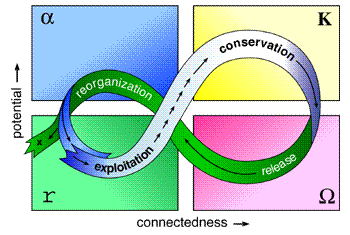
- Also, for people familiar with systems theory, the image of the panarchy loop may come to mind.
- "Panarchy" as a concept was coined as an alternative to hierarchy that isn't simply anarchy. It recognizes the natural flows of growth and dissolution, as part of one larger whole.
- When a "break up" occurs, ie the end of some particular form of relationship, this isn't the end of "the relationship"
- first of all because continuing to be in close contact may be possible & desired
- secondly because even if close contact doesn't happen, the two people have forever affected each others' lives and the lives of those around them, and those impacts continue to be real
- (Since I had this original idea, and wrote the above, I've come appreciate the panarchy loop arc even more, as a phenomenon in my own relationships.)
- If you dig this ↑ check out these ↓
- The Possible Relationship, an article by a group of four called The UV Family, who are exploring something that resonates powerfully with me and with my description of Relationship Panarchy
- "Oh. Maybe attachment bonds were never meant for just your parents and your romantic partners. Maybe they were meant for your tribe."
- Beautiful essay by Qiaochu, who wrote the above tweet about human relations
- Committed to you… on fluidity in relationships, an article that also resonates a lot, although some of how they frame things is actually the opposite of how I would frame things
- they say "I value people over relationships" and I would express what I think is the same sentiment by saying "I value the relationship itself over any specific form that relationship might take"
- The Anatomy of Relationships, an excellent article offering over a dozen different dimensions along which to talk about relationships
- It's important to note that the categories here are also somewhat arbitrary and not to get fixated on them.
- thoughts while editing for a published blog post October 17th, 2020
- something to explore is something like:
- what is the core idea I'm really trying to convey with this post?
- "mono/poly is not the right level of abstraction"
- (right for whom, for what?)
- "I like relationship anarchy but it needs a figure ground inversion"
- most models of relationships don't adequately contain ebbs & flows
- relationships for life
- < insert reflection about panarchy loop itself >
- Things to do before publishing
- more consistent capitalization of Relationship Panarchy
3 linked references
October 28th, 2019
- Added a draft of Relationship Panarchy that I wrote a few months ago
Table of Contents
- Relationship Panarchy (a blog post, since published)