full-fractal buy-in
- full-fractal buy-in is what happens when all parts of a system get common knowledge that:
- 1) if they had a conflict resolution approach that they all liked, then they would all like to use it
- 2) if they had a way (that worked for all of them) to create such an approach, then they would like to do so!
- 3) they have some inkling of how to begin to approach bootstrapping such a way
- it's remarkably stable and self-stabilizing because 1 & 2 are obviously true once understood
- which has two great effects:
- A) it means it's easy to get in touch with and stay in touch with
- B) the fairly general self-evidentness of it means that parts can kind of trust that other parts would agree if they also knew where to look
- (parts are any agentic parts of some whole, most canonically "parts" of a person in the psychological partswork sense, but it could apply to people in a group or groups in a larger group)
- pointed at a slightly different way (although this maybe privileges thrival systems over survival)
- other things to maybe mention
- the quote from ssc about consciousness having an insight thanks to concentration
- OH WAIT. this is just "everybody's bought in" + "fractal coalition theory"
- oh, + meta-protocol
20 linked references
November 21st, 2025
- huhAn exercise for getting same-sided & post-compromise
as is sort of a full-fractal buy-in / omniwin training game exercise
July 18th, 2024
- oh, on which note... how does full-fractal buy-in work here?
- like if I do an urgency check, within the domain of writing, I get no urgent things, sure. but I knew that
- then like...
GTD but good tho
- I'm kind of envisaging a full-fractal buy-in workflow that's like
- is there anything on my mind that's so urgent I just want to take care of it right now before even considering everything else?
- (super important or not important, as long as it's quick)
- ↳ DO IT
- you're finished with this step if it feels like you can totally just rest for an entire [minute? hour? hmm]
- what feels not-handled or you're worried you might forget about it or whatever?
- notably this is not everything you might eventually do or have to do, just things that you don't trust you'll get to in good time
- so if there's mess in the sink but you'll deal with that spontaneously when you're in the kitchen, no worries
- likewise with something that already has a reliable reminder set or a calendar event or whatever
- ↳ WRITE IT DOWN
- you're done with this step if it feels like if all of that stuff were handled, you'd have no worries [lol except xrisk]
- (these "you're done with" steps feel very jank, not at all well implemented)
January 2nd, 2024
- his approach to internal conflict:
- finding a sentence to write down that's the thing, in proposition form
- M > the nature of the conflict?
- yeah... thesis. often in quote marks
- eg if deciding whether to stay for a job or move internationally
- "this is not an opportunity you will get again"
- externalize it, stake it
- M > then you can investigate: is that true, what would it mean if it were...
- M > so guessing that despite having this technique, you don't resolve all of your internal conflicts all the time automatically
- so then a Q of "why not?"
- J > exponential/fractal nature, expands to too many statements
- M > in almost any negotiation, part of what is being negotiated over is the terms of negotiation
- M > if there were a way to resolve internal conflicts that all parts of me felt good about, then they'd obviously want to use that method
- (tautological)
- but how would we find such a way?
- well, if there were a way to FIND such a way, that all parts felt good about, then they'd obviously want to use that
- and this fact is independently verifiable from each part's perspective
- so any part will want to participate in negotiations that feel like they'll work for it, and not negotiations that feel like they won't
- J > two phantom directions
- was expecting you to tell me some conception of the meta-protocol
- or something about understanding that frame negotiations are part of the thing
- ...so yeah, was expecting you to present a method of frame negotiation
- imagining a zipping up fractal coherence of parts
- as a state of affairs for an inner parliament
- M > yes, but it's less about having an approach that works for all time in all contexts (which is impossible and absurdly costly)
- (example of friends resolving fight by yelling & wrestling, which works for them but wouldn't work for all)
- and more about having a stance of finding what works for both/all-involved
- and mutual recognition of this self-evident thing
- (aha it's co-gnosis)
- M > not a commitment but a recognition of fact
- if it appeared to work, either
- it was done in a way that worked for all of us
- the appearance is an illusion
- M > so explore making this move, from a part that really likes the propositional technique you mentioned earlier
- of bringing that part into these recognitions
- J > ...okay, something happened
- held the two (liking propositions, self-evident need for satisfying all)
- sense of shame that came up
- then went for it again, with an inner conflict I'm working with
- got a blinding white "NO"
- so sense of projection
- I would rather hold out in guerilla warfare than think about seceding or acquiescing
- M > so find the part the NO was at
- J > I was kind of in both
- M > NO to each other? yeah
- M > so seems like these parts don't have a sense that a win-win is possible
- or don't trust the other not to hoodwink them on the way there
- M > is there a way for them to recognize together that
- IF there were a solution that fully satisfied both of them, ACTUALLY, they WOULD like that — they'd prefer that over the stalemate
- J > mmm, sense of lightness, grace, relief
- M > a move here of like "well, it makes sense that you don't trust me and that you're digging in your heels while you don't trust me"
- [J intense look on face, kinda still, stiff]
- impressions, as they arose, were something like...
- the part that has been getting its way... made contact with the sense of "I see why you wouldn't trust me"
- very emotive, sense of solidarity/progress
- then that part came down
- and there was a bringing in the part that was more antagonistic / not as much getting its way
- and brought the "I see why you wouldn't trust me" to that part
- and it was like "nah I'm in the right"
- and then the first part kinda backed up from the solidarity into a "fuck you"
- M > seems like the symmetry has shifted dramatically
- this node of "I can see why you wouldn't trust me" feels interesting but doesn't fit back with the tree
- M > well the sense that it makes that the other doesn't trust... comes from the recognition of the self-evident stuff
- M > does it seem like the two parts do actually see this? [together]
- J > let's see if I can fit all that in working memory...
- they don't seem to be able to do that, quickly
- seems like what I've been doing is feeling into the part, and bringing a thing in contact with it
- and it feels like this would be bringing both parts up AND the recognition
- M > I could break it down
- M > bring up part A... can you see this? IF there were a solution that fully satisfied both of them, ACTUALLY, they WOULD like that — they'd prefer that over the stalemate
- J > yeah, self-evident
- M > now bring up part B... can you access the memory of that feeling self-evident to part A, moments ago?
- J > ow
- uncomfortable, I seem to be flinching from understanding that part while embodying it from its perspective
- even being able to be in a state where...
- I'm imagining... a 6-party parliament, some new event
- figuring out coalitions
- for the parts to be able to interface with the full-fractal buy-in
- it's hard to do that when they can't even occupy consciousness
- M > together or at all?
- J > at all, from their own perspective
- M > yeah so maybe either the first part or some third as-yet-unnamed part is objecting to you taking the other part's perspective
- J > yeah could be part A but seemed more like the broader system
- when you get a flash of how someone else is seeing you, and it feels unacceptable
- not sure what part is rejecting what tho
- M > move of differentiation, like OH, you actually DO see me that way, and that doesn't mean I have to
March 5th, 2023
my translations & interpretations of Buddhist stuff › some initial thoughts on how I would articulate the noble… › 4. path: How we get there 😛
- sorta-more-generally, full-fractal buy-in
September 26th, 2022
- vaguely related to full-fractal buy-in
September 24th, 2022
- new articulation of full-fractal buy-in
- context: Michael "Valentine" Smith sent this
- I recently (re?) read Scott's summary of The Mind Illuminated. Something really stuck out for me in it. Been noodling me for days now. I've been wanting to run it by you.
- Here's an excerpt apparently quoted from the book (bolded emphasis mine):
- > What makes [enlightenment/cessation event] the most powerful of all Insight experiences is what happens in the last few moments of consciousness leading up to the cessation. First, an object arises in consciousness that would normally produce craving. It can be almost anything. However, what happens next is quite unusual: the mind doesn’t respond with the habitual craving and clinging. Rather, it fully understands the object from the perspective of Insight: as a mental construct, completely “empty” of any real substance, impermanent, and a cause of suffering. This profound realization leads to the next and final moment of complete equanimity, in which the shared intention of all the unified sub-minds is to not respond. Because nothing is projected into consciousness, the cessation event arises. With cessation, *the tuned-in sub-minds simultaneously realize* that everything appearing in consciousness is simply the product of their own activity. In other words, they realize that the input they’re accustomed to receiving is simply a result of their own fabricating activities.
- (Well, okay, the bolding didn't work, alas.)
- The lead-up to the cessation offers a kind of common-knowledge cascade of the type you & I have been talking about.
- ( see this video )
- Something feels really significant to me about this.
- The rest of Scott's summary gives the impression that the book's model is, there are two kinds of places consciousness can go: RH & LH. RH is expanded awareness. LH is intense focus. But you can build consciousness itself by stretching it to do more of both. Stabilizing attention & expanding awareness, more & more at the same time, since they kind of oppose.
- That consciousness provides the space for these common knowledge cascades to happen.
- These feels like the internal version of the external social thing we're attempting. Somehow my thinking is skipping a beat on a detail here though.
- my response
- whoaaaaa very cool
- maybe tweet all of this and see who else chimes in
- the other main internal common-knowledge-cascade I've been tracking is something called full-fractal buy-in
- idk if it's isomorphic; certainly isn't obviously isomorphic but Ryan has a frame where the core insight of stream entry is something like "you can actually actually just do what you want though" in which case they might somehow map
- and FFBI is basically the realization by all of the parts:
- 1. that if they had a way to find win-wins that worked for all of them they'd want to use it
- 2. that if they had a way to CREATE A way that worked for all of them then they'd want to create it
- 3. that if they attend to 1 & 2 and attempt to achieve this while allowing all parts veto power ("I don't trust this process; it needs to be somehow different") then this will bootstrap 2 which will bootstrap 1
- right and collective consciousness does the same thing
- I wonder what it would do to my sense of motivation to meditate if I saw it as creating increased space for common-knowledge cascades to happen internally
- that feels very motivating
March 24th, 2022
#2tweet if the thing feels wrong, slow the fuck down if p… › › if the thing feels wrong, slow the fuck down if people te…
- (sorta. maybe more like "how to not layer" pith instructions)
August 30th, 2021
- New pithy articulation of full-fractal buy-in:
- (a bit more on the page)
August 1st, 2021
- Widening the Bridges: Beyond Consent and Autonomy - relevant to full-fractal buy-in and fractal Home
- recommended by Richard Bartlett
- it seems full of good stuff, though heavily using some frame I don't quite trust or vibe with
- (one dimension of which is that the whole site is in an anarchist context - site is literally called Center for a Stateless Society)
- and while I'm broadly into a lot of what anarchist folks talk about, some of the frames are missing key pieces from my perspective
- the first part operationalizes "fluid selfing" and so on
- cool bit on networked selves
- > Consent and autonomy both depend on some general recognition of a self through which we can determine both unjustified aggression and the locus of choice. For most situations this kind of works fine. Despite what any guru or academic may have said, there is definitely something that roughly aligns with the self or individual. Obviously this does not map perfectly in all ways though. The self is multi-determined, internally contradictory, and deeply interdependent on social interconnectedness. Empathy, for example, is imprecise. The difference between what an injured person feels and what a strongly empathic observer does is proof of self alone but in any case, blood loss only kills one of them. The brain is hundreds of billions of neurons organized into neural pathways and subroutines through repeated channels of action and thought. These paths can and often do contradict each other because the self is a networked phenomenon.
- then a bit on consent
- > The extent to which we can be seen or see another has structural limits and without a more full recognition, our consent processes are concurrently throttled.
- Quite a statement, talking about limitations of perception & language. Seems broadly true
- then autonomy
- > Autonomy is more so in the realm of the first, and least complex, view of the self. It recognizes a kind of individuality that honors things like personal boundaries and personal choice. Although autonomy is far closer to this static view of individuality, it can also be complexified to include a recognition of the complex self-building dynamic connections as long as those connections are not seen as undermining the primacy of individual choice.
- hmm
- 3 examples of intertwingled things
- decriminalization
- > even if drug addiction can create problematic cycles impacting both individuals and their networks, trying to eliminate their usage would create a net-loss in freedom that would quickly become authoritarian. This doesn’t mean that the freedom of many can be justified by the suffering of one, just that maximizing freedom must take into account the many layers of interconnected agency that make up factors such as suffering and joy.
- suicide
- > A third and final example is our right to make bad decisions and learn from our mistakes. Everyone does things they regret and everyone has watched people they care about make undeniably bad decisions. However, we all learn in our own ways and frankly, it’s our lives and we can even choose not to learn from our mistakes. But watching a child, friend, or lover make choices that we know will hurt them, hurts us. Not only does it hurt them, often we know that when it all blows up, we’ll likely be called in to help. Of course, we could choose not to help, but if no one else will it raises the above issues of obligation.
- > All three of these examples show how someone’s autonomous choices can impact us.
- > A racist may claim autonomy of their beliefs but we have an obligation to stop the spread.
- this is a great example of like "wow, this person has a totally different frame than me"... some sort of frame that has a right to autonomy of beliefs (not a right that had exactly occurred to me - wrong level of abstraction) but still sees ending racism as something that will happen on the basis of obligation as opposed to appetite & purpose? ¯\_(ツ)_/¯
- like I'm super baffled that an anarchist frame would invoke obligation at all - it seems completely incompatible from my perspective
- the piece even had a section a few paragraphs above about obligation, which seemed to agree with me that it's problematogenic
- > So when I finally asked for some basic help I left the caveat of, “I can also ask someone else if you can’t rn no worries” but everyone I asked was super down to help in an authentic way because friendship is built on solidarity and they had the space. So whatever minor cringe of discomfort and obligation I may have caused by asking, was outweighed in all cases by my suffering. An important piece of consent and autonomy is asking for what you need and trusting people to set boundaries as best they can.
- interesting. author seems to conceptually get this but not integratedly (not just in terms of emotional integration but also something like spiritual integration)
- > With intensity can come the honor and genuine joy of mutual-aid but also, real life is about making all kinds of sacrifices and doing tons of shit we don’t want to because we have to.
- yeah, this statement speaks to a lack of integration overall, I think
- but it's also true in the meantime even if a sufficiently integrated being would in some sense always be feeling enthusiastic towards the best possible move they're aware of
- (though I'm thinking also of chess masters sometimes feeling like "yes, this is a v good move" vs "hmm maybe this will do something okay?")
- I followed a link to this other anarchist bit
- > Anarchism does not represent a final state of affairs, but a direction, a vector pointing beyond all possible compromises.
- I like this! post-compromise
- although I'm not particularly inclined to use Anarchism to point at the thing I'm aiming for
- still, seems that there would be lots of allies among anarchists
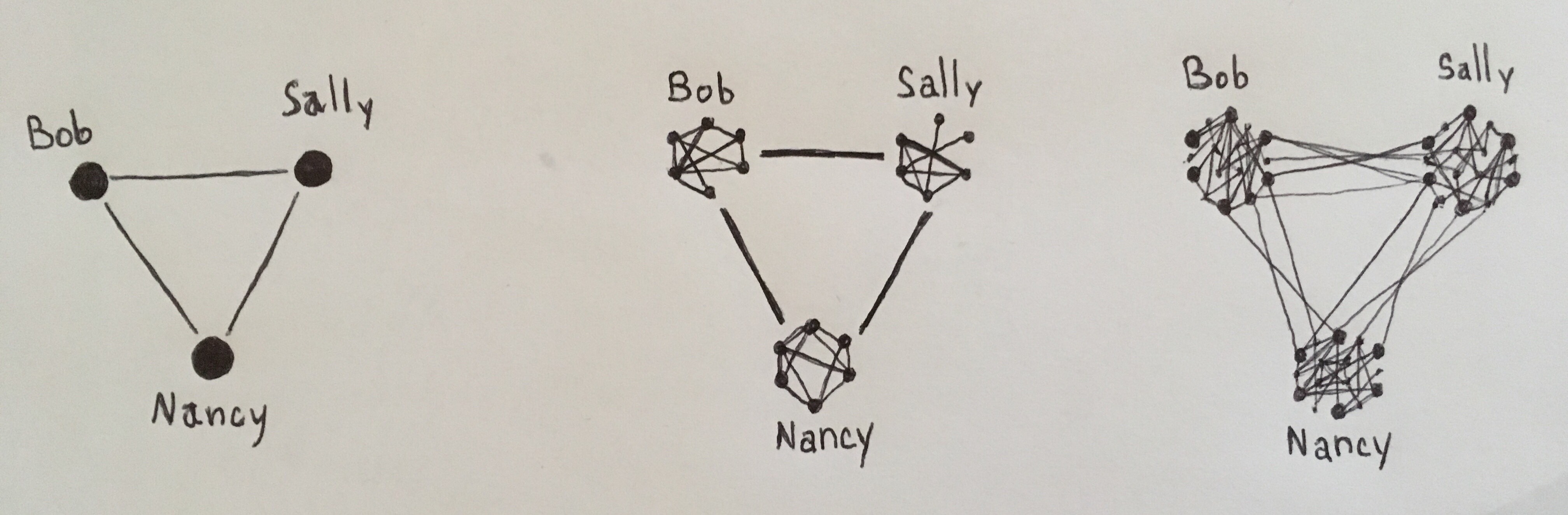
July 3rd, 2021
talking with Mark Lippmann & Jonathan Leung about NNTD an… › J > Domain Focusing: › includes checking if move safe
Sequence on NNTD
- and then I could make it so that for now, malcolmocean.com/full-fractal-buy-in will be a page that redirects to full-fractal buy-in, but then once I actually make a blog post called Full-Fractal Buy-In, that old link will already work for the new page! huh.
- annoyed that roam still doesn't let you link to pages by name
- relatedly, full-fractal buy-in
March 20th, 2021
- relevant to full-fractal buy-in - this particular episode
March 9th, 2021
- and there's a kind of fractal buy-in thing going on, although it's not actually full-fractal buy-in per se? more like Converting Moloch from Sith to Jedi
February 18th, 2021
call with Qiaochu, co-reading PJ Eby's Self-Help Myth › > A funny thing happens with powerful self-help technique…
- relates to the full-fractal buy-in puzzle
call with Qiaochu, co-reading PJ Eby's Self-Help Myth › M > if PJ Eby really gets this, why has he not achieved h…
- maybe lacking full-fractal buy-in, on one level
- commitment to internal dialogue
- common for people to have techniques that they think will help them solve the problems they have
- in practice they don't use them
- Why?
- One reason: an internal conflict that is partially about whether the technique is safe to use
- part of the fractal is that it extends out to interpersonal systems
- e.g. Malcolm bringing in the NNTD that is supposed to help ppl navigate a conflict, but if Benjamin doesn't trust that he is going to be cautious signing up for a form that is threatening on some level
- example of Human and Chimp wanting to resolve a conflict in different ways (e.g. the human by Logic and the chimp by strength)
- Koan in the context of interpersonal stuff: who gets to decide? who gets to decide who gets to decide? who gets to decide who gets to decide who gets to decide? why?
- Where do you ground it out?
- How do you establish coherence if there is no ground?
- with a lot of context sensitivity
- if we go back to e.g. Malcolm bringing in the NNTD that is supposed to help ppl navigate a conflict, but if Benjamin doesn't trust that he is going to be cautious signing up for a form that is threatening on some level
- what difference would it make for any given form we are using any form (NVC, something implicit like the general way ppl resolve conflicts at John St with whatever language is used), for there to be a shared recognition of a way that either of us may use the form that we would be able to say "this is not working for my system, I need it to be different. Some part of me doesn't trust what is happening right now". What difference does it make for us to consciously say, obviously w would want to be able to use whatever form is going to feel best for both of us. And we might not know what that is, and we may need to create it.
- which is inextricable with how we use whatever form
- any tool is associated with a set of attitudes, and is embedded in a context
- It can be hard (for various reasons) ...
- Say that Mal wants to resolve a disagreement with NNTD, and Ben says yes but qualifies that he wants to be able to say if it feels off, and then Mal says "of course!" ... from where does Ben come to trust that Mal both wants that, and that he would actually be able to follow through on that from a skill perspective
- integrating someone's concern is not a straightforward act
- This (the coming to be able to trust the use of a form, including the potential opt-out, for all of the parts of the system) is maybe easier to do internally than interpersonally.
- 1. You can feel internal good will and can do certain kinds of checks. Communication between neurons is quicker
- 2. There is no away w.r.t your internal parts. If you don't get along with another person you can decide not to interact very much. If your inner critic and inner rebel don't get along, they are kind of stuck in the same body. There is a need to find a way to not fight.
- Shapes within the space of this big scenario
- ex 1
- ex 2
- ex 3
- each part of the system says, if there can be a form/process/approach / means of navigating differences, that meets my needs and where my needs can be incorporated, and it can do that for everyone, then I would want to participate in and co-create that thing. And, I as a part in this system, will not ask any other part to settle for anything less
- stance, not a state
- B > or like a koan
- meta-protocol = what allows us to answer the who gets to decide who gets to decide? question/koan fully generally
- It is the process of integrating the entirety of all contexts that are relevant
- it is never done, it's not a state that can be arrived at. It is itself the entire evolving process of the universe. The whole everything.
- Why is full-fractal buy-in important
- it is what allows all parts of a systems eedds to get satisfied
- but in what way does it all it, and why are we calling it buy-in
- if you try to do some technique, if it doesn't happen it's probably because some part of you is not bought-in
- full-fractal buy-in is a kind of mutually conditional buy-in, which is like, I'm not game for the technique as stated, but in as much as some part of the group is proposing it, I would like to do some part of the technique that feels safe for me. And
- re meta-protocol = what allows us to answer the who gets to decide who gets to decide? question/koan fully generally
- ...
- often ppl resist because they feel like if they buy in then they will have to settle
- as opposed to having a move available that allows them to start
- B > I think you could really use a bunch of concrete case studies of resistances coming up for people
- so eg I'm thinking about the recent money pile or whatever we're going to call it experience, and Sarah McManus's experience
- and the sense of like, at this point, 2 calls in, there's a cost to voicing dissent, at whatever level of capacity I have to voice that and whatever capacity the group has to receive that, in whatever way will feed or not feed the group synergy
- M > yeah, she has so much epic skill at being able to notice inadequacies, but her skill at being able to point that out in ways that people will be able to see
- B > yeah, thinking of Paul Graham's Jessica Livingston article
- as an example of that kind of "suss out" role
- M > totally