August 1st, 2021
- oh man, my experience of seeing a sunny day during the 2008 market crash and seeing something larger than the sense of doom there resonates with Bill Wurtz' Mount St Helens song
- #2tweet I now have custom roam favicons!
- Widening the Bridges: Beyond Consent and Autonomy - relevant to full-fractal buy-in and fractal Home
- recommended by Richard Bartlett
- it seems full of good stuff, though heavily using some frame I don't quite trust or vibe with
- (one dimension of which is that the whole site is in an anarchist context - site is literally called Center for a Stateless Society)
- and while I'm broadly into a lot of what anarchist folks talk about, some of the frames are missing key pieces from my perspective
- the first part operationalizes "fluid selfing" and so on
- cool bit on networked selves
- > Consent and autonomy both depend on some general recognition of a self through which we can determine both unjustified aggression and the locus of choice. For most situations this kind of works fine. Despite what any guru or academic may have said, there is definitely something that roughly aligns with the self or individual. Obviously this does not map perfectly in all ways though. The self is multi-determined, internally contradictory, and deeply interdependent on social interconnectedness. Empathy, for example, is imprecise. The difference between what an injured person feels and what a strongly empathic observer does is proof of self alone but in any case, blood loss only kills one of them. The brain is hundreds of billions of neurons organized into neural pathways and subroutines through repeated channels of action and thought. These paths can and often do contradict each other because the self is a networked phenomenon.
- then a bit on consent
- > The extent to which we can be seen or see another has structural limits and without a more full recognition, our consent processes are concurrently throttled.
- Quite a statement, talking about limitations of perception & language. Seems broadly true
- then autonomy
- > Autonomy is more so in the realm of the first, and least complex, view of the self. It recognizes a kind of individuality that honors things like personal boundaries and personal choice. Although autonomy is far closer to this static view of individuality, it can also be complexified to include a recognition of the complex self-building dynamic connections as long as those connections are not seen as undermining the primacy of individual choice.
- hmm
- 3 examples of intertwingled things
- decriminalization
- > even if drug addiction can create problematic cycles impacting both individuals and their networks, trying to eliminate their usage would create a net-loss in freedom that would quickly become authoritarian. This doesn’t mean that the freedom of many can be justified by the suffering of one, just that maximizing freedom must take into account the many layers of interconnected agency that make up factors such as suffering and joy.
- suicide
- > A third and final example is our right to make bad decisions and learn from our mistakes. Everyone does things they regret and everyone has watched people they care about make undeniably bad decisions. However, we all learn in our own ways and frankly, it’s our lives and we can even choose not to learn from our mistakes. But watching a child, friend, or lover make choices that we know will hurt them, hurts us. Not only does it hurt them, often we know that when it all blows up, we’ll likely be called in to help. Of course, we could choose not to help, but if no one else will it raises the above issues of obligation.
- > All three of these examples show how someone’s autonomous choices can impact us.
- > A racist may claim autonomy of their beliefs but we have an obligation to stop the spread.
- this is a great example of like "wow, this person has a totally different frame than me"... some sort of frame that has a right to autonomy of beliefs (not a right that had exactly occurred to me - wrong level of abstraction) but still sees ending racism as something that will happen on the basis of obligation as opposed to appetite & purpose? ¯\_(ツ)_/¯
- like I'm super baffled that an anarchist frame would invoke obligation at all - it seems completely incompatible from my perspective
- the piece even had a section a few paragraphs above about obligation, which seemed to agree with me that it's problematogenic
- > So when I finally asked for some basic help I left the caveat of, “I can also ask someone else if you can’t rn no worries” but everyone I asked was super down to help in an authentic way because friendship is built on solidarity and they had the space. So whatever minor cringe of discomfort and obligation I may have caused by asking, was outweighed in all cases by my suffering. An important piece of consent and autonomy is asking for what you need and trusting people to set boundaries as best they can.
- interesting. author seems to conceptually get this but not integratedly (not just in terms of emotional integration but also something like spiritual integration)
- > With intensity can come the honor and genuine joy of mutual-aid but also, real life is about making all kinds of sacrifices and doing tons of shit we don’t want to because we have to.
- yeah, this statement speaks to a lack of integration overall, I think
- but it's also true in the meantime even if a sufficiently integrated being would in some sense always be feeling enthusiastic towards the best possible move they're aware of
- (though I'm thinking also of chess masters sometimes feeling like "yes, this is a v good move" vs "hmm maybe this will do something okay?")
- I followed a link to this other anarchist bit
- > Anarchism does not represent a final state of affairs, but a direction, a vector pointing beyond all possible compromises.
- I like this! post-compromise
- although I'm not particularly inclined to use Anarchism to point at the thing I'm aiming for
- still, seems that there would be lots of allies among anarchists
- diagnosing part of why the meta-team wants to exist
- I had an old model back in like 2015 or 2016 about this, that I definitely had as a textfile somewhere but I've looked for it a few times over the years and I'm basically concluding I've lost it
- I think it's importantly naive & incorrect, but it would be useful to see an old incorrect model of mine!
- it had 5-6 conditions that I thought were key to doing the mindset thing, and I was trying to model who I knew had these different traits/skills/capacities etc
- and they were things like
- something about knowing the difference between coercive culture and collaborative culture
- (which I would now say ends up turning into thinking that rejects other thinking)
- something about being able to inhibit coercive responses in oneself
- which now seems mostly counteractive to me
- something about kegan stage (with some caveat about age)
- which now seems kinda relevant but mostly handled by other factors
- waaaaaait is it possible I'm misremembering it being in a textfile, and it was actually in a paper journal? hm hm
- AHA! from an email to Michael "Valentine" Smith & Logan Brienne Strohl
- my old 2015 What are the components or dimensions required for collaborative culture? (which I probably see very differently now)
- (argh, with the writing below, I've gotten a bit confused)
- am I trying to think out loud or explain something to someone?
- and if the latter, how much context does that "someone" have?
- really aiming for basic dimensions here, not just little pieces
- current/new model as of sometime in 2021
- these two mindsets described by Arbinger Institute might as well just be pointing at the two hemispheres as basic modes of attending
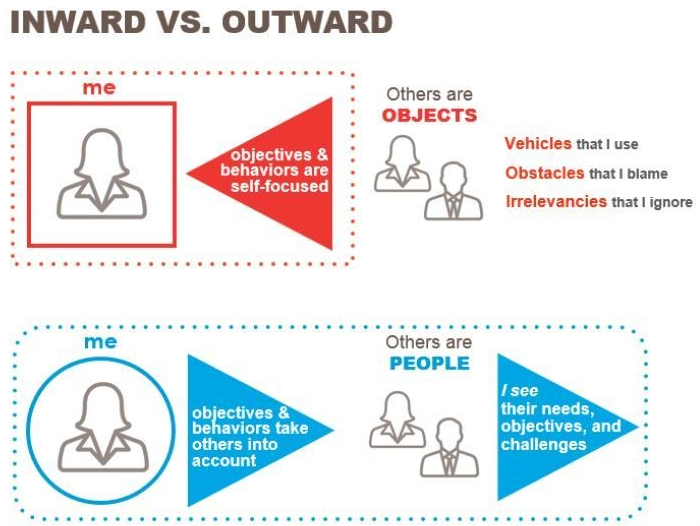
- the piece missing here is that the red mindset shown above is actually entirely appropriate as a way to relate to inanimate objects! it's just unworkable as a way to relate to people or the living world
- the left hemisphere isn't wrong or intrinsically an obstacle, it's just not its job to relate to people (including parts of oneself!)
- so then we might ask "what sorts of exercises might train this aspect, separate from everything else?"
- and it seems that one of the simplest things is going to be something like Alexander Technique, which is a practice for rebalancing the relationship between the brain hemispheres, by practising expanding awareness in each moment (ie about every 3s)
- this also allows inhibiting patterns without suppressing them
- PCT offers a rather straightforward exploration of what coercion is, within the terms of its model, and broadly what an alternative might look like.
- Coercion is the attempt of one control system to control another control system's behavior directly. This occurs both within people and between people—when someone tries to commit to some new behavior, in spite of some resistance, they're engaging in self-coercion.
- This could be contrasted with a different approach to the same situation that takes a basic stance of "I (or this part of me) needs/wants X. I don't know what you (or this other part of me) might do that would satisfy X, but I want to find a way to satisfy it". This stance creates space for creative reorganization, rather than fighting a tug-of-war.
- For more on this, see Internal Trust Dancing case study: EA & relaxation
- 2b? grokking how blame is a confusion; transcending victim mindset
- 3. emotional flashback management / Unlocking the Emotional Brain
- Suppose that someone deeply understands the principles of 1. brain hemispheres / McGilchrist's brain hemisphere model and 2. control systems / Perceptual Control Theory...
- what else might make it difficult to collaborate with them?
- one might be if they've temporarily contracted their awareness around something impersonal, such as when I'm having a Deep Work day coding, and I've recruited all of my brain for modelling the codebase
- this usually requires a bit of meta-awareness and context-shifting, but as long as something isn't treated as load-bearing when it's not, and nobody takes it personally, it's usually a fairly minor issue
- a different element though might be that some aspect of what you try to talk about with them activates some emotional flashback to some moment of unsafety, which generates an acute contracted awareness and then often a compulsion to engage in some defensiveness = protectiveness rather than feeling able to listen or dialogue
- see Dream Mashups for a discussion of this and how to work with it in the moment
- less in-the-moment, there's a need to do some sort of therapeutic process to untangle the system that is hyperactively generating a panic response in a given situation
- some such situations might still be threats of some kind, but the current response heightens the threat rather than neutralizing it
- some such situations might not be threats, but are being tagged as threats by an emotional brain that can't tell the difference (or eg the "same situation" would have been a threat in childhood but isn't now) and it can learn to differentiate
- at any rate, someone who is triggered is going to tend to have trouble being curious
- (although might be able to anyway if they can hold the activation within the expanded awareness of their right hemisphere)
- The implications of Unlocking the Emotional Brain go deeper than just overt trauma though. They provide a scaffold for understanding and respecting our bodyminds as sensemaking systems, such that we can stop trying to stuff the ticket back in the machine and get on with learning and integrating all of our different perspectives.
- This applies internally as well as interpersonally.
- 5. blindspot awareness
- collective blindspots naturally occur in groups of any size from 1 to ∞
- and understanding why blindspot feedback is hard (but possible!) but also how it's possible
- 6. collaboration-compatible meaning-making / Meaningness
- I'm not sure if this one isn't totally covered by the others but it seemed worth including provisionally.
- 7. ??!?
- I like the thing from Book/The 15 Commitments of Conscious Leadership about saying only unarguable things
- 8
- I'm thinking about the Sequence on NNTD and what to write next, and I'm wondering if it might make sense to start with some basics!
- like basically
- what is non-naive trust and why is that important?
- and maybe critique that post of Chloe's that says "assume trust"
- why trust-dancing as a frame?
- a bit about the meta-protocol to make it clear what level this is trying to be on
- related to the obstacle is the way
- > “Perhaps all the dragons in our lives are princesses who are only waiting to see us act, just once, with beauty and courage. Perhaps everything that frightens us is, in its deepest essence, something helpless that wants our love.”
- (from Letters to a Young Poet by Rilke, and/or here)