thinking that rejects other thinking
- status: half-mess, half-genius
- I want to point at a style of thinking that I'll call thinking that rejects other thinking.
- (not sure this is the right name but it's what I'm going with for now)
- It's a hard thing to point at.
- Many have tried to point at thinking that rejects other thinking, in many ways (and with many terms for it) and most of the ways that people try to point at it end up resulting in people (if not the original articulators themselves, then the people around them) ending up engaging in thinking that rejects other thinking about the very concept of thinking that rejects other thinking, despite attempting not to.
- This is unfortunate, not because thinking that rejects other thinking is bad, but because then they miss all the wisdom hiding in whatever other thinking they're dismissing or distrusting because they're seeing it as thinking that rejects other thinking and rejecting it thusly!
- Symmetrically, this is also unfortunate because it makes their own wisdom less accessible to those whose thinking they're dismissing or distrusting.
- On a meta-level, this is furthermore unfortunate because it creates a bunch of muddle around the very thing they're trying to point at, which is an important thing to point at.
- Perhaps, instead of pointing at thinking that rejects other thinking, I will point at what kind of thinking isn't thinking that rejects other thinking.
- Huh—perhaps I already have, by how I wrote the above paragraphs.
- (If you want, you can re-read the above and feel into how I feel satisfied with it as a way of pointing at this kind of thinking while doing something different than thinking that rejects thinking myself. I genuinely wasn't sure, when I started writing this 10 minutes ago, how I'd find a way to do it, and I feel pretty satisfied with how it turned out.)
- But hey, I'm a verbal dude, and while ineffability abounds, I think it's worth spelling this out way more explicitly. So keep reading for that.
- What is thinking that rejects other thinking?
- Essentially, thinking that rejects other thinking is a meta-meme, ie a meme that manages ones' relationship to memes (including itself). This meta-meme functions as follows:
- For a given meme that I hold as important & relevant
- For some particular meme I am perceiving (in my own thoughts or behavior, or in what someone else says or does)
- classify that perceived meme as self or other
- if self, accept & support that thought/utterance/behavior/person
- if other, reject & undermine that thought/utterance/behavior/person
- (in "classify that perceived meme as self or other", "self" isn't the person holding the meme but the meme itself)
- Depending on the object-level meme that the thinking that rejects other thinking meta-meme is using, it might classify other memes as
- either holy (self) or sinful/blasphemous (other)
- either expert opinion (self) or misinformation (other)
- either woke (self) or racist/sexist/etc (other)
- either redpilled (self) or still in the matrix (other)
- either rational (self) or irrational/antirational (other)
- either metarational (self) or rational (other)
- either healthy (self) or unhealthy (other)
- either transformational (self) or counteractive (other)
- either science (self) or woo (other)
- either Game B (self) or Game A (other)
- either paradigm-transcendy thinking (self) or thinking that rejects other thinking (other) 🙃
- either patriotic (self) or traitorous (other)
- (I'd like to break this one down into a more american-flavored one and a more communist-flavored one, like "you said a thing that goes against The Party")
- There are also of course more symmetrical pairs, although these are in some ways less interesting, because the two parties essentially are viewing each other in the same terms, so there's less frame shear
- either capitalist (self) or communist (other)
- either communist (self) or capitalist (other)
- either left-wing (self) or right-wing (other)
- either right-wing (self) or left-wing (other)
- More than half of the above are examples of thinking that rejects other thinking that I have myself experienced from the inside.
- From the inside, sometimes it feels like these simple categories/tags summarize the experience fairly well. Other times it feels more just like a sense of
- "these people don't understand [something important] [and that's a threat]"
or - "I just had a thought/feeling/behavior that some other part of me needs to disown and prevent [because it'll lead to rejection or some other hostility or problem]"
- Those common examples are some large worldview-related examples, but it's also totally possible to have this sort of response just based on reading some book and then encountering some thought (perhaps yours, perhaps someone else's) that seems incompatible with something that's now obvious to you after reading the book.
- It's important to be able to broadly recognize what memeplexes and meta-memes are generating a given thought or behavior, but the "self/other" classification is very limiting, and tends to produce an attitude of defending oneself or one's beliefs, which makes it hard to listen, which makes it hard to learn.
- < something about buy-in >
- The shift out of thinking that rejects other thinking and into being able to learn from everyone comes from internalizing & generalizing coherence empathy—recognizing that everything everyone thinks (and does) somehow actually makes obvious sense from some perspective (which is the perspective from which they thought it or did it). If it doesn't make sense to you, there's something you don't understand.
- Importantly, this applies to your own behavior too—you think things and do things for reasons you are not conscious of, and there's a sense to it even if it seems senseless.
- If you ever find yourself saying about anybody's behavior "that didn't make sense", see if you can find a way for it to make sense to ask "what sense did that make?"
- And if you can't, well, that makes sense.
- In general, someone who looks naive to you knows something you don't.
- You usually know something they don't, of course, as well, which is why they look naive to you.
- But if your relevant knowledge was properly a superset of theirs, it would be straightforward to convey what you know to them, and let's face it—that's rarely the case for anything interesting.
- (I'm not just talking about factual knowledge but embodied or relational knowledge as well, or knowledge of what-it's-like-to or how-it-feels-to or what-happens-when)
- (It's worth noting that while being unable to convey what you know to them is a strong sign that they know something you don't, the mere fact of having had a conversation that appears to result in you conveying something to them does not prove that you actually had such a superset—more common is that the person you're talking to mentally suppresses some of their own knowings that would produce objections that you don't understand and wouldn't be able to respond effectively to. This requires some amount of knowing what they know, but can also occur for many reasons ranging from charisma to social power to frame battle skill.)
- Why does this matter?
- Suppose that someone reads a new book about communication, and tries to apply it in their relationships. Whether these are romantic relationships, business relationships, family relationships, or whatever, there can often be a tendency in these situations to try to get buy-in from the other person to adopt the same framework.
- This has an thinking that rejects other thinking quality - it says "we all need to do XYZ in order to be able to trust each other"
- Culture change efforts at companies often look like this, whether it's
- a subgroup of the company trying to do their own thing and meeting resistance from peers
- the CEO going "guys, we should do New Management Technique 5000™ now!"
- a third-party group coming in with their model that they try to impose
- The level of culture change I'm interested in though is shifting things on the meta-meme level though, moving from thinking that rejects other thinking to coherence empathy-based thinking.
- This means that if I were to be working with a company on their culture change efforts, it creates a kind of paradox where I would want to convey to people there aspects of the framework that I'm using to approach things, but by default, attempting to convey the framework would tend to create polarization around the very axis that the framework is attempting to highlight.
- This is an obstacle, but the obstacle is the way.
- In some ways, the obstacle is the way is the opposite of thinking that rejects other thinking, in the sense that thinking that rejects other thinking
- ---
- (this page used to be called "ideological thinking" and in the below section it hasn't been renamed)
- A story re the commitments & assumptions
- TL;DR = I used to try to ensure that people were bought into my theoretically-post-ideological memeplex as a prerequisite for trusting them. This is a common and natural tendency, and it's also ideological.
- Something about self-trust
- you, confusing yourself for the ideology, don't trust yourself not to get fooled by other perspectives
- and it's legit to not trust yourself to the extent you can't trust yourself!
- but also note how the thinking that rejects other thinking reinforces this distrust, rather than creating a learning ground for developing more non-naive self-trust
- because by rejecting (etc) all bad thoughts, it encourages compartmentalization which results in experiences of oneself doing things that the rest of oneself doesn't understand (because the compartmentalization means no open communication) which reinforces the idea that one can't be trusted, which justifies the need for an ideological way of thinking
- in some sense the whole thing could unravel like an illusion, once seen through
- and yet it actually doesn't automatically generate self-trust just to know that the reasons you distrust yourself are one attractor and there's another where you wouldn't have to
- you still have to actually reorganize your way of doing it, to get out of the self-reinforcing attractor basin and into a new one
- huh, this somehow maybe relates to the "atheist fear of hell" thing I noticed in Sept 2018
- Why am I feeling good about what I wrote, at the top?
- I managed to do it while embodying a very non-ideological stance. I didn't arouse suspicion or distrust towards thinking that rejects other thinking, but rather said "it's a thing that happens, and when it does everybody involved misses out on some learning".
- Sometimes when people make distinctions, they're trying to highlight 2 or more things that are both beautiful/powerful/meaningful/useful.
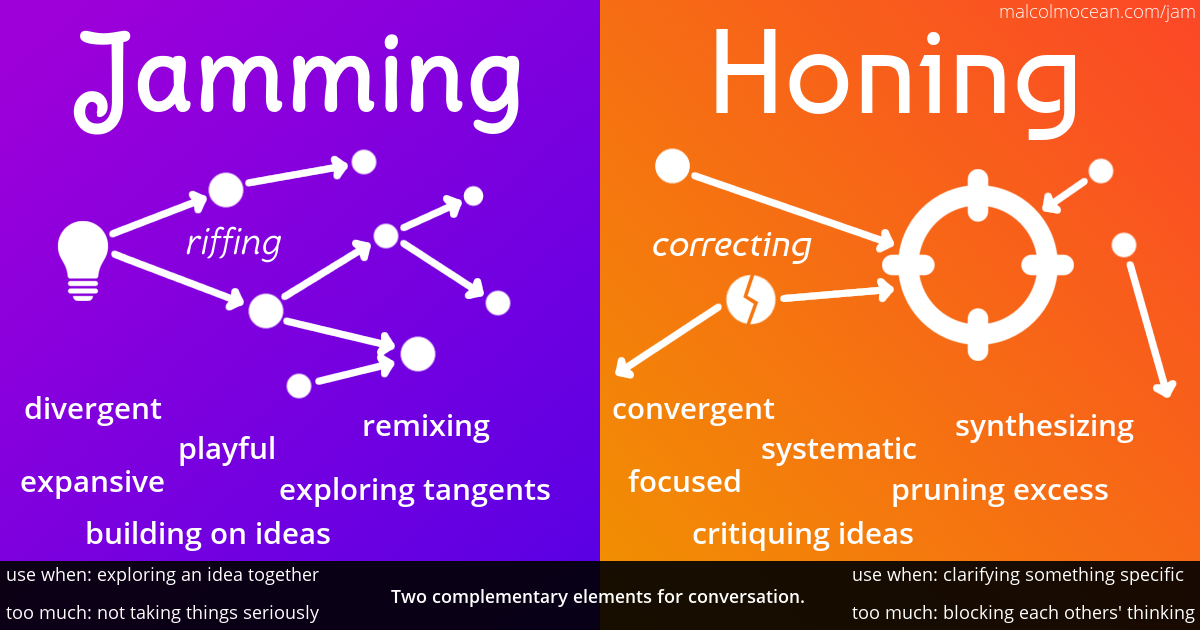
- My honing & jamming blog post is a great example of this. These are two vital aspects of conversation, it says, and the important thing is to be able to tell when you're trying to do one vs the other, on what level of abstraction.
- Many frameworks that have more than 2 are also like this (eg the enneagram or many of Venkatesh Rao's excellent 2×2s) but sometimes you'll see something isomorphic to attachment styles, where there's a clear "best quadrant" and "worst quadrant" and two diagonally opposite dysfunctions.
- Other times, when people (including me) introduce a classification system, they do so with the intention of communicating something to the effect of "X is better than Y".
- This comes in many flavors:
- "X good, Y bad"
- "X friend, Y foe"
- "X right, Y wrong"
- "X safe, Y dangerous"
- "X healthy, Y unhealthy"
- "X makes sense, Y is confused"
- "X me/us, Y other"
- "X virtuous, Y sinful"
- "X enlightened, Y delusion"
- "X ingroup, Y outgroup"
- "X halal, Y haram"
- "X beneficial, Y harmful"
- "X functional, Y dysfunctional"
- "X true, Y false"
- "X cool, Y lame"
- or even simply
- "X works, Y doesn't work"
- "try not to do X, do Y instead"
- As the last two elements hopefully make clear, I'm not saying that making such distinctions is inherently ideological.
- That would be literally insane.
- It's a necessary element of not just maintaining ongoing sanity but even simply staying alive to be able to tell the difference between
- a tool that works for some purpose and one that doesn't
- a food that will nourish you from one that will make you sick (whether that's vomit today or goiter in a decade)
- a relationship that is mutually supportive from one that is codependent or abusive
- Anyway, here are some examples from my blog, of posts where I'm distinguishing two things and suggesting that one works better and that therefore people aim to do that one instead of the other one.
- (I later add a third kind of expectation, at which point I kind of implicitly revised anticipations to neutral and this third kind as good)
- I also have a 2×2 diagram in Towards being purpose-driven without fighting myself where one quadrant is awful, two are okay, and the other is amazing 🤩
- These can both be useful kinds of distinctions.
- The second one is the one that generally leads to the thing I'm calling thinking that rejects other thinking.
- However, it's not just others' distinctions that get used ideologically—it can also be some generalization you make from your own experience.
- Huh! dream mashups are kind of this!
- So the "unfortunate" thing I described in the opening paragraphs is that people come up with some great model that maps onto thinking that rejects other thinking and non-thinking that rejects other thinking, and then finds themselves constantly pattern-matching everything as either paradigm-transcendy thinking (self) or thinking that rejects other thinking (other) 🙃
- And as I said, and as will now hopefully be clear to you as well:
- What does thinking look like when it's not ideological?
- Whatever it encounters, including others' ideological thinking, it asks "What wisdom is there in this?" and if it doesn't have space to do that, it focuses on honoring the wisdom that doesn't have space.
- (kind of a transcend & include move)
- bits
- listening & Bohm dialogue
- extreme example is The Crusades
- tweets about people coercing themselves into "noncoercion"
- related stuff
- obviously relates to David Deutsch's model of static & dynamic societies, irrational & rational memes
- sort of a there is but one duality - between everything and nothing vibe to this
- this whole thing undoubtedly relates to brain hemispheres
- huh, I feel like I'm almost coming back around to a viewpoint that says
- "no, actually, it's all "being on truth's side"—but you can't get the whole truth of anything social without listening & parallaxing"
- (is this 🦋 Kegan 6?)
- ah yeah, it's like... mathematicians being all on truth's side are on the side of a truth any one of them could find, but socially being on truth's side requires acknowledging the limitations of your own viewpoint
- Joel & Diana have a bunch of stuff on this in The Guru Papers and maybe even moreso in the first chapter of The Passionate Mind Revisited
- > If we are either agreeing or disagreeing, then we're not listening, for to listen there must be an openness, an innocence, a temporary suspending of judgment and the familiar, so that the fresh can possibly come in.
- then ch2 (which is Belief)
- > Since closed beliefs are counter to survival in a rapidly changing, dangerous world, let's not initially ask if a belief is right or wrong, good or bad, life-furthering or -destroying, constructive or destructive, but rather just what it means to have closed beliefs that do not change with changing times or changing evidence.
- (here I perhaps diverge somewhat from them, in that I think the issue isn't times or evidence at all)
- > Beliefs that are fixed and unchangeable not only often result in violence, but they can trigger a potential state of internal violence
- > Is defense that different from attack?
- (oh shit, damn, they hit protectiveness is damage control)
- huh, they also seem to think that "knowing something firsthand" doesn't cause closed beliefs, but that seems patently false and emotional flashbacks are a very obvious example of that!
- outtakes
- These last two are important, because it's easy to classify the others as moralistic dualism. And I would agree—dualism is a confusion and (for many purposes) doesn't work...
- many other terminologies end up mapping onto the same thing
- (good & bad as useful concepts, but for wayfinding, not for classifying, or something - see Mark's writing on this)
- damn I don't quite actually believe this thing I tried writing
- > But if your relevant knowledge was properly a superset of theirs, it would be easy (practically effortless, though it might take a bit of time) for you to just explain to them what they don't yet understand, and they wouldn't have any argument with what you were saying—every point you made would follow obviously from the previous one.
- it seems like in fact this isn't clear, because you might have a response to some objection they raise, but you just didn't know they were going to raise that objection so you made a leap too big
- but if you don't have a series of responses to every single objection, that eventually produce a cascade of obviousness, then indeed, your knowledge is not a superset
- and also, you can't get there just by explaining
- they might need to have a completely different set of experiences
- and have those experiences persist for some period of time that could literally be months or years
- (in order to trust that it's real)

20 linked references
September 15th, 2023
- Malcolm & Romeo discuss thinking that rejects other thinking and many related topics: youtu.be/v3-4RxWlx2A
November 13th, 2021
- I think this connects to the defensiveness = protectiveness thing & thinking that rejects other thinking
November 5th, 2021
- Romeo Stevens call re thinking that rejects other thinking (recorded)
- verb-heavy languages are better at not making as many abstraction-level errors
- less modular
- but more context-preserving
- because more process-based
- choice of loss function
- R > this goes doubly true if the thing you're talking about is something that's not able to be cached
- what's not able to be cached?
- R > when your compression libraries get really good, you start running into the same problems as the daoists, but you can't explain it to anyone
- R > Twitter is closer to a market [than Fb]. Markets approach a frontier, then start being unpredictable and interesting.
- Why...? Clearing mechanism... which is same as FB but faster? critical threshold?
- M > twitter is a market for remixable ideas, not just ideas
- because QTs and smallness
- M > different network structure
- twitter is self-organizing in terms of followers etc
- FB you're interacting with whatever subset of your friends gets FB the most ad-revenue
- R > oh and twitter has alts etc
- and those different profiles are ignoring different things
- R > ignoring type errors is one of the ways that the mind is getting a bunch of stuff done, so it ignores the fact that it's ignoring type errors
- internal economy of the mind
- a bunch of shady exchanges, but they know locally which ones are fine, but run into problems when they try to scale
- good critique by R re legal theory, apportioning costs
- R > novel definition of individual
- = a system that has privileged access to the intent about that system
- one of the proper purviews of legal theory in a good society would be investigating this question
- the phenomenon Beeminder talks about, of if your error system reports something that doesn't require immediate action, the immediate action is to fix the false positive
- R > buddhism - suffering is such an error system
- M > maps onto David Deutsch's irrational memeplex
- thinking that rejects other thinking is an error-correcting meta-meme, but it can't listen & can't synthesize
- memetic immune system
- R > you don't want things to scale too fast
- part of you knows more about the world than another part
- but the other part needs to ignore that knows-more part in order to get the understanding it needs
- M > the word organize
- R > "cardiovascular health of a tribe" might be a reasonable concept
- R > double entendre in "active ignorance"
- recognizing that it's happening, help the process along
- similar to shielding children from things
- "if they already knew how to hold those truths at the same time, they'd already be there. they're not, so don't try to force it"
- you can't force someone to do something they don't know how to do
- pointing a degree of freedom out to someone is not the same as grabbing their arm and moving it along that degree of freedom
- R > crazy wisdom
- M > seems to me that thorough awakening would be very viral (though maybe still slow)
- R > modern stuff can possibly record the whole path better, so people aren't just going by what the teacher said
- channel 9 (as working name for a channel of wholesome interactions (business meetings, therapy sessions, etc) that anyone in the world can get a taste of)
November 4th, 2021
- hey can maybe do this now that I've published the thinking that rejects other thinking piece
- I feel like some of what I'm trying to say would benefit from introduction to the mindset & cultural platform shift post talking about the H2/H3 distinction, but it's extremely slippery and could so easily veer into thinking that rejects other thinking
September 4th, 2021
16:00 - starting a kind of writing block › looking at Sequence on NNTD › saw this page: how my thinking has transcended the Upstar… › both the C&As and the circles maps are CC BY-NC-SA, so I …
- man, the circles are so good, but presenting them tends so strongly towards reifying a dualistic H2 vs H3 frame which in turn results in thinking that rejects other thinking
- I feel like some of what I'm trying to say would benefit from introduction to the mindset & cultural platform shift post talking about the H2/H3 distinction, but it's extremely slippery and could so easily veer into thinking that rejects other thinking
- And there's something very potent about pointing at these general principles as they apply to everyone, not getting fixated on the implications for people at the very leading edge of group coherence stuff. Those people will probably be able to see how this stuff all applies to their work anyway.
- If I were to do this though, what would some approaches be?
- One approach would be basically trying to outline the elements kind of like I was doing with this question: What are the components or dimensions required for collaborative culture?
- A different approach would be to compare & contrast like 4 different models of the mindset/culture shift
- eg
- 2. dev psych models
- David Chapman's complete stance (kinda also different)
- Kegan stages (?)
- integral/SD stages (?)
- 3. biz psych mindsets
- below/above the line
- inward/outward mindset
- 4. cultural models
- Robert Gilman's model
- (see many things listed under Pointing at the shift / mindset pairs / ways of being)
- A third approach to this would be something like that piece I started writing in smmo
- That's a fun and very analytic & rigorous piece, and it would be fun to flesh it out and have someone critique it and to refine it. But I don't know if I'm going to be in the mood to work on it more anytime soon.
August 28th, 2021
- on a call w people talking about The Master and his Emissary brain hemispheres model, and struck by how easy it is to pattern-match thinking that rejects other thinking onto the discussion of limitations of the left hemisphere
- although in principle McGilchrist's brain hemisphere model could allow us to get less dogmatic and judgmental about certain patterns of thought, because they can be understood as good functioning of a system rather than as intrinsically problematic
- Michael Ashcroft > "thinking isn't bad, but going thinky, ie losing track of the rest of the world to have a thought, is bad"
August 1st, 2021
What are the components or dimensions required for collab… › I had an old model back in like 2015 or 2016 about this, … › and they were things like › something about knowing the difference between coercive c…
- (which I would now say ends up turning into thinking that rejects other thinking)
July 29th, 2021
- relatedly: the paradox of trying to transcend thinking that rejects other thinking
June 28th, 2021
oh! I could write up a #blogpost on commitment/choice is … › my friend asked me what I thought of the 15 commitments o…
- thinking that rejects other thinking relates to this
meta-memetic principles of the NNTD
- see thinking that rejects other thinking for the notion of meta-memes
June 22nd, 2021
- Worked more on thinking that rejects other thinking
June 17th, 2021
- #2tweet bit about thinking that rejects other thinking (though framing ideo vs "X" kinda defeats the point)
- the difference between ideological thinking and X thinking is that ideological thinking sees everyone and everything and classes as {me, not-me} and distrusts all not-me
whereas X thinking asks "how can I integrate this?"- (not just "distrusts" but "is guarded towards" - defensiveness = protectiveness)
- In principle, GameB, metamodernism, Integral Yellow/Teal, etc, are non-ideological.
But it's entirely possible, and in fact the default in our current era, to get ideological about being non-ideological. - This is both an interpersonal phenomenon as well as an internal psychological one. One's apparent inner ideologues get sent to the gulag—err, shadow.
- It's natural to want to know what common ground there is for trusting each other. The issue is the binary classification into {self, other}.
- To be clear, I'm not talking about people here, but about the meme of the ideology itself. An ideological meme recognizes itself in other people and attempts to colonize them if not already there.
- Also to be clear, there are memes that will fuck you up, and you're wise to do things to avoid that.
- QT the paradox