McGilchrist's brain hemisphere model
- This has been a major topic of inquiry for me starting in February 2019, continuing through February 2020.
- Here are some pages on the topic:
- Hemispheres Linkpost (half-finished draft)
- left hemisphere & right hemisphere (for backlinks)
- See also:
- To write
- Other people writing about brain hemispheres
- here's someone also doing a thread:
24 linked references
Books or essays that answer each others' questions
- Finite and Infinite Games by James Carse seems to me and others to be pointing at two stances of the world that map onto McGilchrist's brain hemisphere model as described in The Master and his Emissary
July 9th, 2023
- thread on McGilchrist's brain hemisphere model and Vajrayana
March 16th, 2023
- from a private convo
- context: this tweet by Divia Eden
- > I also think a concept that babies get very early if they aren’t born with it is something like attunement. Which I could unpack a lot more but I posit that the full real deal is an I-thou thing, and the I-it orientation blocks information flow
- my friend Alex commented
- > Hmmmmm so according to Buber a parent (and in fact the whole world) is always a Thou to the infant, since I-It only occurs after the I splits from the world as a separate entity. I-It relationships are composed of I + It put together while I-Thou is fundamental. But equating attunement
with I-Thou feels a little strange; I want to say something more like attunement is a specific I-It move that will likely make you more open to flashes of I-Thou. Buber says that I-Thou exists outside of space and time, and I definitely wouldn’t say the same for attunement. Definitely happy to say more if people are interested. - > I like to think of I-Thou as the points at which one actually meets reality. When one is viewing the world according to I-It, one’s conscious mind is disconnected from reality; it has the illusion of control, but connection to the world has been replaced by a set of objects that it manipulates according to its “pre-existing programing.” While in I-It, the environment can consciously impact you only through your preexisting frameworks. But in I-Thou, one sort of drops the barrier/separation between oneself and one’s Thou (could be nature, a person, an idea/spirit, etc.) and, by entering into direct relation, allows oneself to be changed in a way beyond one’s control; it is beyond your control precisely because you have met your Thou with your “whole being”, and so there is no part of you left to observe or judge or decide what changes will occur.
- > I don’t think one has to be in I-Thou with an infant in order to be attuned; you could still hold part of yourself back to observe/monitor, but sometimes, an infant might call upon your whole being and change who you are, and those moments could be considered I-Thou.
- > Buber says that “causality has unlimited reign in the world of It”, and I think what he means is that in the world of “It”, the laws of physics or w/e apply, while the self-conscious “I” is just an observer. But in I-Thou, by stepping out of an observer frame and into relation, one has full freedom of will as part of the world, though it will feel more like you just acted as you were called to act rather than making choices, since making choices requires I-It: stepping back and separating oneself from the world in order to evaluate various projected futures
- > This sort of reminds me of what CS Lewis said about how prayer and determinism fit together; time is an illusion (an I-It construction), and all of Eternity is contained within the present moment. It is not that God hears prayers and then changes the course of reality, but rather that God---in Eternity (i.e. outside of time)---hears all prayers at once and creates the world in response to those prayers. Incidentally, Buber says that God is the Thou that can never become an It… i.e. one can relate to a person either directly or as an object, but it is impossible to relate to God as an object; if one tries to do so, it is an idol rather than God whom one is relating to.
Podcast summaries
- Keywords - brain hemispheres McGilchrist's brain hemisphere model Perceptual Control Theory barn-raising Internal Family Systems blindspot blindspot feedback is hard (but possible!) it's only possible to be rational within a frame make shared or different frames explicit Change doesn't just happen Intend productivity Intend Philosophy & Paradigm how to think about goals PCT internal conflict much of human collaboration scales sublinearly but it's possible to scale superlinearly What are the components or dimensions required for collaborative culture? Geoffrey West Questions for teasing apart the concept of commitment commitment/choice is a confused way to relate to stances/mindsets Everyone is basically living in a dream mashup of their current external situation & old emotional meanings everyone is constantly overgeneralizing acceptance isn't the same as acceptance safety self-trust right hemisphere left hemisphere self-energizing
With Jonny Miller — Podcast with Jonny Miller Transcript › Outline of ideas discussed. (I'm M, Jonny is J)
- 1:02:27 - 1:10:32 - Why is Ian McGilchrist's brain hemisphere model valuable? McGilchrist's brain hemisphere model brain hemispheres much of human collaboration scales sublinearly but it's possible to scale superlinearly What are the components or dimensions required for collaborative culture? Geoffrey West Questions for teasing apart the concept of commitment commitment/choice is a confused way to relate to stances/mindsets
December 12th, 2021
- Matt Brockwell says that McGilchrist's brain hemisphere model is supported by Nobel Prize-winning neuroscientist Eric Kandel, who wrote a book called
November 13th, 2021
- the human may be able to understand every phenomenon, and in that sense be a universal explainer
- but it can't have every experience, or see the world from every perspective
October 23rd, 2021
- Matt Brockwell > apophatic knowledge
- knowledge of what to block out
September 7th, 2021
convo w Riccardo Volpato › open questions › What are the components or dimensions required for collab…
- is Self an additional item here? or is it actually covered under McGilchrist's brain hemisphere model + flashback/blindspot stuff?
August 28th, 2021
- although in principle McGilchrist's brain hemisphere model could allow us to get less dogmatic and judgmental about certain patterns of thought, because they can be understood as good functioning of a system rather than as intrinsically problematic
August 1st, 2021
What are the components or dimensions required for collab… › current/new model as of sometime in 2021
- these two mindsets described by Arbinger Institute might as well just be pointing at the two hemispheres as basic modes of attending
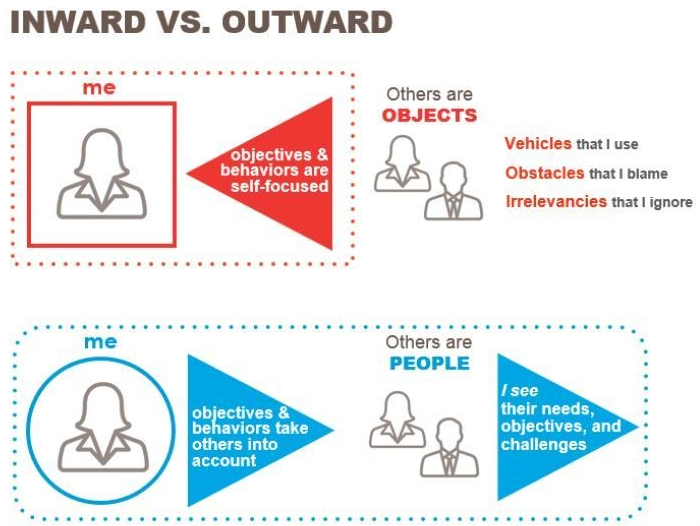
- the piece missing here is that the red mindset shown above is actually entirely appropriate as a way to relate to inanimate objects! it's just unworkable as a way to relate to people or the living world
- the left hemisphere isn't wrong or intrinsically an obstacle, it's just not its job to relate to people (including parts of oneself!)
- so then we might ask "what sorts of exercises might train this aspect, separate from everything else?"
- and it seems that one of the simplest things is going to be something like Alexander Technique, which is a practice for rebalancing the relationship between the brain hemispheres, by practising expanding awareness in each moment (ie about every 3s)
- this also allows inhibiting patterns without suppressing them
March 9th, 2021
- connects to both to brain hemispheres / McGilchrist's brain hemisphere model and to Coherence Therapy & Unlocking the Emotional Brain
- it basically describes the functional application of the very same rapid-response brain systems that cause trauma flashbacks / dream mashups
Malcolm podcast appearances
List › November 5th, 2021 on Curious Humans with Jonny Miller › The Art of Asking Questions, Incentivising Negative Effor…
February 18th, 2021
call with Qiaochu, co-reading PJ Eby's Self-Help Myth › Q > something feels bad to be made out of thermostats! › Q > uhghhhhh... I'm imagining my body made out of thermos… › M > yeah, blows my mind that all these models seem good
September 23rd, 2020
Maybe at some point I'll write something for LW about bra… › Michael "Valentine" Smith reminded me of this old LW post…
- (it summarizes Ramachandran's model, which is less potent than McGilchrist's brain hemisphere model)
July 16th, 2020
- this tweet (a couple others in thread) relates to individuation & McGilchrist's brain hemisphere model
July 13th, 2020
- I need a new page like scientism or something for talking about something that's also related to McGilchrist's brain hemisphere model...
- as a claim it would be something like
- and the reason for them being mostly garbage would be in part because they've been forced to come up with science-sounding explanations so they say things like "it's electromagnetic waves"
- (iirc I have an an article saved somewhere (from my pre-roam days) that is about this)
- anyway, a related tweet
June 22nd, 2020
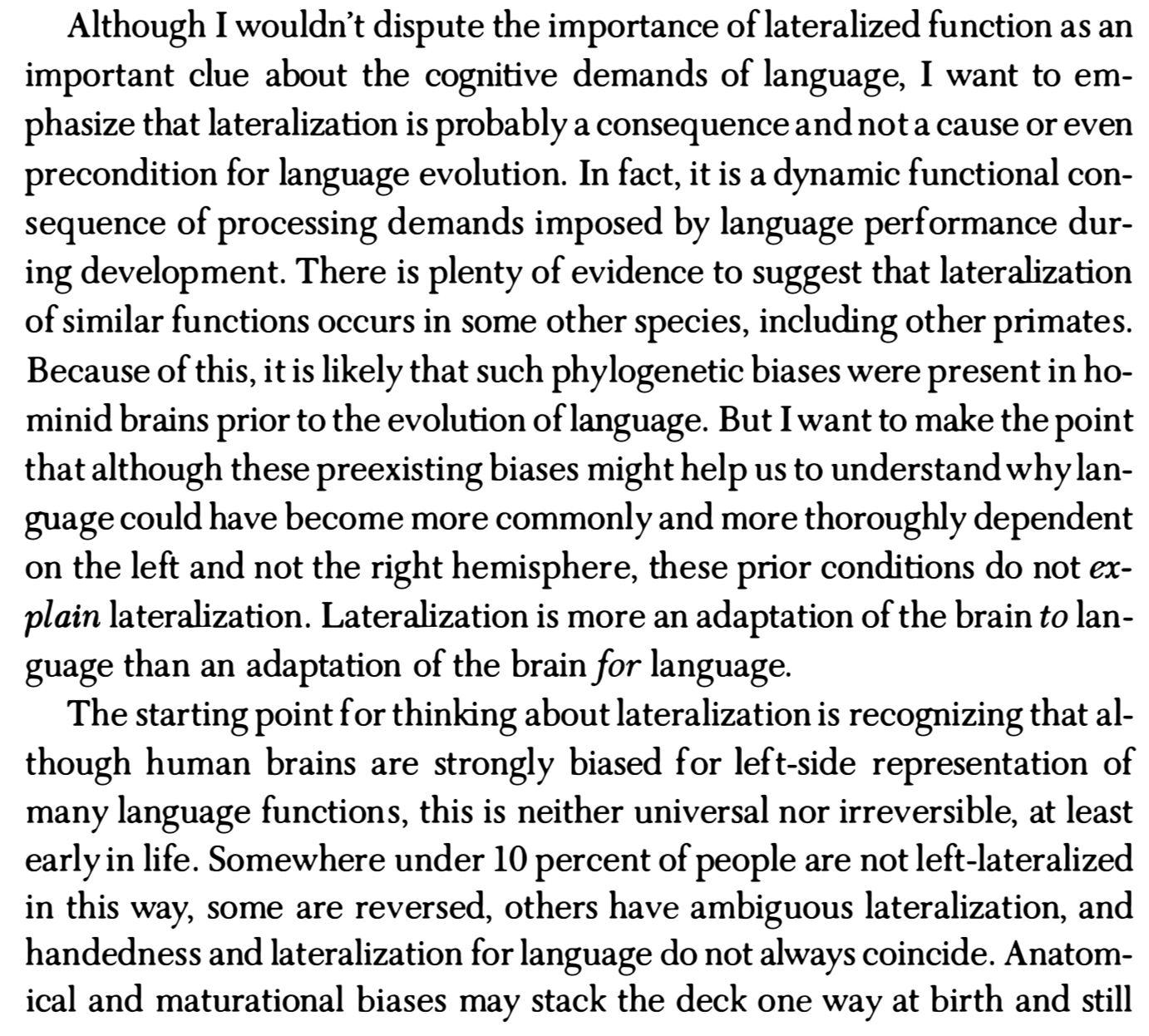
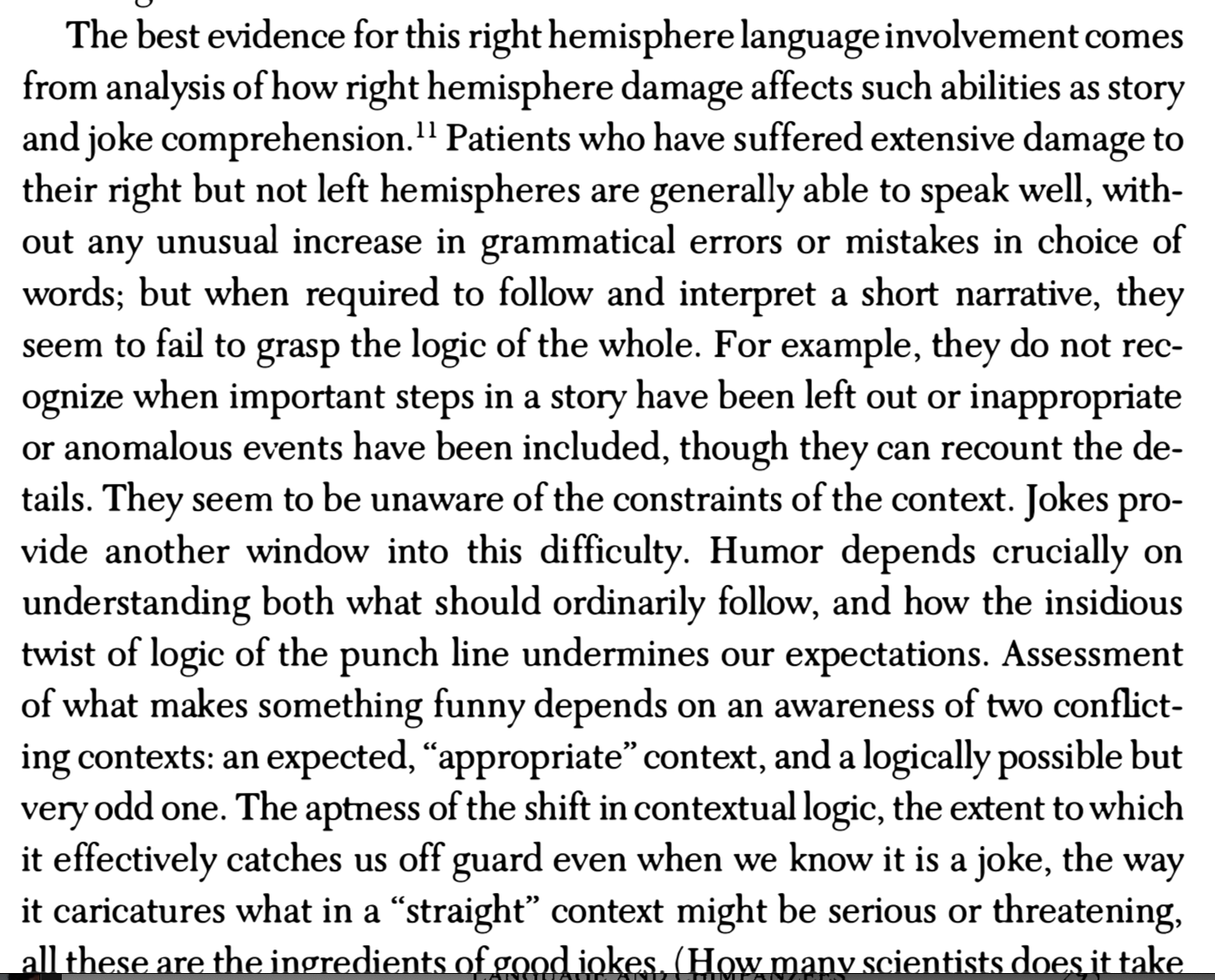
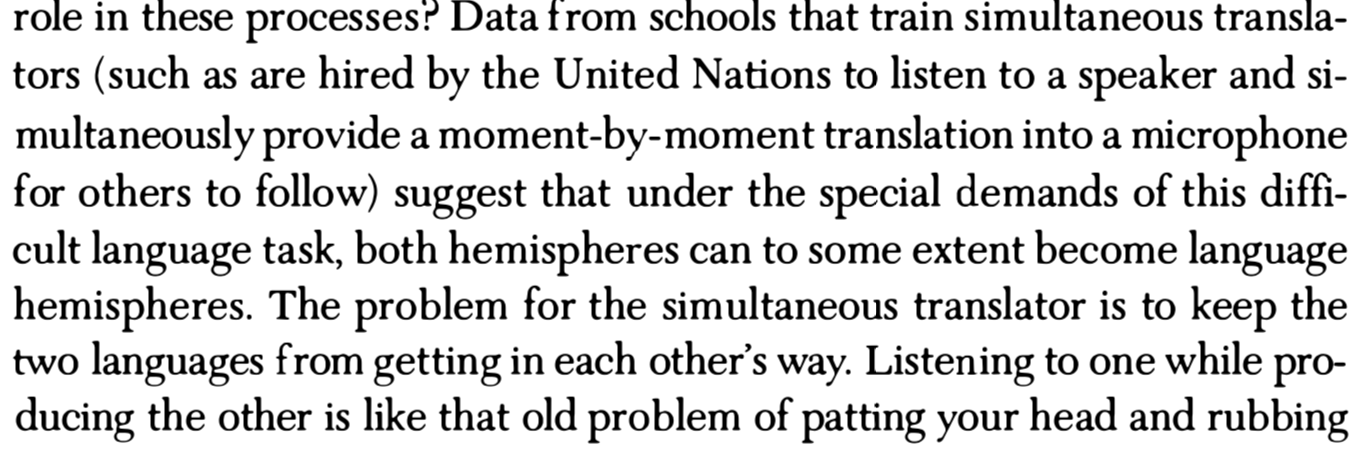
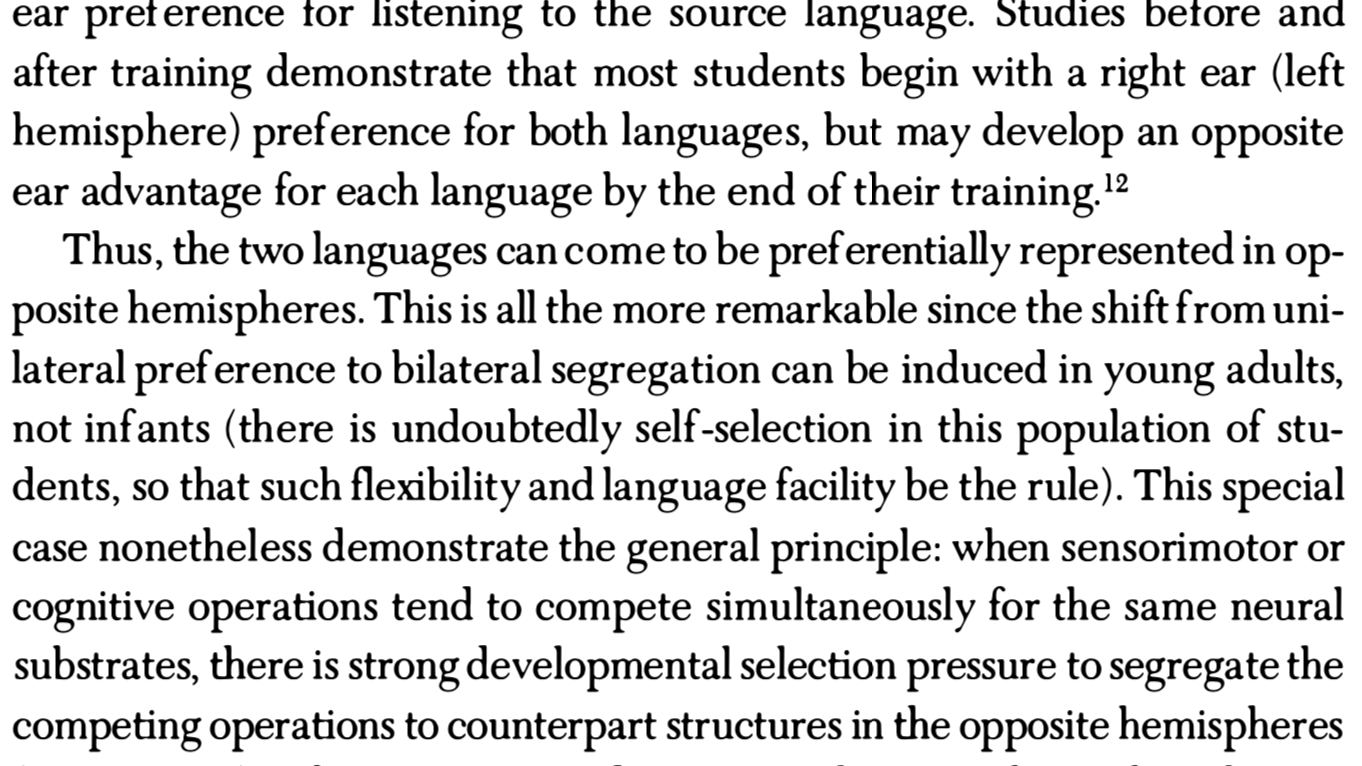
- Mark Lippmann shared these excerpts with me from Symbolic Species by Terrence Deacon, that relate to McGilchrist's brain hemisphere model
Hemisphere Dharma
- I'm assuming if you've read this that you already have general sense of McGilchrist's brain hemisphere model and you have some sense of RH consciousness and want to know how to shift your locus of beingness so that the RH is wisely deploying the LH, rather than the LH running the show. I'm neither going to explain the model from scratch nor justify the shift on this page.
- grasping & grokking McGilchrist's brain hemisphere model
- so that your left hemisphere has at least a theoretical model of where it fits and its own limitations
- note that it has a tendency to take credit for stuff the RH does
- (case study of me thinking "I wouldn't be that dumb" when reading about RH-stroke patients saying bizarre shit like "that arm [their arm] isn't mine, it's my mother's", and then realizing that the very part of me that was confidently asserting "I wouldn't be that dumb" was exactly the part that would be.)