What are the components or dimensions required for collaborative culture?
- would be interesting to also list components that aren't required
- Eric > in particular, things that people think are required but
- are more incidental
- are actually in the way
- on a totally different level of abstraction:
- doing what feels good
- meta-communication
- finding win-wins
- perspective-taking
- sitting with unknowns & discomforts
- orienting towards shared train of thought
- current/new model as of sometime in 2021
- these two mindsets described by Arbinger Institute might as well just be pointing at the two hemispheres as basic modes of attending
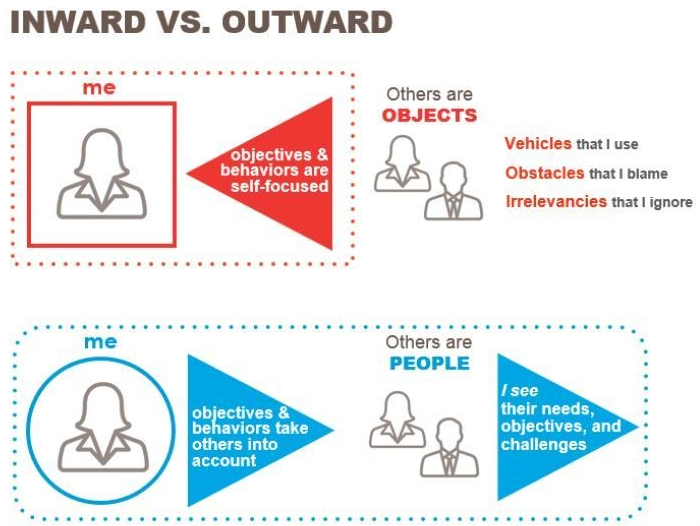
- the piece missing here is that the red mindset shown above is actually entirely appropriate as a way to relate to inanimate objects! it's just unworkable as a way to relate to people or the living world
- the left hemisphere isn't wrong or intrinsically an obstacle, it's just not its job to relate to people (including parts of oneself!)
- so then we might ask "what sorts of exercises might train this aspect, separate from everything else?"
- and it seems that one of the simplest things is going to be something like Alexander Technique, which is a practice for rebalancing the relationship between the brain hemispheres, by practising expanding awareness in each moment (ie about every 3s)
- this also allows inhibiting patterns without suppressing them
- PCT offers a rather straightforward exploration of what coercion is, within the terms of its model, and broadly what an alternative might look like.
- Coercion is the attempt of one control system to control another control system's behavior directly. This occurs both within people and between people—when someone tries to commit to some new behavior, in spite of some resistance, they're engaging in self-coercion.
- This could be contrasted with a different approach to the same situation that takes a basic stance of "I (or this part of me) needs/wants X. I don't know what you (or this other part of me) might do that would satisfy X, but I want to find a way to satisfy it". This stance creates space for creative reorganization, rather than fighting a tug-of-war.
- For more on this, see Internal Trust Dancing case study: EA & relaxation
- 2b? grokking how blame is a confusion; transcending victim mindset
- 3. emotional flashback management / Unlocking the Emotional Brain
- Suppose that someone deeply understands the principles of 1. brain hemispheres / McGilchrist's brain hemisphere model and 2. control systems / Perceptual Control Theory...
- what else might make it difficult to collaborate with them?
- one might be if they've temporarily contracted their awareness around something impersonal, such as when I'm having a Deep Work day coding, and I've recruited all of my brain for modelling the codebase
- this usually requires a bit of meta-awareness and context-shifting, but as long as something isn't treated as load-bearing when it's not, and nobody takes it personally, it's usually a fairly minor issue
- a different element though might be that some aspect of what you try to talk about with them activates some emotional flashback to some moment of unsafety, which generates an acute contracted awareness and then often a compulsion to engage in some defensiveness = protectiveness rather than feeling able to listen or dialogue
- see Dream Mashups for a discussion of this and how to work with it in the moment
- less in-the-moment, there's a need to do some sort of therapeutic process to untangle the system that is hyperactively generating a panic response in a given situation
- some such situations might still be threats of some kind, but the current response heightens the threat rather than neutralizing it
- some such situations might not be threats, but are being tagged as threats by an emotional brain that can't tell the difference (or eg the "same situation" would have been a threat in childhood but isn't now) and it can learn to differentiate
- at any rate, someone who is triggered is going to tend to have trouble being curious
- (although might be able to anyway if they can hold the activation within the expanded awareness of their right hemisphere)
- The implications of Unlocking the Emotional Brain go deeper than just overt trauma though. They provide a scaffold for understanding and respecting our bodyminds as sensemaking systems, such that we can stop trying to stuff the ticket back in the machine and get on with learning and integrating all of our different perspectives.
- This applies internally as well as interpersonally.
- 5. blindspot awareness
- collective blindspots naturally occur in groups of any size from 1 to ∞
- and understanding why blindspot feedback is hard (but possible!) but also how it's possible
- 6. collaboration-compatible meaning-making / Meaningness
- I'm not sure if this one isn't totally covered by the others but it seemed worth including provisionally.
- 7. ??!?
- I like the thing from Book/The 15 Commitments of Conscious Leadership about saying only unarguable things
- 8
- todo - include "layering"
- another model from August 23rd, 2022
- Welcoming Everything
- being in the unknown together
- being able to invite others into the unknown with you
- not empathy in an emotionally resonant sense, but seeing how the world looks from their vantage point - non-empathetic perspective-taking
- though also coherence empathy
- can my perspective safely include theirs?
- theory of mind vs situational reasoning
- convo attention management more RHem
- parallel processing
- ~dynamic facilitation
- surrendered
- "So everything… what now?"
- relates to Quaker convos
- times I've tried this
- 2015: my old 2015 What are the components or dimensions required for collaborative culture? (which I probably see very differently now)
13 linked references
Cointelligence R&D Lab Proposal
Measuring progress › Older thoughts here: › Let's differentiate lead & lag measures: › Lead measures would be evolving, but might include: › developing theoretical and pragmatic answers to relevant …
February 17th, 2022
- my old 2015 What are the components or dimensions required for collaborative culture? (which I probably see very differently now)
- what is it? it's not just a secret, there's a capacity involved too
- what is the core that needs to be nurtured until it's strong enough the the trappings can be stripped away?
- 1. not being subject to the majority of one's own thoughts
- is that necessary? I imagine someone in H3 who is subject to most of their own thoughts. It's more like H1
- is it sufficient? No... you'd also need...
- 2. holding others as beings with subj & obj (not necessarily those terms)
- ...this implies that much of your interaction with someone can just be with those patterns and the patterns aren't them
- is that necessary? I imagine someone in H3 who doesn't hold others this way... my simulation suggests that the person is at least somewhat judgmental
- is it sufficient? I imagine someone with both 1 and 2, who is not in an H3 mindset. They might also need...
- 3. a desire to understand and empathize with others' experience, and a capacity to do so
- is this necessary? yes, otherwise the person would be cold and disconnected
- is it sufficient? I imagine someone with all three, who is not in an H3 mindset...
- 4. growth mindset, including for others, and probably quite a lot of it
- ...arguably #2 contains this, but if we're strict then it doesn't
- is this necessary? yes, otherwise it would produce either despair or elitism
- is this sufficient? I imagine someone with all four, who is not in an H3 mindset...
- Abstractly, it's hard to imagine someone with all four who is not in an H3 mindset.
- Do I *know* anyone who has all four of these capacities, who is not in an H3 mindset?
- Thinking about these people in general it seems that there is a fifth thing, which is the main thing lacking in most circles:
- 5. a model of the main pattern dynamics and the ability to interface with them constructively
- is this necessary? maybe not in a world where everyone grows up H3y, but for now certainly and probably even still then
- is this sufficient? It feels important to note that this needs to be not just a conceptual model but a working model that can be used in the heat of things
Podcast summaries
- Keywords - barn-raising collecting barn-raising resources metaphor meta-team meta-vision Goal-Crafting Intensive Intend Philosophy & Paradigm Intend Philosophy & Paradigm Intend Philosophy & Paradigm me as project advisor / biz consultant / design jammer / co-visioner steward ownership What are the components or dimensions required for collaborative culture? Self-Organized Criticality Everything is a Remix how do we arrange the world so that I get to eat bananas in Canada and everyone is satisfied with the arrangement? UBI
- Keywords - brain hemispheres McGilchrist's brain hemisphere model Perceptual Control Theory barn-raising Internal Family Systems blindspot blindspot feedback is hard (but possible!) it's only possible to be rational within a frame make shared or different frames explicit Change doesn't just happen Intend productivity Intend Philosophy & Paradigm how to think about goals PCT internal conflict much of human collaboration scales sublinearly but it's possible to scale superlinearly What are the components or dimensions required for collaborative culture? Geoffrey West Questions for teasing apart the concept of commitment commitment/choice is a confused way to relate to stances/mindsets Everyone is basically living in a dream mashup of their current external situation & old emotional meanings everyone is constantly overgeneralizing acceptance isn't the same as acceptance safety self-trust right hemisphere left hemisphere self-energizing
- 38:04 - 42:59 - How can culture aid the creation of adults with agency? what is culture? land value tax two people adjusting behavior based on each other leading to multiple stable attractors doing community well What are the components or dimensions required for collaborative culture? how do we make groups with the union of their individual wisdoms rather than the intersection of their individual wisdoms?
With Jonny Miller — Podcast with Jonny Miller Transcript › Outline of ideas discussed. (I'm M, Jonny is J)
- 1:02:27 - 1:10:32 - Why is Ian McGilchrist's brain hemisphere model valuable? McGilchrist's brain hemisphere model brain hemispheres much of human collaboration scales sublinearly but it's possible to scale superlinearly What are the components or dimensions required for collaborative culture? Geoffrey West Questions for teasing apart the concept of commitment commitment/choice is a confused way to relate to stances/mindsets
December 29th, 2021
- this question, and how the elements relate, is sort of discussed in a thing I'm working on writing today, trying to reintegrate the concept of choice in the wake of commitment/choice is a confused way to relate to stances/mindsets
- google docs link (currently not public)
- the main element incorporated so far is expanding awareness
November 26th, 2021
- basically covered under What are the components or dimensions required for collaborative culture?
October 26th, 2021
- re Dimensions of Growth and also What are the components or dimensions required for collaborative culture?, although it's not exactly about either of those, the Ultraspeaking folks seem to have a really detailed model of a bunch of vibing skills

September 7th, 2021
- is Self an additional item here? or is it actually covered under McGilchrist's brain hemisphere model + flashback/blindspot stuff?
September 4th, 2021
16:00 - starting a kind of writing block › I feel like some of what I'm trying to say would benefit … › If I were to do this though, what would some approaches be?
- One approach would be basically trying to outline the elements kind of like I was doing with this question: What are the components or dimensions required for collaborative culture?
August 1st, 2021
- I had an old model back in like 2015 or 2016 about this, that I definitely had as a textfile somewhere but I've looked for it a few times over the years and I'm basically concluding I've lost it
- I think it's importantly naive & incorrect, but it would be useful to see an old incorrect model of mine!
- it had 5-6 conditions that I thought were key to doing the mindset thing, and I was trying to model who I knew had these different traits/skills/capacities etc
- and they were things like
- something about knowing the difference between coercive culture and collaborative culture
- (which I would now say ends up turning into thinking that rejects other thinking)
- something about being able to inhibit coercive responses in oneself
- which now seems mostly counteractive to me
- something about kegan stage (with some caveat about age)
- which now seems kinda relevant but mostly handled by other factors
- waaaaaait is it possible I'm misremembering it being in a textfile, and it was actually in a paper journal? hm hm
- AHA! from an email to Michael "Valentine" Smith & Logan Brienne Strohl
- my old 2015 What are the components or dimensions required for collaborative culture? (which I probably see very differently now)
- (argh, with the writing below, I've gotten a bit confused)
- am I trying to think out loud or explain something to someone?
- and if the latter, how much context does that "someone" have?
- really aiming for basic dimensions here, not just little pieces
- current/new model as of sometime in 2021
- these two mindsets described by Arbinger Institute might as well just be pointing at the two hemispheres as basic modes of attending
- the piece missing here is that the red mindset shown above is actually entirely appropriate as a way to relate to inanimate objects! it's just unworkable as a way to relate to people or the living world
- the left hemisphere isn't wrong or intrinsically an obstacle, it's just not its job to relate to people (including parts of oneself!)
- so then we might ask "what sorts of exercises might train this aspect, separate from everything else?"
- and it seems that one of the simplest things is going to be something like Alexander Technique, which is a practice for rebalancing the relationship between the brain hemispheres, by practising expanding awareness in each moment (ie about every 3s)
- this also allows inhibiting patterns without suppressing them
- PCT offers a rather straightforward exploration of what coercion is, within the terms of its model, and broadly what an alternative might look like.
- Coercion is the attempt of one control system to control another control system's behavior directly. This occurs both within people and between people—when someone tries to commit to some new behavior, in spite of some resistance, they're engaging in self-coercion.
- This could be contrasted with a different approach to the same situation that takes a basic stance of "I (or this part of me) needs/wants X. I don't know what you (or this other part of me) might do that would satisfy X, but I want to find a way to satisfy it". This stance creates space for creative reorganization, rather than fighting a tug-of-war.
- For more on this, see Internal Trust Dancing case study: EA & relaxation
- 2b? grokking how blame is a confusion; transcending victim mindset
- 3. emotional flashback management / Unlocking the Emotional Brain
- Suppose that someone deeply understands the principles of 1. brain hemispheres / McGilchrist's brain hemisphere model and 2. control systems / Perceptual Control Theory...
- what else might make it difficult to collaborate with them?
- one might be if they've temporarily contracted their awareness around something impersonal, such as when I'm having a Deep Work day coding, and I've recruited all of my brain for modelling the codebase
- this usually requires a bit of meta-awareness and context-shifting, but as long as something isn't treated as load-bearing when it's not, and nobody takes it personally, it's usually a fairly minor issue
- a different element though might be that some aspect of what you try to talk about with them activates some emotional flashback to some moment of unsafety, which generates an acute contracted awareness and then often a compulsion to engage in some defensiveness = protectiveness rather than feeling able to listen or dialogue
- see Dream Mashups for a discussion of this and how to work with it in the moment
- less in-the-moment, there's a need to do some sort of therapeutic process to untangle the system that is hyperactively generating a panic response in a given situation
- some such situations might still be threats of some kind, but the current response heightens the threat rather than neutralizing it
- some such situations might not be threats, but are being tagged as threats by an emotional brain that can't tell the difference (or eg the "same situation" would have been a threat in childhood but isn't now) and it can learn to differentiate
- at any rate, someone who is triggered is going to tend to have trouble being curious
- (although might be able to anyway if they can hold the activation within the expanded awareness of their right hemisphere)
- The implications of Unlocking the Emotional Brain go deeper than just overt trauma though. They provide a scaffold for understanding and respecting our bodyminds as sensemaking systems, such that we can stop trying to stuff the ticket back in the machine and get on with learning and integrating all of our different perspectives.
- This applies internally as well as interpersonally.
- 5. blindspot awareness
- collective blindspots naturally occur in groups of any size from 1 to ∞
- and understanding why blindspot feedback is hard (but possible!) but also how it's possible
- 6. collaboration-compatible meaning-making / Meaningness
- I'm not sure if this one isn't totally covered by the others but it seemed worth including provisionally.
- 7. ??!?
- I like the thing from Book/The 15 Commitments of Conscious Leadership about saying only unarguable things
- 8