Dimensions of Growth
- page status: braindump
- Contents:
- Things we might like to categorize:
- Psychotherapy / Emotional Processing / traumaturgy of many different flavors
- Physical fitness
- Physical relaxation etc
- Development of capacity for logical & mathematical reasoning, formal rationality, etc
- Development of meta-rational capacity
- Subject-object shifts
- Various kinds of spiritual awakening
- Whatever you get from kinds of meditation that aren't aimed towards "awakening"/"enlightenment"
- Mindfulness?
- Getting better at communication & relationships
- Developing better emotional literacy
- Developing systems-thinking awareness
- Developing Outward mindset
- Developing Growth mindset
- Experimental dump from summer 2019
- (this model is definitely out-of-date but I haven't yet written a better one)
- things that may need to be worked with as part of that learning process
- body
- trauma
- The Body Keeps the Score - Bessel van der Kolk
- The Revolutionary Trauma Release Process - David Berceli
- structural integration
- < Feldenkrais >
- 8 Steps to a Pain-free Back - Esther Gokhale
- emotions/feelings/stories
- Your Resonant Self - Sarah Peyton
- Focusing
- Bio-Emotive Framework - Doug Tataryn
- Narrative Meditation
- competing commitments / internal conflict
- Feeding your Demons
- PCT
- The Master and his Emissary
- addiction
- The Guru Papers
- The Biology of Desire
- The Globalization of Addiction
- epistemological stuckness / assumptions
- Spectrum of Ecstasy
- Meaningness
- The Master and his Emissary
- relational habits
- Conscious Uncoupling
- Conscious Loving
- The Passionate Marriage
- (not) understanding power
- Wilden
- The Guru Papers
- memetics & culture
- David Deustch
- The Secret of Our Success
- not-sorted-yet
- Mindfulness Meditation
- Rob Burbea's Imaginal
- Circling
- here's a dimension by Richard Bartlett:
- denial → rage/panic → burnout → flow
- Critiques
- Memetic ontogeny doesn't recapitulate memetic phylogeny
- There's an old now-discredited notion from biology that "ontogeny recapitulates phylogeny", ie that a human fetus would go through stages resembling "lesser-evolved" life forms
- Various models (eg integral stages) seem to get applied to both:
- the development of human culture through history
- the development of a person in one lifetime
- It seems to me that even if there are strong connections between these two developmental arcs, they need to continually be distinguished so we can regularly talk about their differences.
- Others' meta-collections
- Categories others have
- A Tentative Curriculum For Psychotechnologies Of Self-transformation by Andrew Taggart
- Hanzi Freinacht's book The Listening Society has four different pieces
- seemingly quite good reference on Hanzi Freinacht's dark depth, light depth, etc - keep thy mind in hell and despair not:
- Model of Hierarchical Complexity (MHC)
- a developmental model that seems much more concrete (can easily be applied to animals or AIs, unlike Kegan)
- also unlike Kegan it orients to "highest stage at which you've ever had an original thought" whereas Kegan is "lowest stage you can be reliably triggered to"
- Symbol Stage
- eg modern, postmodern, metamodern
- this is something where ontogeny shouldn't recapitulate phylogeny at all
- state
- depth = integrated state
- Delancey Street Foundation (as of Sane Asylum's publication in 1976)
- Work - practicing samesided collaboration
- Games - collective trauma work
- Club - living together & enjoying each other
- Political activism - working with systems change
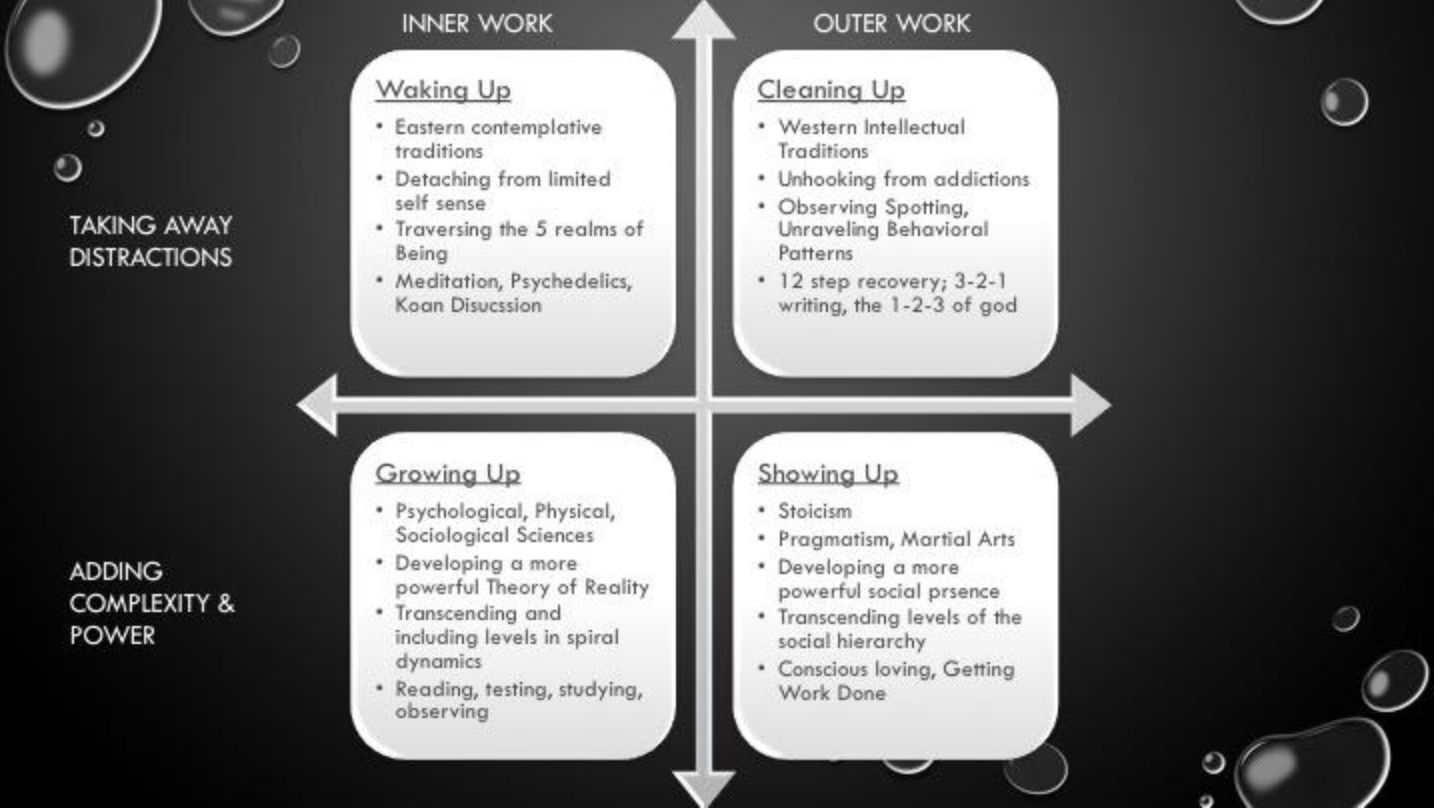
- Ken Wilber has a well-known model often known as the Four Ups or Four Facets
- Wake Up, Grow Up, Clean Up, Show Up
- Doug Tataryn has a modified version (see a video)
- Wake Up = spiritual enlightenment, de-identification with ego
- Clean Up = emotional processing, dealing with feeling-beliefs, etc
- Grow Up = implicit in some spiritual teachings... developmental stages ish
- Show Up = "I call it looking around"
- Wilber: "taking your place in the world"
- me: showing up in all ways, eg showing up emotionally, spiritually, on all energetic levels etc
- I think Wilber's model sacrificed a LOT of quality for elegance. It's catchy but (as evidenced by this twitter thread ) there's a lot of disagreement about what "Show Up" means, and no particular basis for which to consider this list of four to be exhaustive. Unfortunately, the elegance of this model seems to have made people disinclined to propose a better one.
- Update: Daniel Thorson made this 2×2 which I feel points at a more coherent version of what these four pithy phrases might mean:
- (And this thread contains further discussion)
- On 2019-11-13 I found myself thinking about like... which models are most at the core, for each?
- Unlocking the Emotional Brain by Bruce Ecker et al is literally "this is how you Clean Up—no exceptions just different flavors"
- Iain McGilchrist's book The Master and his Emissary provides a backbone for some really important insights about each of Wake Up, Grow Up, and Show Up, but doesn't explicitly articulate any of them. Needs to be paired with:
- Dzogchen writing for the Wake Up connection
- (eg Roaring Silence of Spectrum of Ecstasy, both by Chogyam Ngakpa Rinpoche & Khandro Dechen)
- subject-object stuff for the Grow Up connection
- (eg Robert Kegan's writing, though it now seems to me to )
- I wrote a basic article on the structure of subject-object shifts here: Subject-Object Notation
- mindset writing for the Show Up connection
- (eg The Outward Mindset by The Arbinger Institute)
- Buddhism has a Seven Factors of Awakening model, which is obviously not intended to be exhaustive on the scale I'm talking about here.
- Mindfulness (sati). To maintain awareness of reality (dharma).
- Investigation of the nature of reality (dhamma vicaya).
- Energy (viriya) also determination, effort
- Joy or rapture (pīti)
- Relaxation or tranquility(passaddhi) of both body and mind
- Concentration, (samādhi) a calm, one-pointed state of mind,[1] or clear awareness
- Equanimity (upekkha). To accept reality as-it-is (yatha-bhuta) without craving or aversion.
- (also the eightfold path...)
- Aella (@Aella_Girl ) has been interviewing purportedly-enlightened people and has come up with a bunch of different dimensions for this
- 1. Science awe spectrum (sensation of smallness, universe bigness, intense complexity, deep realizations about being walking matter, product of evolution, host to memes)
- 2. Mental Health spectrum (getting happier, more efficient, more aligned)
- 3. Magic Tricks spectrum (figuring out how to do crazy shit with your brain; altering perception, slowing time, encountering vast space)
- 4. Superpower spectrum (telepathy, astral travel, talking to spirits)
- 5. No-self spectrum (identifying with objects, other people, viewing self from outside, ego death)
- 6. Understanding spectrum (spiritual 'clicking into place' - 'getting' what reality is, having 'no more questions')
- 7. Word-free spectrum (distrusting words, playing with words, going meta with words, going silent, not-claiming, contradictions)
- 8. Perception spectrum (seeing your experience as your own; sometimes described as "realizing how much my brain is constructing things", can involve dreamlikeness)
- 9. Morality spectrum (how 'good' you become; finding 'right' behavior, ethical behavior)
- 10. Love spectrum (increased compassion and love for all living things)
- 11. Tradition spectrum (classic wisdom; finds value in following rules for behavior, believes traditional frameworks for reality such as reincarnation
- 12. Ecstacy spectrum (mania, joy, exploding in spiritual bliss, nirvana)
- 13. Disassociation spectrum (ability to control emotions, stoicism, independence from environment)
- Notes from Doug's Four Facets/pillars talk January 17th, 2020
- "Why do enlightened people do dumb things?" (the motivating question)
- This one is sort of interesting, and strikes me as sort of an odd question from the context I've come from.
- Like why would one have assumed that it would? People did, of course, and do, but that largely seems downstream of guru stuff among other things.
- And yet there is also a sense in which I also orient to the idea of a synergic mode in which it's impossible to perform an unethical act (this is a quote from Synergic Power). So what is that?
- And to what extent is it one thing or multiple things? eg a car needs an engine, wheels, steering, seats, etc.
- It seems that that requires samesidedness, at minimum. It may also require some amount of having already processed your traumas etc. It doesn't presently seem to me that it requires a particular developmental level per se, though it may require stepping sideways from the left hemisphere fixations from
- Interesting question for me emerges here in relation to my dream mashup metaphor.... Which seems to kind of relate to all of the classic Four Facets...
- Or particularly Doug's piece about Look Around
- And moreover, what role does samesidedness play. I'm thinking about the bit from Ecker 1996, about fifth order schemas
- They describe a self-creating purpose, as well as a potential not-self-creating purpose. But it seems like there is in general a possibility to create the different ~5th/6th order thing that isn't no-self but has a fundamental samesided quality.
- This seems to be at a sufficient level of generality & meta that it can be installed without needing to uninstall all of the 4th order schemas first or something...
- It would then serve to unravel the stuff at 4th-1st
- Eckhart Tolle clap exercise: close eyes, breathe, then after he claps, name the first thought that comes to mind,
- "in disidentifying with your thoughts, what are you going to be?"
- ...pure awareness
- "I talk about cleaning up in terms of Physical, Emotional, & Intellectual brains"
- Intellectual mostly just pointing at beliefs that are known to be inaccurate
- Muscular interference theory of repression
- Found huge correlations (0.5-0.7) between which muscles tense and which mental health issues they have. Got an APA award for this... Wondering if QRI might be interested in following this up, as it seems to maybe relate to their present work
- "you can be high on any one of these dimensions and be mistaken for a spiritual master... temporarily."
- Oh. Hm. I guess samesidedness could sort of be pointed at by talking about SD-Tier2...
- The developmental dimensions doesn't afford this through Kegan's model, which would implies one couldn't be samesided or whatever until stage 5...
- Similarly, the dozen-ish stage dev model in Hanzi's book doesn't cover this at all, I don't think. It's better for abstraction than many of the other models though; I'd like to learn it.
- Doug has apparently been working on some koans/mantras for prompting a shift from one developmental stage to the next
- Like he gives something to someone at traditional, and they mull on it and end up modern.
- Oh man, grow up sort of includes
- Hanzi dev
- What SD level is your culture at
- What relation do you have to that culture
6 linked references
October 26th, 2021
- re Dimensions of Growth and also What are the components or dimensions required for collaborative culture?, although it's not exactly about either of those, the Ultraspeaking folks seem to have a really detailed model of a bunch of vibing skills

September 30th, 2021
- Waking Up - Becoming acutely aware of the extraordinary suffering and injustice that continues to occur on our planet and gaining a comprehensive understanding of the various existential crises we now face as a species.
- Tuning In - Tapping into the subtle and spiritual (a la the Metamoderna interpretation) aspects of our own inner experiences. Feeling more deeply into the changing states of our bodies and minds through contemplative, somatic, shamanic and mindfulness based practices.
- Leaning In - Having the courage to show up, engage with others and take on a level of responsibility within our communities. To open our hearts and risk having them touched by those around us.
- Integrating In - Recognising those areas in which we can still mature and grow. Identifying our own interpersonal edges, shadow material and personal trauma and then doing the work to integrate the parts of our selves that we are either not yet conscious of or have perhaps chosen to repress.
- Levelling Up - Recognising the kind of cultural codes and cognitive frames we use to interpret reality and continually orienting ourselves towards a more nuanced and all encompassing understanding of how the world works and our place within it.
- Throwing Down - Directing our energies towards making art, music or any other kind of creative endeavour that allows us to fully express ourselves and then sharing the fruit of our talents with our wider community. This also involves taking in others creative expressions.
- Giving Back - Taking effective collective action towards bringing about more ecological balance, social justice, peace and joyfulness into the world.
June 28th, 2021
- decent image for Ken Wilber has a well-known model often known as the Four Ups or Four Facets; I don't per se agree with it - source
March 16th, 2021
- seemingly quite good reference on Hanzi Freinacht's dark depth, light depth, etc - keep thy mind in hell and despair not:
Hemispheres Linkpost
- One perspective suggests that subject-object shifts or developmental upgrades (see "Grow Up" in Dimensions of Growth) are essentially something going
- from being novel & paradoxical & only apprehendable by the right hemisphere
- to being familiar & understood & conceptualized by the left hemisphere
November 13th, 2019
- Did a braindump on Dimensions of Growth