Self-Organized Criticality
- This seems like a really important structure, possibly in some sense more fundamental to the universe than the idea of addition (which first requires the notion of separate "things" that can be counted and combined without regard to relation; itself not a simple affair, though quite native to a human left hemisphere)
- For context, "criticality" here refers to a system being in a critical state, which is a state in which small inputs can lead to large changes.
- #critique I'm not actually sure that this is an accurate definition, as I'm reading more
- The next few paragraphs are mostly from memory of stuff I learned years ago in SYDE 332; they may contain inaccuracies on various levels
- Systems theorists, when first discussing criticality, constructed toy models in which critical states occur, thinking that this would be a rare occurence.
- They then realized that certain kinds of criticality are actually profoundly common, because they are attractors of certain kinds of physical systems. This is called "self-organized criticality"
- The canonical metaphor for this is a sandpile. Any given type of grain (of sand, or rice, or whatever) has a maximum slope it will stably stack at, and if more sand is added, an avalanche occurs. The avalanche might be small but can be arbitrarily large—a massive sandpile could have an avalanche all the way down from the addition of just one more grain of sand. These are less common than smaller avalanches, but do happen. The fact that these large avalanches do happen is interconnected with the distribution of avalanche size being power-law distributed rather than exponentially distributed—fat tails.
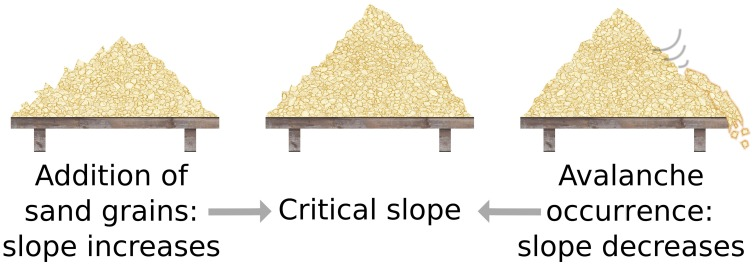
- Okay, anyway, I was recently reading Mutual Causality by Joanna Macy and was struck by a sense that, in the metaphor here of the sandpile, society was in some sense a sandcastle, that had been built up WAY past the critical slope,
- but somehow held up nonetheless with some combination of
- water to make the sand stickier
- fortifications: plastic shovels propped up against it
- active hands-on attempts to patch it
- (I'm not sure what these are all metaphors for, exactly)
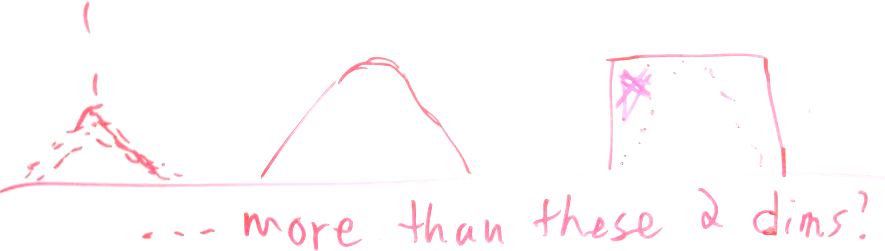
- here's a whiteboard diagram I made when I was thinking about this. the right side illustrates the sandcastle, with a sort of pink star in one region that's totally unstable
- this is a new metaphor for talking about what's broken with our civilization, and like any new metaphor it has new affordances
- talking about sustainability/unsustainability in the sense of resource depletion is one lens on it
- but this new sandcastle metaphor allows us to talk about not just the consumption of the society, but the instability of the structure itself:
- it's not simply that it will run out, but that it will fall down
- moreover, like any falling down, civilizational collapse would involve a release of potential energy
- which points at how while there's a sense in which since the industrial revolution we've used more energy than is sustainable, there's also a sense in which a lot of that energy, not in exactly a physical sense in terms of joules, but in terms of meaning-energy or something, is still embedded in #unfinished
- and—while the sandcastle metaphor lacks the level of detail to describe this—it's clear that society has more dimensions & complexity than just a pile which is effectively a 2D shape (up↔down and horizontal spread)
- and this means that the state-space has multiple options, so we can ask:
- "what shape would it collapse into?"
- "what shape would we like it to collapse into?"
- "to what extent are new structures emerging that can catch #unfinished
- We can apply a similar metaphor to an individual person, and consider what parts of their way-of-being are being held up unsustainably and might fall down given an adequate shake
- Sources etc
- p201 of Mutual Causality by Joanna Macy
- explores how this might work on the level of society, noting a pull towards commonality and a pull towards distinction, and needing those to be in balance
- > The SOC process (in algorithms) apparently helps the optimization from getting stuck in a local optimum without the use of any annealing scheme, as suggested by previous work on extremal optimization.
- This article about Covid, Coronavirus as a test-run for X-risks
- suggests some interesting sort of emergent control system that keeps the rate of infection, R, almost exactly equal to 1 (the point where the infection neither grows nor dies off)
- this is not necessarily self-organized criticality on one level, but I think it is on another level, in the sense of keeping the system in maximum suspense
- SoCiety
- convo w coponder
- neural annealing - uncertainty - first week of college
- how to be holding a deep unknown ongoingly
- staying in the uncertainty
- more surprise, less surprise on a meta-level
- Brains
- Critical brain hypothesis
- Selen Atasoy's work on connectome-specific harmonic waves and criticality / power-law distribution of those
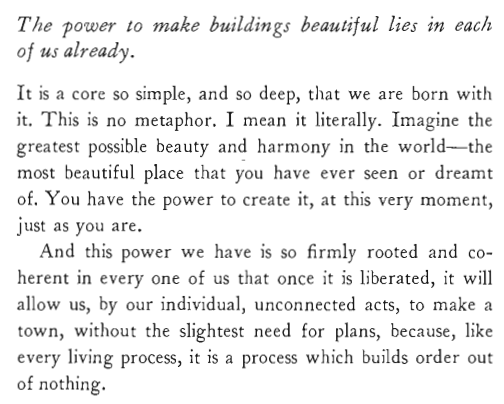
- from chapter 1 of A Timeless Way of Building by Christopher Alexander, read June 25th, 2020 at Relational Exegesis
- open system that maintains order and dumps entropy
4 linked references
Podcast summaries
- Keywords - barn-raising collecting barn-raising resources metaphor meta-team meta-vision Goal-Crafting Intensive Intend Philosophy & Paradigm Intend Philosophy & Paradigm Intend Philosophy & Paradigm me as project advisor / biz consultant / design jammer / co-visioner steward ownership What are the components or dimensions required for collaborative culture? Self-Organized Criticality Everything is a Remix how do we arrange the world so that I get to eat bananas in Canada and everyone is satisfied with the arrangement? UBI
- 12:48 - 19:43 - Have barn-raising sessions been effective so far? How can they be more effective if not? barn-raising Self-Organized Criticality
July 21st, 2020
- Inspired by someone else tweeting about the same topic, I adapted much of what I'd written on Self-Organized Criticality into this twitter thread:
June 28th, 2020
- More writing on Self-Organized Criticality