psychopaths
- approximately aka sociopaths, but this page makes a very useful distinction:
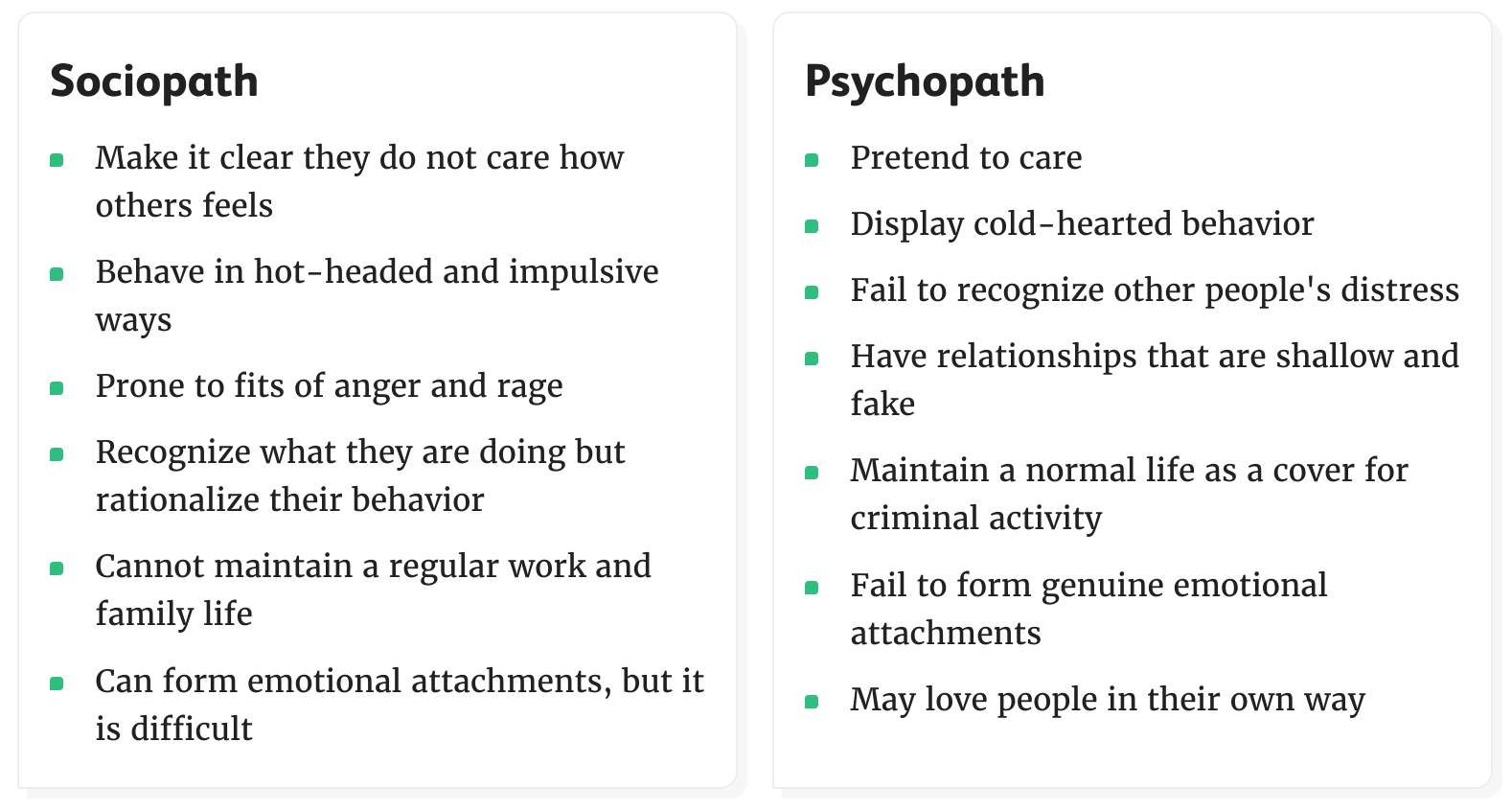
- (this page used to be called "sociopaths" and I've not yet renamed all instances of "sociopathy" and "sociopathic")
- A fascinating topic for anyone as interested in group coordination as I am.
- Many people who focus their attention on psychopaths are asking the question:
- "what, if anything can/should we do about psychopaths within Game A cultures?"
- To the extent that one operates in Game A subcultures, this is an inevitable question, but it's not one that I have a particularly novel opinion on. I say:
- try to avoid them
- threats don't really work [one core feature to psychopathy is not caring particularly much about punishment, only about reward source]
- As far as I can tell, for various reasons, this question is not a leverage point for systems change. The relevant leverage point is nurturing Game B social dynamics, primarily with empathic humans, while ensuring that those cultures can work creatively and generatively with psychopaths as well.
- My current perspective seems to be that, given a workable solution to the initial challenge of getting Game B dynamics working with non-psychopaths, solving the psychopaths edgecase is actually a relatively easy problem. The reason for this page is to explore my thinking about why this appears so.
- I'll caveat that the presence of psychopaths will surely furthermore make the transition process harder, so that's not irrelevant
- Or, put another way, I'm not particularly worried about psychopaths undermining contexts with deep non-naive trust via infiltrating them—that's part of what it means for the trust to be non-naive! But they could still destroy those contexts materially from the outside.
- If you've thought deeply about this exact question ("how do psychopaths integrate with Game B?") and want to share your perspective on what I've written below, I am interested in that! I'm mostly not interested in discussing "what, if anything can/should we do about psychopaths within Game A cultures?" in general terms.
- Info you may not know that as far as I know is well-established:
- one core feature to psychopathy is not caring particularly much about punishment, only about reward
- source: When Your Child Is a Psychopath
- this means that trying to prevent bad behavior of sociopaths using existing criminal systems is profoundly naive and confused, like trying to dry someone off with water
- Too-pithy summary of my perspective. Written March 6th, 2020
- Most cases of non-empathic behavior among humans is not performed by people who lack the capacity for empathy. It is caused by people not being in touch with their empathy, for various reasons. Often this is caused by scarcity & fear, and peoples' meaning-making thereof.
- People learn non-empathic coping mechanisms to deal with a Game A world, at a young age, and then Everyone is basically living in a dream mashup of their current external situation & old emotional meanings so they persist these dynamics even in contexts where they aren't needed.
- Much of this is on a small scale & self-limited by various internal mechanisms that include Game A mechanisms like guilt but also just like... that people do still have empathy and their empathy still doesn't want to hurt people.
- Even for psychopaths who are completely selfish*, the state of the world at present is such that there is still a shared purpose between psychopaths and everyone else. They can thus join the amorphous distributed team comprised of everyone who understands that current modes of human thinking are a threat to everyone's well-being, via global catastrophic risks of various kinds. Whether psychopaths can join any particular working group will depend on many other factors particular to the situation.
- *it's not clear to me that "selfish" is quite the model to use
- Some cases of apparent clinical psychopathy may be just as curable as anything else stored in early childhood trauma / emotional schemas. Which is to say very, and with much difficulty, and only if the person has the will to do so.
- See Kaj Sotala's summary of Unlocking the Emotional Brain for "what are emotional schemas and how do they work?"
- This is unlikely to be 100%, given what research I've read. More like 20-80%.
- And again, may be extremely hard and not feasible with current psychotechnologies.
- I'm not suggesting more marginal effort go towards this at this phase, nor am I suggesting people be naive to the damage that anyone's schemas can cause in the meantime, whether "psychopathic" or otherwise.
- Existing Game A societies are places where psychopathic behavior is incentivized in everyone, not just psychopaths. This is true in any context that uses blame, essentially, because of either/or scarcity-based thinking that's inherent to blame.
- For more on how blame is a confusion, read Reality is alive: don't carve it
- Game B societies will:
- not actively incentivize psychopathic behavior among anyone
- actively incentivize prosocial behavior among everyone, including psychopaths
- Since one core feature to psychopathy is not caring particularly much about punishment, only about reward, we can observe that to the extent psychopaths damage systems (on whatever scale) by playing win-lose games, it is because the incentive systems we have are simply failing to make win-win games more winful on those scales. It seems possible, at least in principle, to do so, including for people who lack empathy and thus care only about their own well-being.
- Moreover, many of the aspects of culture that allow people (psychopaths or anyone) to effectively "win" win-lose games rely on certain underpinnings like feelings of scarcity, lack of self-trust, and people not speaking openly about what is happening due to shame or other threats. All of these factors can be adjusted, and will be in any Game B culture, which is an elaboration on how Game B will not actively incentivize psychopathic behavior among anyone
- My understanding that psychopaths exploit this sort of thing came largely from reading Too Late for the Pebbles to Vote, a series of 3 articles, about a sociopath who was a leader in an open source community
- Also, perspective-taking, when understood in terms of systems thinking, is an orthogonal axis from emotional empathy.
- Learning perspective-taking in this sense is high-priority for everyone, regardless of sociopathy, as it yields people being able to make decisions that care better for the larger systems they are participants within and rely on for their survival & thrival.
- Thus: My current perspective seems to be that, given a workable solution to the initial challenge of getting Game B dynamics working with non-psychopaths, solving the psychopaths edgecase is actually a relatively easy problem. The reason for this page is to explore my thinking about why this appears so.
- Sources
- Quote from goodself/badself chapter of The Guru Papers
- > Psychotic “dis-integration” comes from an inability to integrate parts of oneself judged bad or wrong. Many psychotics are very sensitive and painfully aware of the hypocrisy masking so much of social interaction where people pretend to be far more virtuous than they are. They are unable to cope with the so-called negative aspects of being human, such as aggression, not only in others, but in themselves. Their solution is to leave the field of normal human interaction.
- > The sociopath or psychopath who has that mysterious ailment of being without conscience has adopted as a survival strategy the negation of the goodself, which results in loss of empathy and care. This adaptation is more likely the result of an emotionally impoverished childhood than of conscious choice. If intelligent, a psychopath maintains the guise of conventional morality and is never discovered. Elevating self-centeredness (the badself) as the only reality, the sociopath’s access to human connection becomes power and domination. Although bright psychopaths are usually able to construct safe ways of getting their power needs met, some resort to violent outlets which can become compulsions, serial murder being an extreme example. The most heinous crimes are often committed by those who are noteworthy for being unnoteworthy. Serial killers, like Nazi leaders, are renowned for their outward ordinariness.
- (not yet sure how this integrates)
- Ones I've read, that are informing my thinking here (there aren't actually many)
- a ton of articles and comments on a random blog somewhere, where a psychopath reflects on masking (I forget the url — if you have a guess, lmk)
- some Quora answers
- Too Late for the Pebbles to Vote
- a series of 3 articles, about a sociopath who was a leader in an open source community
- I had the serendipitous experience of coming across the articles in 2016 when someone I knew was accusing someone else I knew of being a similar sort of sociopathic character, having a similar impact on a mutual community.
- If you're wondering if you're thinking of the same situation, know that this situation in question actually basically completely resolved by April 2018, and nobody that I'm aware of now seems to think that the accusations were at all founded.
- talks about a rehabilitation center for child-psychopaths, which has... more success than you might expect, but still pretty limited.
- It's based in part on ignoring punishments and focusing on rewards.
- My Life As a Psychopath (interview)
- this woman was diagnosed in adulthood; she has a partner and friends and some of them know, but her family doesn't
- interesting discussion of masking
- curious how that's similar & different for autistic people vs psychopaths
- comments on reddit
- Other ones I'm aware of / have seen recommended
- < something about sociopaths as predator-humans, who don't feel most of the human emotions, I forget the link but @QiaochuYuan had it up last June >
- might be this:
17 linked references
September 15th, 2025
- psychopaths - interviews etc
- example interview:
May 25th, 2024
- though this tweet suggests that it's not just psychopaths
- > a similar result has also been observed in nonpsychopathic but conduct disordered teens. It’s called delinquency training. It is a real worry among researchers who treat disruptive behavior in children and adolescents.
- > "among 4th grade boys, perspective-taking superiority was associated with relatively more severe antisocial behavior...some children have high level social reasoning which they use to plan effective aggressive acts" onlinelibrary.wiley.com/doi/pdf/10.1111/1467-9507.00083
- > "The Neuroscientist Who Discovered He Was a Psychopath" smithsonianmag.com/science-nature/the-neuroscientist-who-discovered-he…
May 20th, 2024
- convo w friends about psychopaths reflecting that maybe they're stuck with certain kinds of emotional processing skill that are more characteristic of a baby
- and it occurs to me that this creates an interesting connection with Book/Power-Under: Trauma and Non-Violence
- that book describes in detail how a lot of abuse is committed by people who are
- suggesting that in some sense certain emotional flashbacks
March 9th, 2024
- book Sociopath is a memoir that talks about learning to live well in the world as a sociopath
- > Are you able to describe how you’ve built a sense of morality?
Just because I don’t care about someone else’s pain, so to speak, doesn’t mean I want to cause more of it. I enjoy living in this society. I understand that there are rules. I choose to follow those rules because I understand the benefits of this world, this house where I get to live, this relationship I get to have. That is different from people who follow the rules because they have to, they should, they want to be a good person. None of those apply to me. I want to live in a world where things function properly. If I create messes, my life will become messy. I think people are uncomfortable with the idea of, You don’t really care? What does it matter? What does it matter why I choose to help the woman cross the street? Why does it matter why I choose to pick up a wallet and hand it to the person in as opposed to keeping it? It’s not because I’m a good person. It’s not because I would feel shame or guilt. But why does that matter? - > there are times when I’ve wondered if the skills that I’ve learned from doing my job over the years are basically just forms of interpersonal manipulation, and I was curious to talk to you as a roundabout way of exploring that question for myself.
Where does that question reach you?
What do you mean?
Do you manipulate people in order to execute your job?
I think there is a degree of manipulation, but what do we really mean by manipulation? Is manipulation by definition negative, or does manipulation just mean intentionally creating a certain interpersonal context?
That sounds like a justification to me, which means you’re sidestepping shame or sidestepping guilt.
I disagree. That would be like saying therapists are always guilty of “manipulation.”
Just so we’re clear, when I said justification, I wasn’t trying to say that what you were doing was bad. You’re talking to a sociopath! I don’t think anything that you’re doing is bad. Yes, you are manipulating people to a certain extent — to your point — in the way that I might manipulate somebody in therapy, but I would never feel the need to justify it, and your justification came so quickly. That’s why I was like, Hey, what’s happening that you felt the need to defend your answer?- great example of someone projecting judgment onto someone else!
March 5th, 2024
- interesting thread about being friends with psychopaths
December 2nd, 2023
- theory that maybe all of the symptoms of psychopaths are just downstream of inability to learn via punishment / pain-based negative feedback
August 26th, 2023
interesting excerpt related to trust-dancing › > His confession to Ms Muirhead came after she spotted hi…
- and also this is sort of how justice works among non-psychopaths—bearing the guilt and dishonesty of having done this, without being able to have someone else know it, without being able to be forgiven and loved, was too hard for this man, so he basically had to tell her at that point
everything makes sense
- Except for psychopaths, most people are in some sense being quite honest most of the time, although due to Game A power dynamics they're usually sufficiently compartmentalized that it's hard to tell what's going on.
- Let's consider a borderline-lying case here, not psychopaths etc.
- Say you ask your partner "what's wrong?" and they say "I'm fine" and obviously they are not fine.
- Well, here's a great opportunity to again
- put your own oxygen mask on first and validate your own perception that something's not fine, even though you don't know what and it might be that you're confidently assuming it has something to do with you when it actually is about someone else or is just a stomachache.
- (Though again, if you bother the person enough, you might be able to make it be about you, proving yourself right even though you were originally confused. Taking things personally sometimes does make them be about you.)
- then consider that no matter how much it upsets you or no matter how much you feel like it would be helpful for them to talk about it, it makes sense to them not to talk about it. And it makes sense to them to try to pretend that there's nothing going on.
- This is fucky, which is why you need to validate your own experience first.
- With psychopaths, the sense it makes that they're lying might simply be "they want to trick you into doing something that doesn't benefit you but benefits them"
February 18th, 2022
- E) psychopaths/sociopaths exist; it's unclear what to do about that but punishment doesn't work for them either (seemingly even less so than for most people)
June 8th, 2020
- around minute 55 or so, he talks about his learning process in relation to psychopaths, and it resonates a lot with my sense of things
- including not punishing, just protecting (since It's based in part on ignoring punishments and focusing on rewards.)
Werewolf variant ideas
Exploring a whole new metaphor space for talking about va… › this game would have super fucking fascinating dynamics, … › 2. by contrast, say there's only one scarcity-minded pers… › one weird naive strategy here is actually to reveal that … › there's actually a few things you could say! › "please protect me from dying, because I... don't want to… › and therefore, even when you're nominated for "jitsu", an…
- (this, btw, is why I think that real psychopaths will actually be able to play along fine in Game B—it's truly a game where the benefit from playing positive-sum, positively-correlated games is actually stronger than the benefit from playing zero/negative-sum, negatively-correlated games)
Exploring a whole new metaphor space for talking about va… › 3 roles › person › scarcity-minded person
- After writing a few thoughts over on a new psychopaths page, I found myself thinking that this role couldn't possibly metaphorically fit with "sociopath"
- because they still care about the human team winning
- whereas a true sociopath character would only care about making it to "the end of the game"
- but then I realized that win condition doesn't actually say that, it just says wins if all murphy eliminated, which a sociopathic person does want because... OH. Oh interesting. I'm actually implicitly importing some old meanings from the werewolf metaphor version
- with werewolves, all a sociopath wants is to stay alive, and they're only safe once there are no more werewolves
- but if, in shifting to the ((murphy))-metaphor, we take the sting out of being eliminated... then... yeah. hm...
- damn, this breaks a bit. because there aren't clearly two different ways to metaphorize the whole thing
- there could in principle be a character that only cares about making it til game-end, which I guess would basically mean that if only they and murphy were left, they would also win, which is not true of a person
- oh yeah, that's a coherent win condition with coherent strategies to pursue, mostly to be vaguely helpful to everybody but not very helpful to anybody
- this idea feels bizarre as long as I continue importing the werewolf metaphor, but once I set the werewolf aside, it's clear that this is a coherent role that's basically the opposite of observer
- but "sociopath" is only one way to language this, and not necessarily the best way at all
- especially since a real sociopath might be on a team where they are indeed actively wanting to execute the shared purpose (in this case eliminating the murphys)
- ones that are about not getting targeted might be
- dodger
- nothing to see here
- survivor
- ones that are about the meaning of this in the context of the game, similar to observer
- "no spoilers"
- (as long as you stay "in" the game, you don't find out any secret information; there's a role of trying to do this)
- "talker" etc
- (this player wants to continue being part of the discussions, even though they don't care about what happens)
- this scarcity-minded person, whatever you call them does actually only care about their own survival, because they are