trust
No content on this page itself — see linked references below.
24 linked references
October 20th, 2025
- true = if you point your learning apparatus at it, you'll find it (given skill, time, etc)
- truth
- trust, n
- trust, v
- non-naive trust
- forced trust
- stable
- stabilizable
- stabilize
- ~= choose, commit to, adopt faith in
- often when people use "trust" in the imperative, they are actually trying to say this
- but it has huge implications
- ah yeah but this is also kind of the unquestioned attitude!
- faith, n
- "suppose someone has stabilized a faith"
- "key features of their faith"
- [some good usage examples in NNTD Virality Squad doc - gonna pull it out tho]
June 10th, 2025
- my threads on twitter - new short one on trust, vibes with trust as an unquestioning attitude, uses a tool metaphor for trust, and gets at the power of self-trust for allowing you to be less concerned with other-trust
March 4th, 2025
- > If you're hiding a friend in your attic, and his mortal enemy comes to the door and asks if he's there, the question is a lie. They're really asking 'can I come in and kill your friend?'
'No' is a completely truthful answer to that question.
A lot of life works like this. 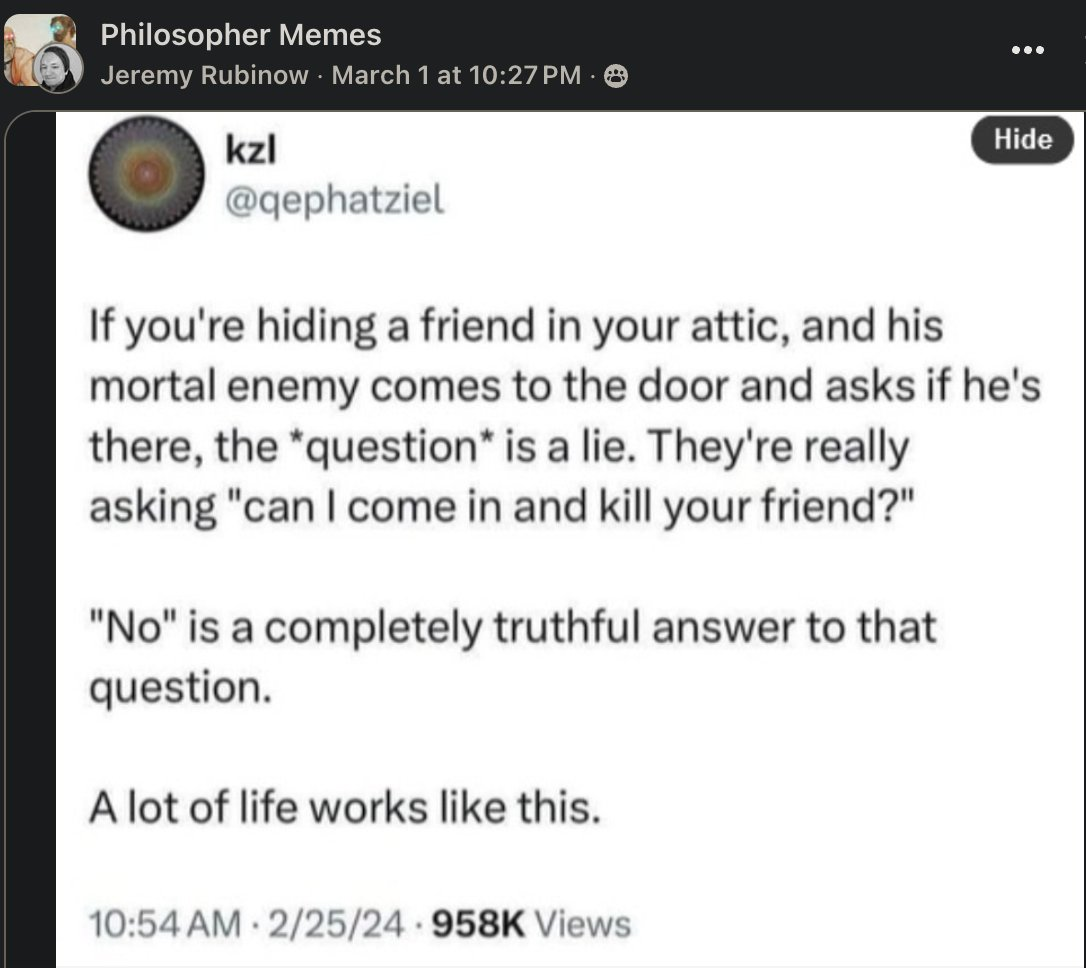
September 13th, 2024
- there's the "trust your own distrust" version of this
- but there's also something more like how I think Jean Robertson thought of this
- a friend wrote:
- > I don’t know how much this comes from you but my definition of trust is like “do I trust myself here? Do I have my back if I fail?”
- I replied
- this is not mostly how I think about trust, although it's definitely relevant! like it's not dissonant, just sort of on a different level
- I guess the connection is like, if I trust myself in relation to a situation, then I can also sort of let reality be what it is... because I trust myself to navigate it!
- which is sort of like trusting the thing itself
September 6th, 2024
- forced trust = bullshit trust = rationalized trust
August 9th, 2024
- this #poem (Rest Stop by Chandler Peters-Durose) is an interesting case study of something about trust, naive trust maybe... NNTD mode 2: trust bet... also something about faulty sensory appreciation? like this person's past is full of abuse, which on some level they trust in the sense that it feels familiar...
- When given the opportunity to connect with
No
To be welcomed back into your
Home
No
Family?
Do you take it?
//
You reached out your hand and I took it. It felt too good —I pull away almost immediately
I look behind me seeing the ash of my life I burned
and I begin to cry
Through the tears I see you next to me
Still here
Still—
Here
Tears tear through my body and we sit down on the bench. You hold me close
Rest here as long as you need, im here and im not leaving, but you need me to promise that you
will not go back. You made it too far
Everything in my body says to turn back to the life I knew.
I look deep into your eyes, and my voice shakes as I whisper ok, I promise
You do not let go as I watch the life I thought I knew disappear before my eyes.
May 8th, 2024
- other people's work on trust — this tweet, and some replies have other frameworks:
January 12th, 2024
- pretty short paper operationalizing trust into 5 factors
- which seem about right on the object-level
- tho it seems to be missing the magic of meta-trust
October 7th, 2023
- hum hum, this feels totally relevant to... something. justification obviously, but something more about Real Talk and meaning-making and trust more generally
December 12th, 2022
what am I trying to say in this post about choice, that I… › like what are the key bullet points? › choice has something to do with
- trust and opening to collaboration
November 14th, 2021
- re trust handshakes
- > and sort of: the point is mostly not to predict one another's behavior at a holistic level (which I think is a mis-framing that decision theories incline toward), but instead to find enough shared structure to handshake on the things we care about
https://twitter.com/paul__is__here/status/1459045752232108038
September 4th, 2021
16:00 - starting a kind of writing block › looking at Sequence on NNTD › saw this page: how my thinking has transcended the Upstar… › looking at What's the deal doc (another unpublished piece… › and this obviously can't be published as is, but has a lo…
August 23rd, 2021
- I can probably make a bolder statement there but that's a start for a handle
- a friend wrote
- > I think one of my approaches to noticing that there are healthier dynamics preferable to the one I'm in is to just go "oh, I'll simply do the good thing!" And I guess that only works so long
- I replied
- > It's worth trying as long as you don't get attached to it!
- > But then imx whatever parts you're blocking in order to generate the healthier interpersonal dynamics, don't necessarily update because they're not around to see it working and dialogue their own concerns with it
- > an analogy I use here is "if you have 2 groups of people, that aren't mutually trusting/friendly, and in particular one person in Group A is thinks Group B hates them, then if Group B invites Group A to a party, and the hostile/scared person doesn't go, they can--reasonably!--conclude something like "well, Group B might not hate the rest of Group A, but they still hate me and it would have been a bad time if I had gone to the party"
August 3rd, 2021
- > "I trust Alice to return a $10 loan but not a $10,000 loan, Bob to return a $10,000 loan but not to babysit an infant, Carol to babysit but not with my house key, Dave with my house key but not my intimate secrets, and Ellen with my intimate secrets but not to return a $10 loan. I trust Frank if a friend vouches for him, a taxi driver as long as he’s displaying his license, and Gail as long as she hasn’t been drinking."
- From Bruce Schneier, Liars and Outliers -- via Kaj Sotala, "Don’t trust people, trust their components"
July 27th, 2021
- > everybody wanna complain about low-trust environments but don't nobody want to take no hard-ass actions to engender trust
May 16th, 2021
- re trust-dancing, a distinction between favor & trust
- the thing I'm calling trust-dancing kind of includes both of these, but they're indeed worth distinguishing for sure!
- much later, very relevant
inside role, outside role
- the idea that solving some interpersonal trust-related psychological tangles, when working with a friend/coach/therapist/etc...
- you're both trying to solve a kind of lock box puzzle, but one of you is inside the box and the other of you is on the outside
- so neither of you has the full information, and you've got to find a way to put that information together
- unfortunately, this is kind of like being lost, separate from each other
- and you can easily naively find yourself thinking that the things you're referring to as shared landmarks are actually different things
- I have a blog post about this:
- that blog post only tracks half of the issue though, which is the part about the external referents
- there's also an issue for clarifying psychological referents, and that one is way way trickier