Coherence Coaching
No content on this page itself — see linked references below.
5 linked references
January 26th, 2022
- functionless byproduct symptom
- the symptom inevitably follows from how the client solves some other problem
- "I have no social life"
- functional if eg fear of rejection, social fears etc
- functionless if eg person is workaholic and that's the functional symptom
- person who really hates being overweight
- functional if it's necessary to be overweight, eg to avoid harassment
- functionless if they use food to self-regulate anxiety and it's eating that's the functional symptom
- functionless helpless symptom
- client feels helplessly vulnerable as a result of trauma and has the expectation of ongoing helplessness
- El > when someone has a flashback, this isn't really a byproduct of a solution
- (I'm not actually sure of this! it's not a good solution but afaiu the flashback is some attempt to make sense of the traumatic situation or apply its insights to the current situation dream-mashup-wise)
- Two-step
- a discovery technique for functionless byproduct symptoms
- (or if you're not getting anywhere)
- step 1: what shift would you have to make so that [the symptom] would stop? what would have to change in your perspective, attitude, behavior?
- step 2: (symptom deprivation)
- imagine making that shift... what do you notice?
- (how is it important not to make that shift?)
- very relevant for Goal-Crafting Intensive I think
- "what would have to change for you to be able to do that?"
- M > is there a reason not to start with this approach, in some situations?
- El > if someone comes with a functional symptom... it can sound like "Why aren't you making that change?" - slightly counteractive
- normally in coherence work we avoid the conditional
- because it keeps people separate from the experiential discovery work
- Eric > prime example might be someone's sleep schedule
- S > tho maybe they have nightmares
- (I feel like this could be assessed with a pretty quick question like "do you like sleeping when you do sleep?" or "if you had the ability to step out of time to sleep?")
- El > imaginal exercises are great, yeah
- difference between sort of cognitive conditional vs experiential imaginal
- (I'm so excited to run a CFAR-like workshop but with coherence-based tools!)
- Who else?
- For Deepening Discovery
- After overt statement of an emotional truth to a relevant party
- Is there anyone else you‘d like to say that to?
- Who else comes to mind when you say that?
- Visualize those people and use the overt statement again
- (very similar to "what was the earliest time when you felt this way?")
- Cycling
- An Integration Technique
- Client repeatedly experiences a scene, alternating between having the symptom and not having the symptom
- Powerful opportunity for client to notice her/his agency in creating the symptom for a purpose (“pivot into agency“)
- Can have multiple versions of each
- suppose you didn't have this concern so you did X
- but you do have this concern, so suppose you don't do X
- but also what if you pushed yourself to do X anyway?
- meta-level constructs
- hearing what's underneath what people are telling you
- eg someone says
- "I have to punish my mother for this or that because otherwise she'll think she got away with how she treated me"
- there are meta-level constructs underneath that that the person isn't at all aware of, like "it is possible to show my mother that she did something wrong"
- punishing is an effective way to effect some kind of change
- Er > how to bring this up?
- El > not quickly, not early on
- delicately, with empathetic overt statements
- [I think I'm hearing a construct here...]
- "if your mother gets away with that..."
- "yeah, it would really feel as if there's no justice in the world"
- "hm. and... there is justice in the world... interesting"
- "hm, yeah, and punishment is a way of convincing a person"
- "yeah, and if you punish someone, they'll change"
- "yeah, and if you don't punish someone, they won't change"
- trying to uncover what the person really believes
- El > you have to do it in a way where there's not an inkling coming through of "that's ridiculous"
- Stance of Coherence Coaching:
- Process directive/active intentionality
- never directed about content
- but always very directive about process
- we always know where in the process we are
- we have the intention with every session to move forward with discovery, integration, and/or transformation
- by contrast with talk therapies where people can talk for years
- Freedom to clarify
- at any time, it's out right and our job to ask eg "you're using the phrase get with him... can you tell me more about what that means to you, to get with somebody?"
- Phenomenological/anthropologist's view
- curious... wanting to know what happens
- knowing as anthropologists that we don't know anything
- we're discovering with the client
- Powerlessness
- we don't change anything
- we don't make any decisions for the client
- nothing is up to us
- (except how we're navigating through the process)
November 10th, 2021
- "experientially revisit a potent example"
- (is it okay to use a present example, eg if the client needs to reply to a text message right now)
- "let's try a little experiment"
- can do it with coach saying first half of sentence and client just completing second half
- some clients prefer this—keeps them more in the experience
- or some clients like to take over doing the first half of the sentence
- don't be afraid to use it 10 times
- "good, good, let's try it again!"
- aim: to help the client understand and remember the symptom
- if doing this in second-person (eg "so afraid of losing you") feels too intense or blocked
- can do it in third-person instead (eg "so afraid of losing my sister")
- problem (of the psp) & solution
- "here's the lesser suffering I have to do to avoid the greater suffering"
- "I must" / "I better not"
- Phrases for Deepening Discovery
- "There‘s something you know about that..."
- "That feels familiar in some way..."
- "That feels important. Let‘s stay with that for a moment..."
- "What are you noticing right now?"
- "What‘s it like to be in touch with that?"
- Have client tell relevant person what s/he just told coach...
- "What do you experience when you tell him/her that?"
- "What does that mean about you? about that relationship? about your life?"
- we don't tend to ask "how do you feel?" questions
- because they tend to produce a cognitive searching for feelings 😅
- (I find myself thinking we could probably use Bio-Emotive tools for this, if we wanted)
October 27th, 2021
- Core Concepts:
- PSP, ASP
- Pro-symptom position
- Pro = symptom is emotionally necessary to have according to implicit knowings
- Position = active and self-protective positioning; agency, client produces symptom
- Makes deep emotional (initially unconscious) sense
- Anti-symptom position
- Client is against having the symptom
- Symptom happens automatically, client feels powerless
- Existence of symptom means “I am defective“
- The Two Sufferings
- the lesser suffering
- The unwanted suffering due to having symptom
- the greater suffering
- Not having the symptom brings suffering that is even worse
- pro/anti synthesis of sufferings
- Awareness of how the symptom is necessary to have plus recognition of the costs of having the symptom
- Empathy
- Standard empathy
- Empathy for client‘s suffering due to symptom
- “Yes, you‘re really frustrated at feeling so stuck...“
- Empathy for how the symptom is necessary to have
- “Mm hm, it just doesn’t feel right to you to take a next step...”
- Combining the two:
- “Yes, you‘re really frustrated at feeling so stuck... And at the same time, there‘s something in you that knows something about this...“
- the greater suffering piece highlights something really important about the wholeness of the system, not just that it's in conflict but that in some sense it has reached whatever equilibrium it has in that conflict, as a whole
- and something about respecting the person's choice of the lesser suffering, even if it seems worse from your perspective
- (although of course if you're in relationship with the person, it may actually be worse for you personally)
- (though this is also hard to know before you've actually uncovered the greater suffering)
- Yatharth > are The Two Sufferings just from two parts?
- me > yeah, often the output is from a conflict/compromise
- so it's not like the unconscious part is winning, exactly
- Y > when conscious parts are winning over unconscious, we don't come to therapy
- Y > Abhay:
- > “Perhaps "going away" as the desired resolution can concede its territory to a growing acceptance of the mechanism's karmic configuration. i.e., the problem isn't the problem - it's the very category of "problem" that can be remapped fundamentally to pure opportunity/offering.”
October 13th, 2021
- notes re Coherence Coaching
- my own motivation mostly around being a good person in my personal relationships
- Elise > so much of coaching training about
- how to get people to commit harder
- how to reframe things to trust more
- Y > my experience of coherence is less formal, more mystical
- in therapy/coaching, very easy to focus on changes you think will happen as a result of something, vs being in touch with whatever change is actually happening
- “Coherence empathy for samsara”
- M > I had an idea: what if we have one of the learners try to explain each slide, and Elise clarifies or fills in what she sees as missing?
- Y > really good way of suggesting your idea, in a way that showed the enthusiasm behind it, without suffering the awkwardness one might in proposing such things
- excellent tone control and sincerity and invitational tone
- Y > calling it Active differential learning in my notes
- (only works when the learners already have a lot of context)
- Emotional Learnings
- "Anything learned in the presence of strong emotion"
- thinking about emotional schemas as like ASICs, vs software
- so they're faster & more efficient but can't be reprogrammed directly
- (ASIC = "application-specific integrated circuit", ie a circuit that just does one thing, like you'd have in a microwave or whatever)
- Eric > my main nitpick being that you can't reprogram an ASIC at all
- "unlocking the emotional brain" = "reverse-engineering the system into software, then reprogramming, so you can make a new ASIC" (?)
- Elise > as coaches, we just don't know, we have no idea what's underneath things for our clients
- (I think I hadn't fully internalized this actually)
- the coach is responsible for the process, but the coach has no idea about the content (what makes this symptom necessary to have)
- only the client knows that, and only unconsciously at first
- sometimes my familiarity with the client allows me to have a sense of reading between the lines
- but I don't just tell them
- I offer an experiment
- #toask how does this sort of thing work?
- M > "respecting that your mind is a sensemaking system, that it can't do anything other than make sense"
- Elise > "old neural circuits" but they're alive and active today
- Elise > "symptom" vs "target of change"
- flowchart:
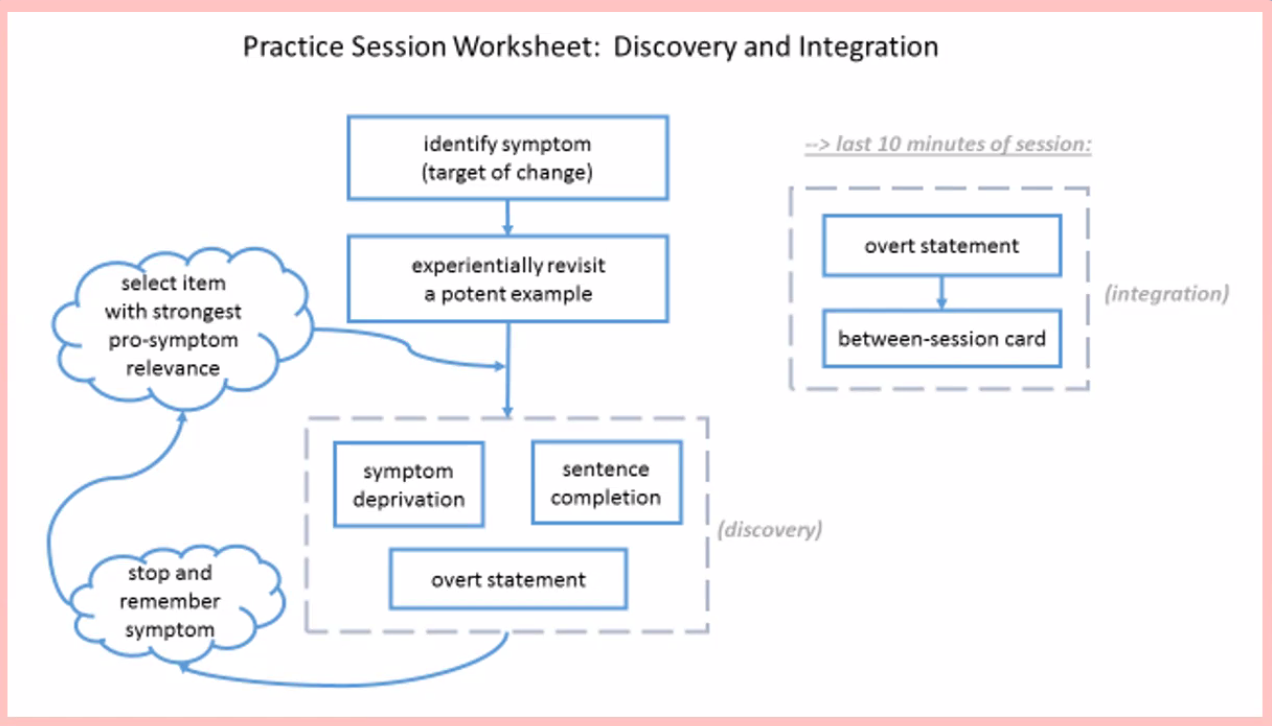
- "what is the problem as you experience it" (to hint at this being experiential)
- listen for 2 things
- strong emotions
- ontological statements
- rules, black & white statements about self, world, necessities, shoulds
- "obviously"
- let the client tell you as much as feels important to say about the potent example
- would like to practice overt statements
- because they're a really powerful way of holding onto whatever has come up
- ("pitching a tent")
- deepening the experience
- instead of "but", say "and, at the same time"
- don't have to ask, can just say "correct me if I'm not understanding, and what I'm hearing is..."
- "a part of you wants X, and at the same time, a part of you wants Y"
coherence
- (not sure if this is a good word to use for "group coherence" but it's at least a technical term in Coherence Therapy / Coherence Coaching)