SYDE 332
- Systems Design Engineering course I took at UWaterloo in 2014
- By far my favorite course of my undergrad degree.
- When I took it it was called Earth Systems and Society
- Now seems to be called Introduction to Complex Systems
- Was about:
- nonlinear systems
- nongaussian statistics
- really big numbers
- Textbook:
- An Introduction to Complex Systems by Paul Fieguth
3 linked references
Self-Organized Criticality
- The next few paragraphs are mostly from memory of stuff I learned years ago in SYDE 332; they may contain inaccuracies on various levels
- Systems theorists, when first discussing criticality, constructed toy models in which critical states occur, thinking that this would be a rare occurence.
- They then realized that certain kinds of criticality are actually profoundly common, because they are attractors of certain kinds of physical systems. This is called "self-organized criticality"
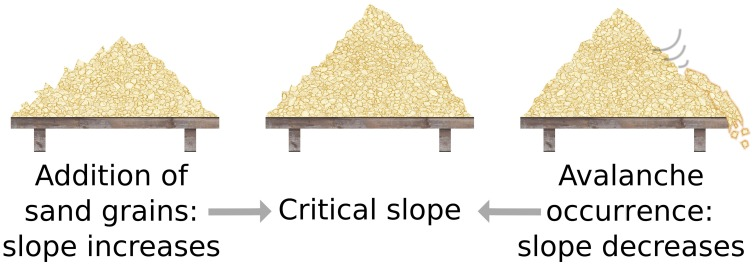
- The canonical metaphor for this is a sandpile. Any given type of grain (of sand, or rice, or whatever) has a maximum slope it will stably stack at, and if more sand is added, an avalanche occurs. The avalanche might be small but can be arbitrarily large—a massive sandpile could have an avalanche all the way down from the addition of just one more grain of sand. These are less common than smaller avalanches, but do happen. The fact that these large avalanches do happen is interconnected with the distribution of avalanche size being power-law distributed rather than exponentially distributed—fat tails.
Don't Pay For Options You Don't Want
- In particular, I'm going to give a shout-out to Prof Fieguth and his course SYDE 332, which was called Earth Systems at the time, and now seems to be called Introduction to Complex Systems.
- (From my perspective, it's absurd that this is both (A) an elective, and (B) only for Systems Design Engineering students. All engineers need to know about complex systems, and to know the the linear systems & gaussian statistics they learn about in all of their other courses are largely oversimplifications that break down in exactly the sort of unexpected situations that as an engineer one ought to understand. Black swans, etc.)