Duncan Sabien
No content on this page itself — see linked references below.
10 linked references
September 2nd, 2024
- good article by Duncan Sabien on resistance to being bossed around, refusing on principle, adaptive entropy
May 23rd, 2024
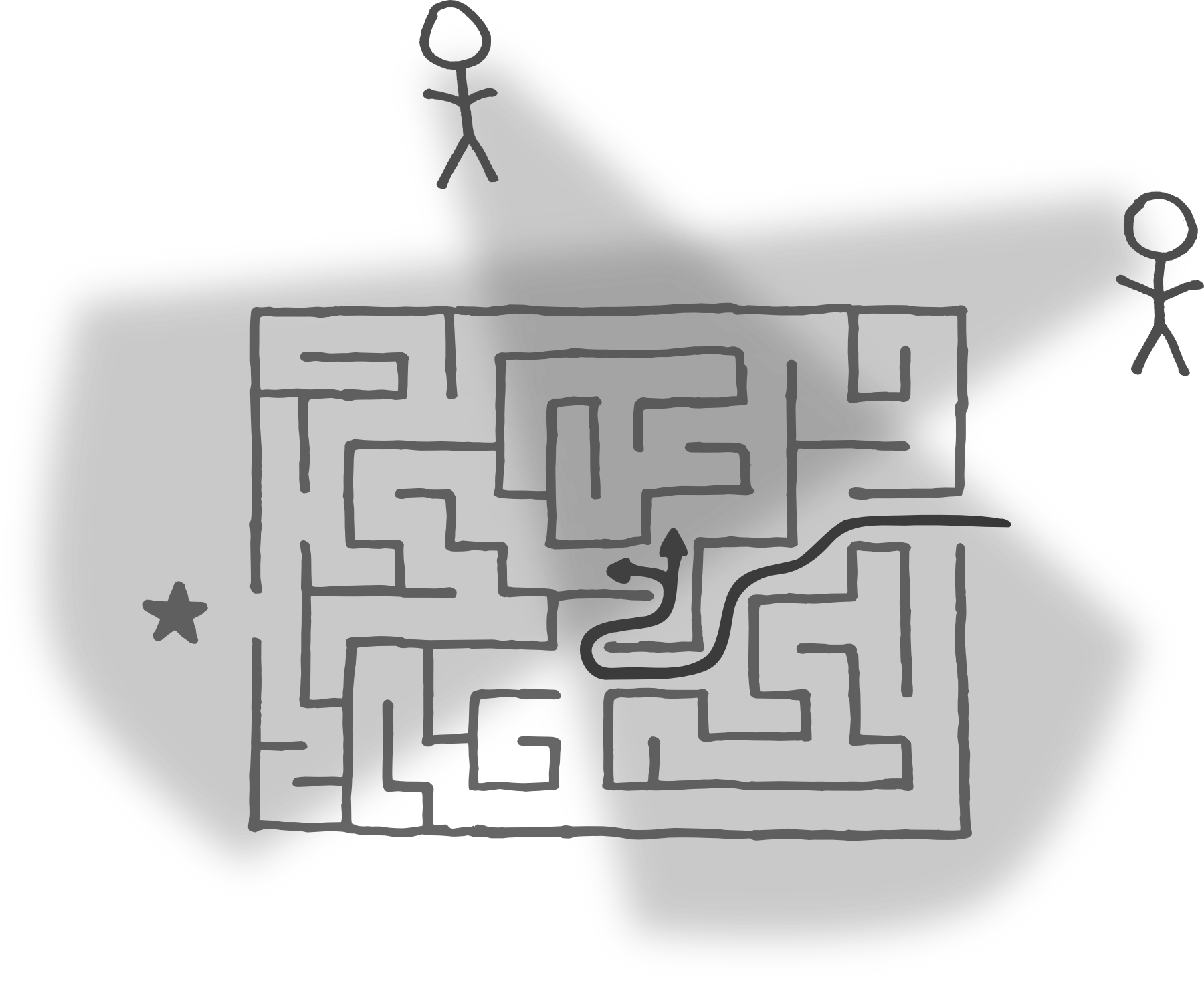
- Duncan Sabien's Double Crux post has a thing on integrating info, kinda parallax style, with a metaphor of navigating a maze where you need both peoples' perspective
February 8th, 2023
- this is discussed in Sapir-Whorf for Rationalists by Duncan Sabien
- here
- > > "I claim that passe muraille is just a variant of tic-tac."
"Obviously, passe muraille is just a variant of tic-tac."
"It seems to me that passe muraille is just a variant of tic-tac."
"I might be missing something, but as far as I can tell, the most sensible way to think of passe muraille is as a variant of tic-tac."
"Passe muraille is just a variant of tic-tac." - > There are a lot of reasons why people argue that the distinctions between these sentences shouldn't matter—
(Two of the more common ones being "I don't want to put in the effort to track it" and "It's useful for me to be able to equivocate between them, e.g. using verbal markers of confidence for emphasis rather than to express strength-of-justified-belief.")
—but if you're in a subculture whose explicit goal is clear thinking, clear communication, and collaborative truth-seeking, it seems pretty likely to me that you'll get further if you can sustain common-knowledge agreement that these sentences are, in fact, different.
- and here
- > I often object to certain conversational moves, and occasionally that objection takes the form of me attempting to rewrite what my conversational partner said—trying to express what I think they genuinely believe, and meant to convey, without violating Duncan-norms in the way their original version did.
- > (Because usually there is indeed something in there that's expressible in Duncan-culture; it is an intentional feature of Duncan-culture that many more things may be prosocially expressed than in most enclaves of American culture.)
- > After doing this, though, I often get back a counterobjection of the form "why should I have to put in that much interpretive labor?" or "if I have to put in that much work, I'm just never going to say anything3(lesswrong.com/posts/PCrTQDbciG4oLgmQ5/sapir-whorf-for-rationalists#fny…)" or "yeah, no, I'm not gonna arbitrarily swap out words to meet some opaque and inscrutable standard."
- > And there seem to me to be several things going on in that sort of response, most of which aren't appropriate to dive into here. But there is one aspect of it that sticks out, which is that it seems to me that such people assume/believe that I'm doing something like applying a politeness filter after the fact, or tacking on empty catch phrases to appease the audience, or similar.
- > Which is just not what's happening, ever—at least, not in my head. The differences between:
- Harley is a liar
- Harley is lying
- It seems like Harley is lying
- It seems to me like Harley is lying
- I'm having a hard time understanding how Harley could be being honest, here
- > ... are quite real, and quite salient in Duncan-culture. Those are not sentences which would ever be mistaken for one another and the differences between them are not cosmetic; they are crucial.
- tracking Duncan Sabien's paradigm
- this post is full of examples of intersubjective tension & confusion
- & frame stuff, like missing as far as I can tell and other co-epistemic frame tags
- which results in people making competing claims on reality
- > They're looking at me, and perceiving something I am not.
February 17th, 2022
- Duncan Sabien makes a case for using "color blindness" not "blindspot" but I don't think it captures the self-hiding nature of the thing...
- although this makes a good point
- > For calibration: mostly-replacing my mental category of "blind spot" with "color-blind" has been one of the ten most useful shifts of my last three years, by virtue of a) giving me a much better starting point for navigating inferential gaps, and b) somehow causing me to be more empathetic? ...I suppose because if the problem is a blind spot, then if they just shift their focus a little, they should see the thing, dammit, whereas if I model them as simply lacking the ability to perceive (even if only because they haven't practiced enough in this domain yet) it suddenly seems much less their-fault if merely shifting their focus doesn't fix it.
January 25th, 2022
- I've mostly had a pretty decent relationship with myself, so I resonate with "largely true, false for me". I did at one point in ~2015 notice that I was trying to motivate myself towards doing homework with a "get your head out of your ass and just do it" energy and then I realized with someone walking me through an emotional introspection process that I was ALSO the person TO WHOM I was saying "get your head out of your ass" and then I felt sad. I didn't want to be yelled at! (I also "didn't want" to yell at people (in this case myself) I just didn't know what else to do.)
- So there's also something about like, do you identify with the part of you who is telling yourself what to do and sometimes frustrated you won't do it, or do you identify with the part of you that is constantly getting berated by the inner critic and feeling not good enough? Power-over or power-under? And maybe for some people it goes back & forth. I could imagine this paragraph doesn't apply to Duncan Sabien at all though.
- On a different level of abstraction, I think "abuse" is kind of a bad frame for this (and also a bad frame for most, though not all, of interpersonal harms). But most people most of the time don't respect that people have coherent reasons for doing what they're doing, and also they don't respect that they themselves have coherent reasons for doing what they're doing. As I sometimes like to put it, "if what you/he were doing didn't make some sort of sense, you'd be doing some *different* apparently-senseless thing!"
- And their strategies (inner & outer) are therefore engaged in various distrustful battles, wishing the other would just give in. This approach to conflict is wasteful like running your AC to try to cool down your house when your furnace is also on trying to warm your house.
- Here's a case study of me exploring an approach for creating a different quality of dialogue internally. It's notably different than double crux in that it assumes both perspectives are in some sense right and seeks to find out how that's possible, rather than seeking to find out which is right.
October 13th, 2021
- article re frame battle by Duncan Sabien that I haven't read but I'm sure it's useful even if I disagree
May 25th, 2021
- Duncan Sabien points out "in the leantime"
- > It's likely not an actually good term, since it's pretty opaque. But like, how well you can weather the lean times. If you have $100 in the bank, then you can only handle small hits before you flatline; if you have $100,000 then you can handle much more.
May 18th, 2021
- > ... that 𝘰𝘯𝘭𝘰𝘰𝘬𝘦𝘳𝘴 do not usually put forth active effort to solve both problems at once.
- thissss
February 10th, 2021
- > Dallas: "Well, it *is* slimy. That's...kind of the point of lubrication, is to be slimy, so that things that might otherwise snag on each other don't, and instead glide past each other."