One of the longest-running courses that
CFAR teaches is called
goal-factoring. The basic jist is one that shows up in lots of places:
ask yourself "why?" in relation to something you're doing or considering doing
keep asking yourself "why?" until you get deeper whys
ask yourself if there might be more effective ways of achieving those whys
try doing those instead
These days, CFAR mostly suggests doing this on a relatively small scale, but back in 2013 they sometimes recommended making a giant chart with hundreds of actions & whys on it, all interconnected, so you could completely refactor your whole life.
In mid-2013, about halfway through my Systems Design Engineering degree, I set out to do this, beeminding the progress, and eventually got a graph with over a thousand nodes & connections. I'll post a screenshot of the big mess at some point.
Anyway, it took a few dozen hours and was a huge mess, and I didn't get that much out of it, except for one insight that was worth the whole thing!
One of the actions I was tracking was "study hard" which had two purposes: learning & getting good grades. I pretty quickly discerned that the learning I was doing in school wasn't that important compared to the learning I wanted to do, so I set aside that reason. But getting good grades? Well, that had a few purposes:
This third one was harder to directly dismiss than the others—I figured it was basically the case that without good grades I wouldn't be able to go to grad school. But then I asked myself "why did I want to have the option to go to grad school?" and the answer was "have lots of options". So I asked myself "why do I want to have lots of options?" and the answer was "be able to do what I want". And why I wanted that was Freedom, which I labelled as a terminal goal since I seemed to want it for its own sake. Freedom definitely mattered a lot to me, and still does.
But as I inspected this chain, I realized something:
having more options only helps me do what I want when those options are options that I actually want
to take a simple example: a restaurant with a dozen flavors of milkshake is no better than a restaurant with one flavor if you're allergic to milk
similarly, a coupon for a free makeover at a local salon is useless—just one more piece of paper to keep track of—if you don't want a makeover
and so I asked myself: do I actually want to go to grad school?
and I felt into it, and it pretty quickly emerged that the answer was "no."
When I imagined all of the things I wanted to do in 2 years when I graduated, there were many possibilities, and grad school didn't make the list at all.
So I switched my study strategy to satisficing—intentionally & strategically doing the minimum possible to pass my courses & get my degree, without worrying about getting good grades. (see
whole-assed half-assing)
This included:
Not going to class, or just doing other things in class when class was boring. I'd already been doing this somewhat, but I became more strategic about it.
Writing essays in whatever way was most fun, rather than optimizing for what I thought the prof would like. Honestly I probably could have gone even further in this direction
Waiting until 1h before certain assignments were due to even look at them
This ensured I didn't waste time on them, and also made the process feel exciting & thrilling, trying to get them done before the digital submission window closed.
In many cases I managed to get full grades on them anyway!
Tracking how much time I was spending on school, with the aim of minimizing it
Hacking the syllabus—to pieces
Most people assume that every time something is assigned, you have to do it. School isn't the military. What actually happens if you don't? Often, not much.
Sometimes teachers would assign fiddly assignments that were only worth 1-2% of the final grade. I ignored these without any guilt or stress, unless they seemed interesting.
A couple times, for courses without a final exam, I had already collected more than the 60 percentage points required to pass the course, by the time I had to even start working on a final project or assignment. So I didn't do it.
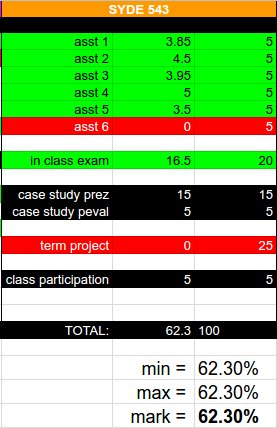
In one case, my Cognitive Ergonomics professor sent me an email on the day a project (worth 25%) was due saying
I replied
I have a lot on my plate at the moment and in ruthless prioritization it ended up getting cut, after I made sure that I would still be able to pass the course without it. I enjoyed learning about the various concepts in this course and expect that I will apply many of them when making design decisions for my tech startup. My product,
Complice, is a productivity app, so the sections on attention and multitasking will probably be particularly relevant. It just made more sense for me to focus on actually improving my product than to write this paper, given that I have no intentions to go to grad school.
I appreciate your understanding,
Malcolm
(Some friends from a different university suggested that profs at some schools might fail you for this, so unless you're somewhere very startuppy like UWaterloo, it might make more sense to just not reply and have the whole thing go unnoticed.)
In a few rare cases, I found my way into classes I deeply valued and enjoyed, and for those, I spent more time learning & working on the projects.
In particular, I'm going to give a shout-out to Prof Fieguth and his course
SYDE 332, which was called Earth Systems at the time, and now seems to be called
Introduction to Complex Systems.
(From my perspective, it's absurd that this is both (A) an elective, and (B) only for Systems Design Engineering students. All engineers need to know about complex systems, and to know the the linear systems & gaussian statistics they learn about in all of their other courses are largely oversimplifications that break down in exactly the sort of unexpected situations that as an engineer one ought to understand. Black swans, etc.)