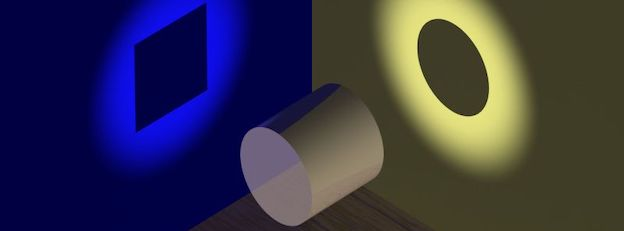
Why does this matter? People often as "what is the opposite of X?" as if any given thing could only have one opposite, and this piece attempts to make it clear that that's a narrow way of thinking that bakes in some assumptions. Unpacking these assumptions can reveal what one is taking for granted.
EDIT: idk what I think of this page. definitely pointing at something important but also I'm definitely confused about some of the math I'm trying to point at here
What is the opposite of 4? Is it -4? or 0.25?
Definitively, if X is the opposite of Y by some definition of opposite, then Y must be the opposite of X.
An opposite requires a center point around which to oppose, so the opposites could in principle cancel each other out. The center point between 4 and -4 is 0; the center point between 4 and 0.25 is 1.
(note that this center point forms what's called an identity; the identity of a given operation is the number that when you perform that same operation with it, nothing happens. eg A+0=A, or B×1=B)
Interestingly, 0 doesn't have an opposite (or is its own opposite) in the addition schema where it is the center point, but in the division schema (4 & 0.25) the opposite of 0 is ∞.
(The division schema implies that opposite(X) = 1/X, but you could have one that does both and has opposite(X) = -1/X, in which case the opposite of 0 would be -∞ and the opposite of 4 would be -0.25)
(fun fact: JavaScript actually has not just positive and negative infinity, but also positive and negative zero)
Other examples, not necessarily much good:
Colors
To take something more tangible, that's still mathematically mappable, consider colors. We're going to pretend, for these purposes, that your computer's screen colors are all there is.
Now consider: what is the opposite of navy blue?
HSL: 240°, 100% Sat, 25% Lightness
HSV... might be more intuitive for this
Inverted: ffff7f - pale yellow
HueFlip: ~606000
Desat = 404040, though that has no hue...
Hmm... this is a bit of a mess. Maybe getting deep into representations is not actually helpful, and simply saying
in RGB, you can invert everything and get light yellow
in HSL/HSV, you can just flip the hue (what is the zero point for 180° rotation?) and get dark yellow
also in HSL, you can flip the lightness to 75% and get rgb(128, 128, 255)
in HSV, this particular color is already at the center of the V axis, but for another color you could flip it around 50% V and get some other color
Also there's clearly a sense in which the main opposite of black is white, and one obvious opposite of "black and white" is "grey" in the sense of being least extreme, but of course another opposite to "black and white"
Opposite of an electron?
a debt of one electron
a proton (same particle type, but cancels out charge)
a positron (same mass, cancels out charge)
photons (& others) are their own antiparticles
Excellent stuff on this in first section of Man and Woman, War and Peace by Anthony Wilden
Who distinguishes oppositions from negations, and contradictions:
true may be the opposite of false
but in real symbolic language, not(true) is not the same as false, not(not(true)) is not the same as true