Leverage Points: Places to Intervene in a System
by Donella Meadows
Made into a thread for QTing, by me! 🧵👇
Some Systems Theory terminology:
the state of the system is some key stock, eg "water in damn", "money in bank", "trust in officials"
inflows increase stock, outflows decrease it
inflow > outflow ↔ stock goes up, & vv
an agent w/ a goal may compare state to ideal state & act
For example, imagine filling a bathtub with water: inflow from the faucet, outflow through the drain.
Turning the faucet fully open doesn't immediately fill the tub—it takes time for flows to accumulate.
You control the inflow & outflow to make the water level match your goal.
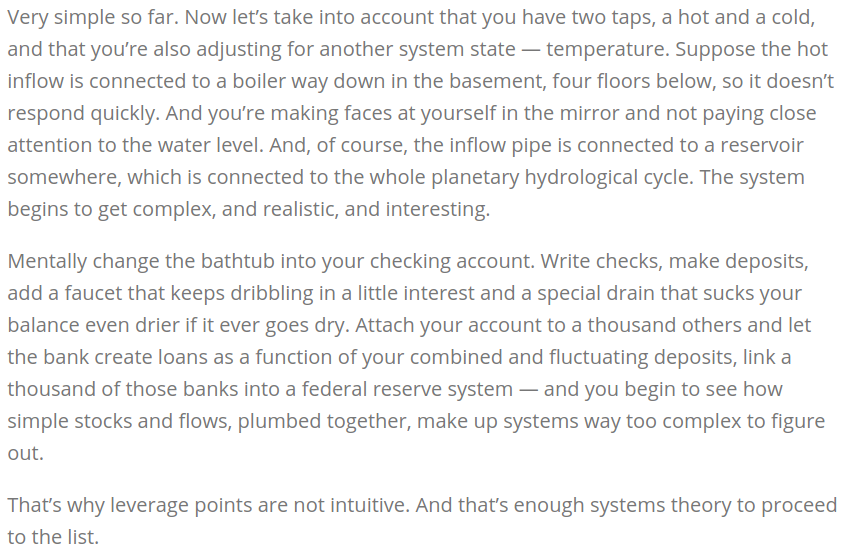
Of course, in reality there's also a temperature variable, with a delay to get hot water from the basement, etc
and this applies to other systems, from global climate feedback loops to perceptual control systems in your own brain
okay: enough systems theory, time for the list!
(We're starting with the lower-leverage interventions)
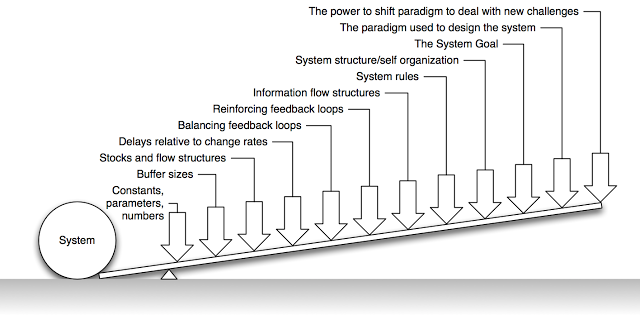
Leverage Point #12: Constants, parameters, numbers
eg
- tax rates
- wages, prices
- pollution limits
- funding availability
- which person is in a particular role
Parameters are only high-leverage to the extent they affect higher-leverage items, like loop gain or goals.
Leverage Point #11: sizes of buffers & other stabilizing stocks, relative to their flows.
eg difference between
🔵 a lake (mostly buffer)
↩️ a river (mostly flow)
More buffer usually means more stability & margin-for-error, but can be costly & less agile. Often hard to change.
Leverage Point 10: structure of material stocks and flows
eg Hungarian road system send all traffic thru Budapest—that creates a lot of air pollution & commuting delays that are not easily fixed by 🚥, ⚠️, speed limits
Low leverage to rebuild; higher to design well in 1st place
Leverage Point 9: lengths of delays, RELATIVE to rate of system change
Delay can be in perception or execution
Often issue is too much delay (overshooting oscillations, eg shower temp🥵🥶) but too little = overreaction (eg👻➡️😱)
Often easier to mod rate of change than delay.
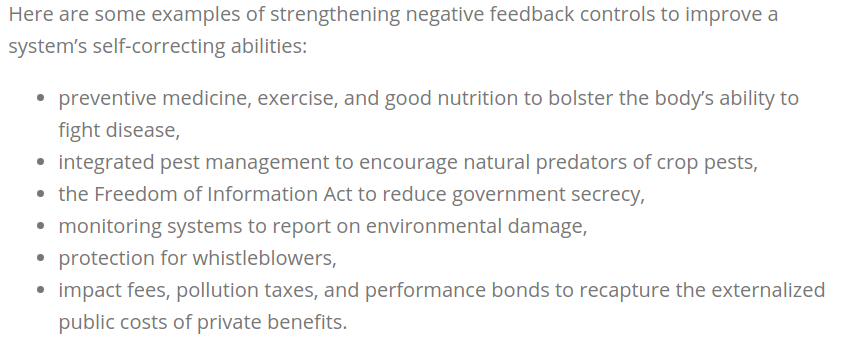
Leverage Point 8: strength of negative feedback loops
these self-correcting loops maintain equilibrium (dynamic or status)
some usually-inactive but vital (eg fuse)
RELATIVE to disturbance size: eg thermostat+furnace can handle a cold winter day but not if all windows opened
Leverage Point 7: gain around driving positive feedback loops.
these self-reinforcing loops drive exponential growth
eg more sick people, more transmission of virus:
way costlier to fight each instance than reduce gain #StayAtHome
eventually will hit a limit (sometimes 💥)
Leverage Point 6: structure of information flows (who does & does not have access to information)
usually the leverage point here is in restoring the flow of information that has been blocked to avoid accountability
eg companies pollute less if required to publish emissions
Leverage Point 5: the rules of the system (eg incentives, punishments, constraints)
All previous leverage points are subject to the rules of the context they're in. The real incentives: de facto, not de jure.
> "Suppose a class got graded as a group, instead of as individuals"
Leverage Point 4: the power to add, change, evolve, or self-organize system structure
eg
- evolution
- technology
- cultural change
More self-organization = more resilience & creativity & learning, but harder to externally control so often resisted (in govt, corp, edu, family).
Leverage Point 3: the goals of the system.
All points so far are subject to "what is system trying to do"
Often "control"/"power-over", which undermines self-organization, as above.
One of the ways people impact systems (govt, corp) is by aligning people around new goals.
Leverage Point 2: the mindset/paradigm out of which the system arises
The meaning-context in which to have goals, rules., is in the shared ideas in the minds of society, unstated because everyone already knows them.
Hard to change but (unlike 🚉🏭🏦) can flip in an instant.
Leverage Point 1: the power to transcend paradigms
to realize that NO paradigm is “true”
to “get” at a gut level the paradigm that there are paradigms, & see that that itself is a paradigm, and to regard that whole realization as devastatingly funny
to let go into Not Knowing
D.M. concludes ~
> so much has to be said to qualify this list [this goes 10× for this tweetstorm]
> It is tentative & its order is slithery… exceptions to every item can move it up or down"
> The higher the leverage point, the more the system will resist changing it
Thoughts while working on this
9 - wait, what is too little delay?
8 - negative feedback loops
5 - I don't quite understand why rules/incentives are so high, on one level, except inasmuch as they affect what people do to the other lower levels. I guess that's why.
4 - power to change structure
"Allowing species to go extinct is a systems crime, just as randomly eliminating all copies of particular science journals, or particular kinds of scientists, would be."
Other stuff that relates