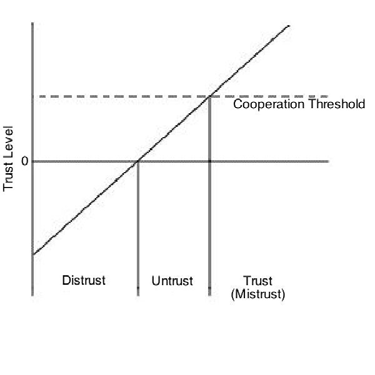
> The field grew out of multi-agent systems and AI in the 1990s. Stephen Marsh's 1994 PhD thesis, Formalising Trust as a Computational Concept, is usually cited as its founding work. The motivating problem was that once you have autonomous software agents negotiating, trading, routing data, or sharing resources with agents they've never met, each one needs a way to decide whom to cooperate with. Humans handle this with a messy mix of intuition, reputation, and experience. Computational trust tries to make that explicit and calculable.
In practice this covers things like:
1. Reputation systems, such as eBay seller ratings and peer-to-peer file-sharing networks deciding which peers to download from.
2. Trust in distributed systems, such as which nodes in a network to route through or accept data from.
3. E-commerce trust, which is probably where your slide comes from. The "controls or trust agents" line echoes a strand of that literature asking whether people trust the trading partner itself or the surrounding control mechanisms, like escrow, certificates, and third-party guarantees.
4. Formal trust models, which assign trust values, update them on evidence, and set thresholds above which an agent will cooperate.
Those thresholds are where the paper's "untrust" comes in. In Marsh's framework, trust runs on a scale from negative (distrust) through zero to positive. Untrust is the zone where you trust someone positively, but not enough to clear the bar for this particular situation. They might be generally decent, but not decent enough to hand over something this important. The abstract's point is that the field had mostly treated trust as the goal to maximize. Marsh and Dibben argue that the states short of trust, or opposed to it, are informative in their own right, and sometimes the correct stance rather than a failure to reach trust.